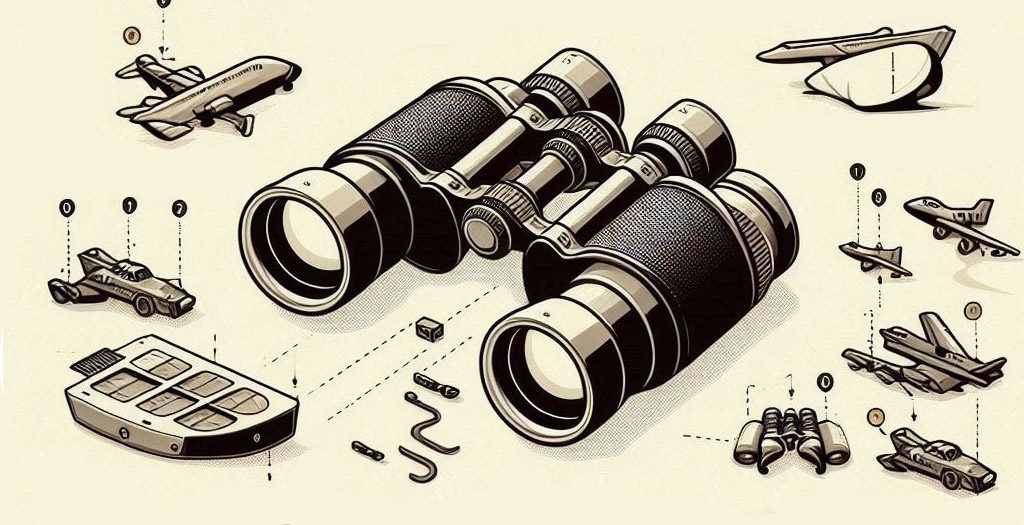

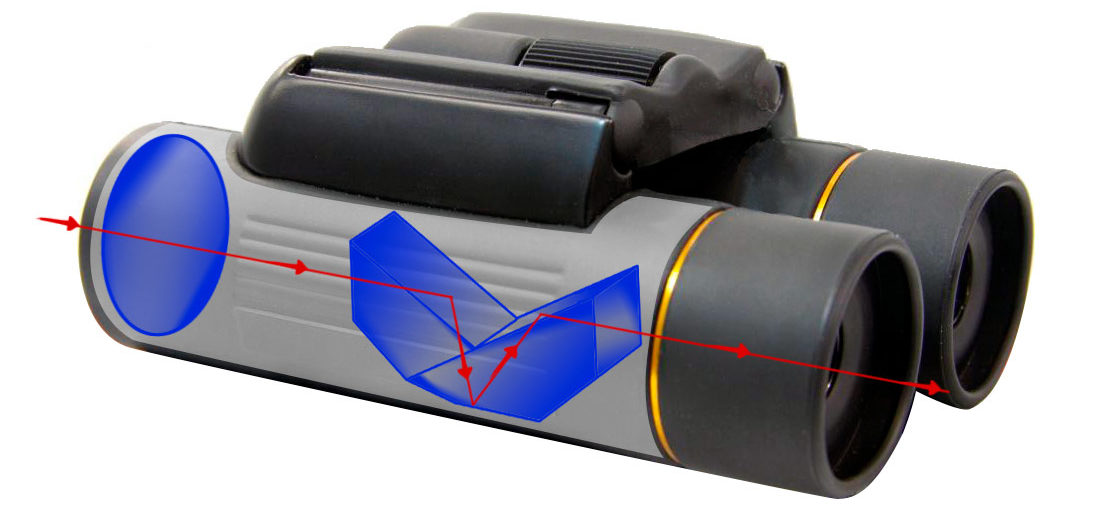
If you are faced with the need to choose binoculars, then you probably already noticed that modern binoculars have either a direct design or offset. In the first case, the binoculars are similar to 2 spotting scopes fastened together. The second type has an offset shape.
A roof prism system is a type of prism constructions in which an optical axis of the lens and eyepiece coincide. A beam of light goes in a straight line from an objective lens into an eyepiece, and this fact allows to create compact binoculars. The binoculars with a roof prism system are easy to recognize: their objective lenses stand straight in line with the eyepieces. These are thin, elegant models.
For binoculars with Porro prisms, the eyepieces are offset inward from the line of the objective lenses. Such an optical type has both advantages and disadvantages. It is impossible to say definitely which type of prism you need; choose based on your needs. We’ll talk more about choosing binoculars on Roof-prisms a little bit later. Now let’s deep learn more about the Roof prism system itself.
Roof prism system
So, you are in a store, and you see compact straight-shaped binoculars. What is inside the pipe?
Inside, between its eyepiece and its objective lens, there a system of prisms. Their reflective surfaces set at an angle of 90 degrees to each other and resemble a roof. All reflective surfaces are placed under each other (not side by side how it would be in a Porro prism system). A beam of light passing through the objective lens hits a prism and refracts. Refraction occurs in different ways, depending on the type of structure.
For now, four types of roof-prism systems exist:
- Amici roof prism
- Abbe–Koenig prism
- Schmidt–Pechan prism
- A pentaprism
Amici roof prisms
Reflect the image 90 degrees and flip it. This type of prism is most commonly used as a diagonal mirror of telescopes to correct the direction of the image. Amichi prisms are the simplest of roof prisms.
A pentaprism
Can also be used in making roof prism systems of binoculars, gives a mirrored image. It is often used in mirror cameras.
The following two types of prisms can most often be found in binoculars:
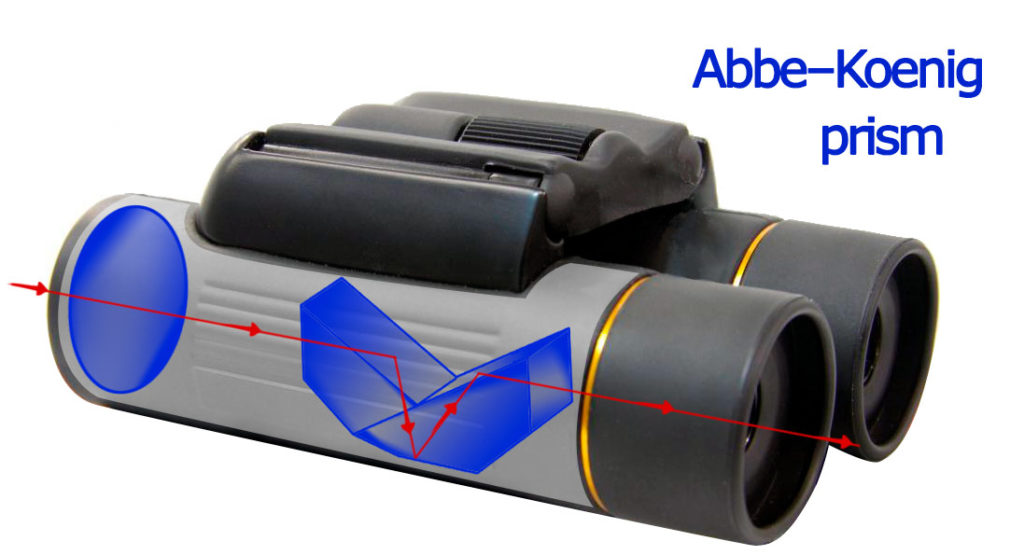
Abbe–Koenig prism
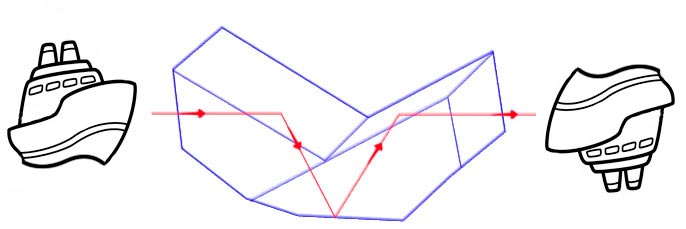
Light is reflected three times in this type of design – less than in the Schmidt-Pechan prism. Such a prism is much more difficult in manufacturing so that binoculars with Abbe-Koenig prisms are more expensive. But the image quality is higher, so it’s worth it. Such binoculars are perfect for observation at low light. In Europe, the companies Zeiss, Docter/Noblex, Swarovski, Leupold, Sig Sauer, and Optolyth produce Abbe-Koenig prisms.
Binoculars with Abbe–Koenig prism are:
- Expensive;
- Form a qualitative image with minimal distortion;
- Often elongated due to prism design;
- Good for low lighting.
This type of prisms is often used in professional binoculars for birdwatching.
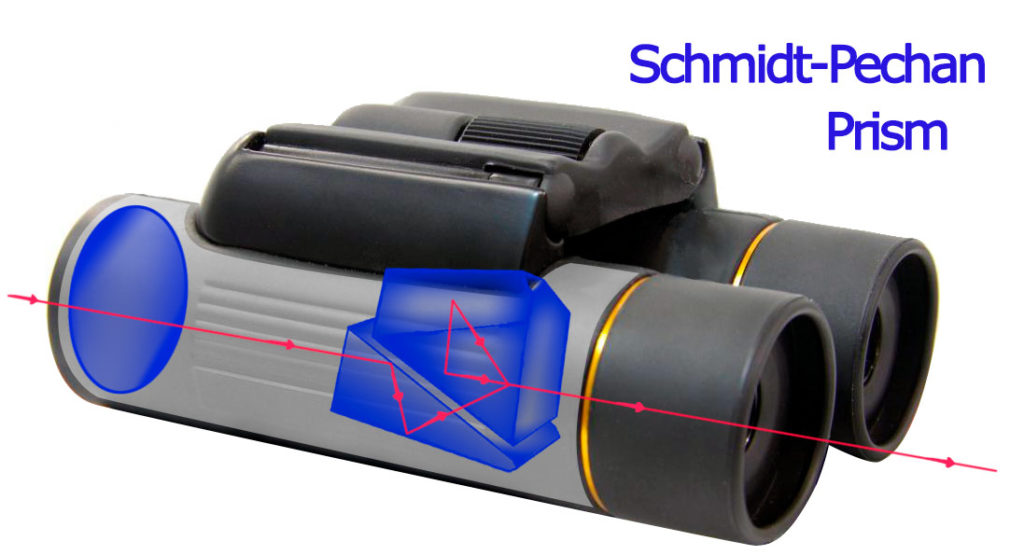
Schmidt–Pechan prism
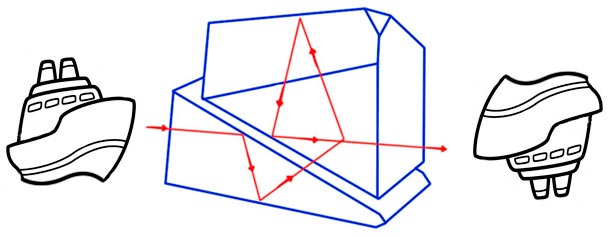
Binoculars with Schmidt-Pehan prisms are cheap and compact, but they have significant light loss
Binoculars with Schmidt-Pehan prisms are much cheaper than binoculars with Abbe-Koenig prisms and are more compact. But the loss of light in them is significantly greater due to their design. Schmidt–Pechan prisms are used in constructing of compact everyday binoculars for standard tasks. You can often find them in binoculars of the companies Nikon, Leika, Svarovski.
Binoculars with Schmidt-Pechan prisms are:
- Cheaper than binoculars with Abbe-Koenig prisms;
- Give an image not perfect, but enough qualitative;
- Suitable for everyday tasks;
- Can be as compact as possible.
Roof prism binoculars diagram
Let ‘s look inside and see what these prisms are.
What do roof prism binoculars mean for you?
👍 Compactness
The main advantage of roof-prisms binoculars is their compactness. If we compare binoculars on roof prisms and on Porro prisms at the same increase, binoculars on roof prisms will be more compact and thin. But the image quality is likely to be a bit worse. Such binoculars are difficult in manufacturing, so binoculars on roof prisms, equal in image quality to binoculars on Porro prisms, will cost more.
💰 Quality is expensive
The higher the increase in binoculars with roof prisms, the more the image resolution suffers. After all, in the prism, the beam of light is broken into parts and comes out into the eyepiece already with light losses. Therefore, in expensive binoculars, prisms are provided with a dielectric coating that reduces losses. Enlightenment coating of objective lenses also helps to save brightness and colors.
In the middle price segment, Porro binoculars give a brighter and more contrast image.
Image quality also depends on production material. It can be:
- Glass SK15 – is a glass of the highest quality with a crystal-clear image.
- Glass BAK-4 – is a Barium Crown Glass. It allows for creating more compact binoculars of the average price segment. There are insignificant light losses.
- Glass BK-7 – is a Crown glass with Bor. Image quality is worse than that of BAK-4, but it is still a special optical glass. Binoculars with such BK-7 are the cheapest.
BAK-4 and BK-7 are the most popular for making prisms. You can learn more about the glasses of binoculars prisms in our article about BAK-4. Actually, a regular, non-special optical glass, is also used in binoculars. But I don’t recommend you buy them.
💪 Waterproof and durable
Roof prism binoculars are better for sport and activity. They are easier to make sealed, for example, to fill the case with nitrogen. It will protect binoculars not only from moisture but also from fogging. For hunters or sportsmen, poor visibility can cause serious consequences. If it’s important to you too, take a look at roof prism binoculars in a rubberized nitrogen-filled case.
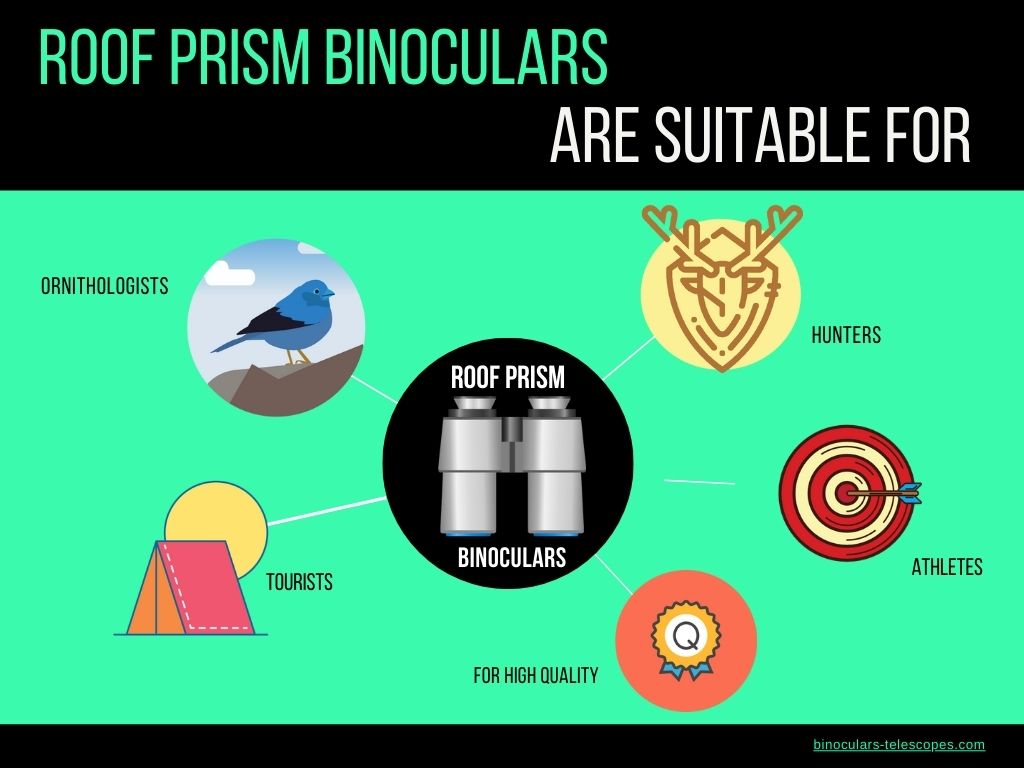
Who roof-prism binoculars are suitable for?
- Tourists;
- Athletes;
- Hunters, ornithologists;
- You, if you are looking for expensive quality binoculars.
An interesting fact:
In roof prisms binoculars the distance between lens centers (interpupillary distance) is equal to the distance between the center of their eyepiece. So that you will not see on sale such binoculars with objective lenses more than 65 mm. Such binoculars will not be possible to use: most of us have a smaller distance between the eyes.
Still, sometimes it happens that binoculars are too small for its owner: the maximum interpupillary distance is not enough. You have to pay attention to it, too. It can happen as to Roof Prism Binoculars, as to Porro ones.
Still, the vast majority of modern binoculars can increase the interpupillary distance to 72 mm. This should be enough for everyone because our interpupillary distance is about 66 mm.
Roof Prism vs. Porro Prism Binoculars
| Feature | Roof Prism Binoculars | Porro Prism Binoculars |
|---|---|---|
| Design / Shape | Straight, slim barrels. Eyepieces and objective lenses are in line. | Offset, Z-shaped design. Objective lenses are wider apart than eyepieces. |
| Compactness | High. Slimmer and easier to pack or carry in a pocket. | Low. Bulkier and takes up more space in a gear bag. |
| Weight | Generally lighter, making them ideal for long-distance hiking. | Heavier due to the physical displacement of the prisms. |
| Image Quality | Excellent in high-end models; requires phase-correction coatings. | Superior depth perception (3D effect) and wider field of view at lower prices. |
| Light Transmission | Can have light loss in cheap models. High-end models match Porro quality. | High. Fewer internal reflections, resulting in a brighter image for the price. |
| Durability | Very High. Easier to seal (waterproof/fogproof) and harder to knock out of alignment. | Moderate. External moving parts are more prone to dust, moisture, and misalignment. |
| Manufacturing | Complex and expensive to produce with high precision. | Simpler and more cost-effective traditional technology. |
| Price | More expensive for equivalent optical performance. | More affordable; best “bang for your buck” in the budget segment. |
| Best For | Hunting, birdwatching, active travel, and sports. | Astronomy, marine use, and stationary observations. |
FAQ: Roof Prism Binoculars
Roof prism binoculars are a type of optical instrument where the internal prisms are aligned in a straight line. This design allows the objective lenses to be in direct alignment with the eyepieces, resulting in a slim, compact, and streamlined “H-shape” body.
Yes, 8×42 is considered the “gold standard” for all-around use. They offer a perfect balance between magnification, a wide field of view, and a bright image. They are highly recommended for birdwatching, hunting, and general nature observation.
Absolutely. 10×42 models are very popular for long-range observation where you need more detail, such as identifying distant birds or wildlife in open fields. Note that they have a slightly narrower field of view and require a steadier hand than 8×42 models.
Yes, especially for low-light conditions. The 50mm objective lenses gather more light, making them excellent for dawn, dusk, or even basic stargazing. However, they are heavier and bulkier than the standard 42mm models.
An Amici roof prism (also called a non-deviating prism) is a type of reflecting prism used to flip an image upright and correct it left-to-right. While common in spotting scopes and telescope diagonals, in binoculars, they are usually part of the system that allows for the compact, straight-through design.
Yes, they are the modern industry standard. Their main strengths are extreme durability, compact size, and superior waterproofing. While high-quality models are more expensive than Porro prisms, their portability and ruggedness make them the preferred choice for most outdoor enthusiasts.
This is a common misunderstanding: BaK-4 is the type of glass used to make the prism, while Roof is the design of the prism itself. For the best performance, you should look for Roof prism binoculars made with BaK-4 glass, as it provides better light transmission and a perfectly round exit pupil compared to cheaper BK-7 glass.
In the premium tier, the Swarovski EL, Zeiss Victory SF, and Leica Noctivid are considered the best in the world. For mid-range budgets, the Vortex Viper HD and Athlon Midas ED offer exceptional performance for their price.
The main disadvantages are cost and complexity. Because the prisms require extreme precision and special coatings (like phase-correction and dielectric coatings) to prevent light loss and “phase shift,” a high-quality roof prism binocular will always be more expensive than a Porro prism model of similar optical quality.
Folding (or “double-hinge”) roof prism binoculars are excellent for travel and theater because they can fold down to fit in a pocket. However, because they are so small, they usually have smaller objective lenses (20mm-25mm), meaning they aren’t as bright in low light as full-sized binoculars.
Collimate (aligning the two barrels) a roof prism binocular is significantly more difficult than a Porro prism model. Most roof prisms have internal adjustment screws hidden under the rubber armoring, and the prisms themselves are often glued in place. It is highly recommended to send them to a professional repair service rather than attempting it at home.
Most modern roof prism binoculars are designed to be waterproof and fog-proof. Their straight-tube construction makes them much easier to seal with O-rings and fill with nitrogen or argon compared to Porro prism designs.
Schmidt-Pechan prisms are more compact and common in everyday binoculars but have more light loss. Abbe-Koenig prisms are longer and more expensive but offer superior light transmission, making them the choice for high-end, professional optics used in low-light conditions.
In a roof prism, light waves get slightly out of phase as they reflect off the surfaces. Phase-correction coatings are applied to the prisms to realign these waves, ensuring the image remains sharp, high-contrast, and color-accurate.
The primary advantage is their compact and streamlined design. Because the prisms are aligned in a straight line, these binoculars are much thinner and easier to carry than traditional Porro prism models, making them ideal for hiking and travel.
It depends on your budget and needs. Roof prisms are more durable and compact, which is better for active use. However, at a lower price point, Porro prism binoculars often provide better image depth and brightness because they don’t require expensive phase-correction coatings.