
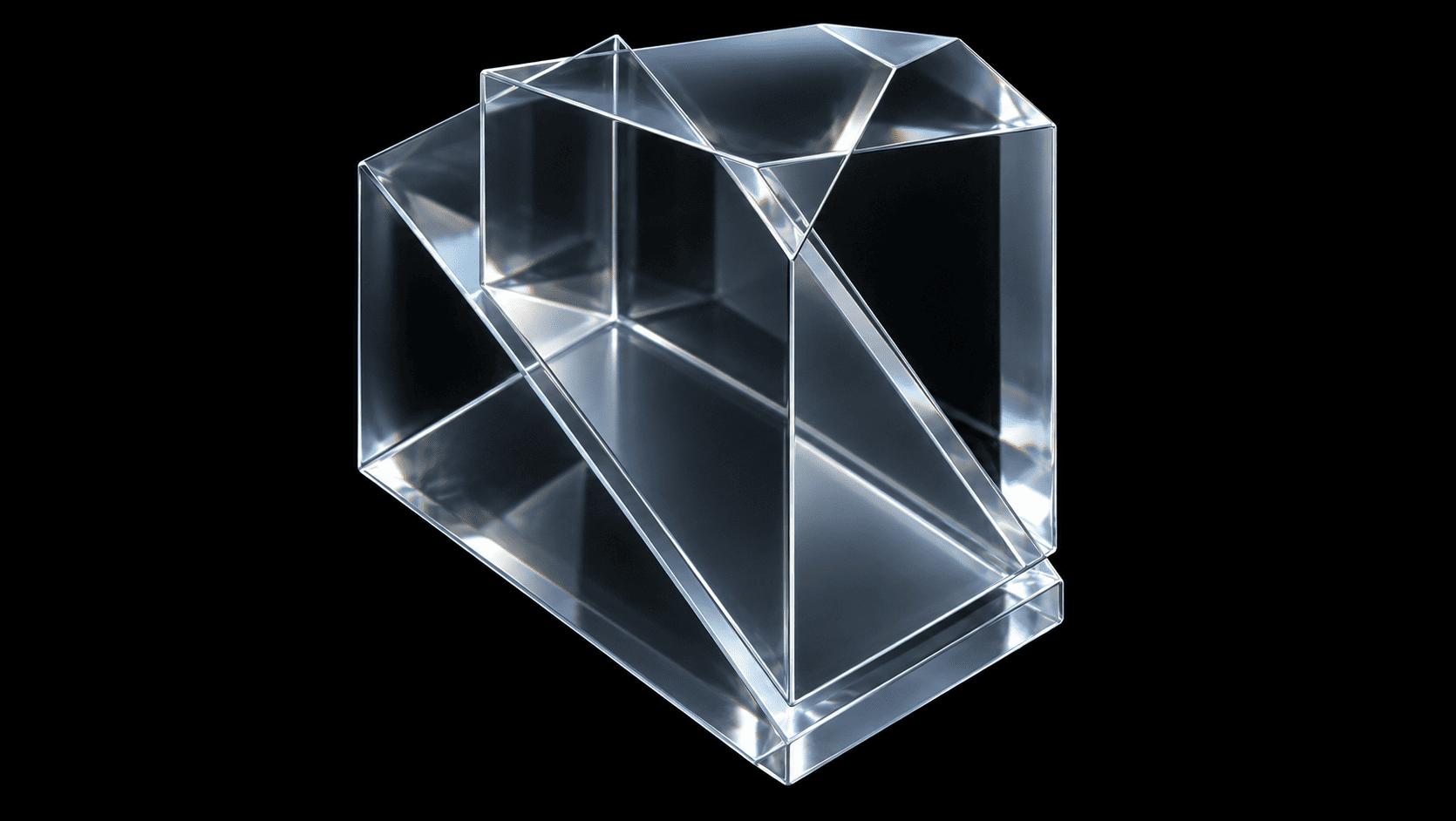
A Schmidt–Pechan prism is a compact roof-prism optical system that rotates an inverted image by 180 degrees so it appears upright and correctly oriented. Its folded light path keeps the entrance and exit beams nearly coaxial, which is why the design is widely used in modern compact binoculars.
Quick Specifications
| Characteristic | Schmidt–Pechan system |
|---|---|
| Image rotation | 180° |
| Prism type | Roof prism |
| Construction | Two air-spaced prism elements |
| Number of reflections | Six |
| Main advantage | Compact, straight-barrel design |
| Important coatings | Mirror, anti-reflective, and phase-correction coatings |
What Is a Schmidt–Pechan Prism?
Definition
A Schmidt–Pechan prism is a compound image-erecting system used to correct the upside-down and laterally reversed image formed by an objective lens. It folds the optical path through six reflections and rotates the image by 180 degrees without creating a large permanent displacement between the incoming and outgoing optical axes.
The Schmidt–Pechan is classified as a roof-prism system because part of the light path encounters two roof surfaces. These surfaces perform one of the image-orientation operations needed to produce the upright, unreversed view expected through binoculars and other direct-view instruments.
Schmidt Prism and Pechan Prism Components
The complete prism system uses two separate glass elements:
- A Schmidt roof-prism element containing the roof section.
- A Pechan or Bauernfeind-type half-pentaprism element.
- A narrow air gap separating the two elements.
The prisms are not cemented together. Light passes from glass into air and then back into glass as it travels between them. This air-spaced construction helps establish the required reflection geometry, but it also creates additional glass–air transitions that must be managed with effective anti-reflective coatings.
Is a Pechan Prism the Same as a Schmidt–Pechan Prism?
No. A Pechan prism and a complete Schmidt–Pechan prism system are related, but they are not interchangeable terms.
A Pechan prism can invert or revert an image depending on its orientation. It can also be used for image rotation or derotation without permanently changing the direction of the line of sight. A Schmidt–Pechan system adds the Schmidt roof section and combines the required image operations to produce full 180-degree image rotation.
The complete assembly is sometimes called a Pechan prism pair. However, a single Pechan prism does not provide the same optical arrangement as the full Schmidt–Pechan roof-prism system.
How the Schmidt–Pechan Optical Path Works
Step-by-Step Light Path
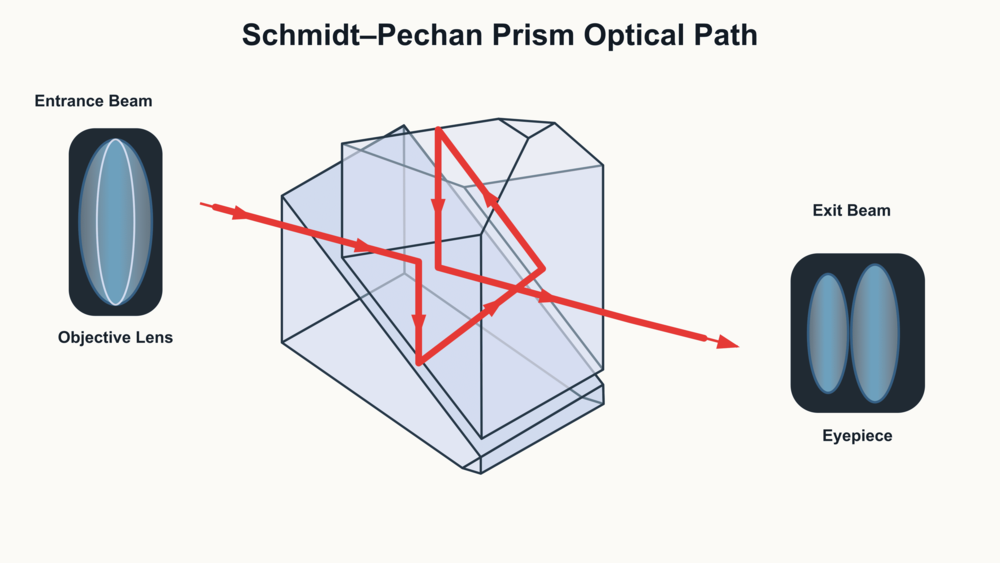
The light path through a Schmidt–Pechan prism is folded into a compact volume:
- Light from the objective lens enters through a transmissive prism surface.
- The beam travels through the lower portion of the system and encounters its first internal reflections.
- It crosses the air gap between the two prism elements.
- The beam reaches the Schmidt roof section.
- The two roof surfaces divide the wavefront into adjacent portions that follow slightly different reflection paths.
- Those portions recombine after leaving the roof section.
- The beam completes a total of six reflections.
- It exits through a transmissive surface on an axis that is nearly coincident with the entrance axis.
This folded route is longer than the physical length of the prism assembly. It allows the system to correct the image while occupying relatively little space inside the binocular body.
Image Inversion, Reversion, and Rotation
These terms describe different changes in image orientation:
- Inversion turns the image top to bottom.
- Reversion switches the image left to right.
- Derotation removes an unwanted rotation introduced elsewhere in an optical system.
- 180-degree image rotation performs both inversion and reversion, producing an image that appears upright and correctly oriented to the observer.
The objective lens initially forms a real image that is both upside down and reversed. The Schmidt–Pechan prism acts as an image erector, applying the necessary reflection sequence before the image reaches the eyepiece.
Why the Beam Remains Coaxial
The prism surfaces redirect the beam several times inside the assembly, but their combined geometry cancels the angular deviations. The central ray therefore leaves in essentially the same direction in which it entered.
This direct-view geometry does not mean that every ray follows a straight line. The optical path is heavily folded inside the glass. “Coaxial” refers to the relationship between the entrance and exit axes, not to the route taken within the prism.
Schmidt–Pechan Prism Tunnel Diagram
The prism tunnel is the restricted optical passage through which the full light bundle must travel. Its size, the prism dimensions, and the position of internal baffles determine whether marginal rays pass unobstructed. If the tunnel or a baffle clips those rays, the result may be vignetting or an asymmetrical exit pupil.
Schmidt–Pechan Prism Design and Construction
Two-Prism Air-Spaced Design
The air gap is an active part of the optical design, not simply unused space between the prisms. It helps create the incidence conditions required at particular surfaces and prevents the two elements from functioning as one cemented block.
Because light must cross additional glass–air boundaries, untreated surfaces would reflect part of the light. High-quality Schmidt–Pechan binoculars therefore use anti-reflective coatings on relevant transmissive surfaces to reduce loss, flare, and ghost images.
Roof Edge and Roof Surfaces
The roof consists of two reflective planes meeting at a nominal 90-degree angle. Their angular accuracy is critical because each half of the wavefront encounters a different side of the roof.
Errors in the roof angle can reduce resolution and make fine details appear less distinct. A rounded, chipped, or poorly finished roof edge can scatter light and create flare. ZEISS notes that the accuracy of the roof surfaces, the angle between them, and the sharpness of the roof edge all influence optical performance.
Bauernfeind and Half-Pentaprism Section
The terms Pechan prism, Bauernfeind prism, and half-pentaprism are sometimes used differently in technical descriptions. In the context of a Schmidt–Pechan system, they generally refer to the non-roof element forming the lower part of the compound optical path.
This section works with the Schmidt roof element to provide the complete sequence of reflections. It should not be confused with a full pentaprism, which has a different geometry and primarily redirects the line of sight.
Prism Glass
Prism glass affects how light behaves at internal surfaces. Important properties include:
- Refractive index.
- Dispersion.
- Homogeneity.
- Surface quality.
- The critical angle for total internal reflection.
BaK-4, a barium crown optical glass, has a relatively high refractive index and is commonly associated with high-quality binocular prisms. Its optical properties can help support favorable internal-reflection geometry and reduce pupil clipping in suitable designs.
However, not every Schmidt–Pechan prism is necessarily made from BaK-4. Designers may select other optical glasses according to the prism geometry, spectral requirements, manufacturing process, and target cost. Glass type alone does not determine the performance of the finished binocular.
Why Schmidt–Pechan Prisms Need Coatings
Anti-Reflective Coating
Anti-reflective, or AR, coatings are applied to surfaces through which light must pass. They reduce Fresnel reflections at glass–air boundaries, improving transmission while limiting flare and ghost images.
A coating described only as “fully coated” or “multicoated” does not reveal the entire optical performance of a binocular. Results also depend on which surfaces are treated, how well the coating is matched to the glass, and how consistently it performs across the visible spectrum.
Reflective or Mirror Coating
Most internal reflections in the Schmidt–Pechan system can occur through total internal reflection. One surface, however, receives light at an incidence angle that does not satisfy the total-internal-reflection condition. That surface requires a reflective mirror coating.
Without this coating, a significant portion of the light would leave the intended optical path instead of continuing toward the eyepiece.
Aluminum, Silver, and Dielectric Mirror Coatings
| Coating | Main advantage | Limitation |
|---|---|---|
| Aluminum | Affordable, durable, and relatively stable | Lower reflectivity than high-quality silver or dielectric systems |
| Silver | Higher visible-light reflectivity than basic aluminum coatings | Requires protection against tarnishing and environmental degradation |
| Dielectric | Very high reflectivity across a designed wavelength range and potentially excellent transmission | More complex and expensive to manufacture; performance depends on layer design and quality control |
“Dielectric-coated” usually describes the mirror treatment on the non-TIR surface. It does not automatically mean that every optical surface has received the same coating.
Phase-Correction Coating
When light reaches a roof prism, the two sides of the wavefront reflect from separate roof surfaces. These portions can acquire different phase shifts before they recombine. The resulting interference effects may reduce contrast and the visibility of fine detail.
A phase-correction coating modifies the phase relationship between these wavefront portions. Properly applied, it improves contrast, resolution, and edge definition.
Phase correction does not replace the mirror coating:
- The mirror coating keeps light on the required path at a surface where total internal reflection cannot occur.
- The phase-correction coating compensates for wave-optical effects created by the roof surfaces.
Schmidt Prism vs Phase Correction
A Schmidt prism and phase correction are not competing prism types. The Schmidt roof section is a physical part of the optical system. Phase correction is a coating technology used to control the phase difference produced by a roof prism.
A binocular can therefore use a Schmidt–Pechan prism and also have phase-corrected roof surfaces. When comparing product specifications, look for both phase correction and information about the reflective coating.
Image Quality and Light Transmission
Sources of Light Loss
Potential losses in a Schmidt–Pechan system come from several sources:
- Reflections at glass–air transitions.
- Imperfect reflectivity at the mirror-coated surface.
- Incomplete or poorly matched anti-reflective coatings.
- Absorption within the glass and coatings.
- Dust, contamination, haze, or surface defects.
- Vignetting within the prism tunnel.
- Light scattered by rough surfaces, the roof edge, or internal components.
A well-designed system controls all of these factors. Prism geometry alone cannot predict the final transmission percentage.
Resolution and Contrast
Phase correction is important, but it is only one part of roof-prism performance. Resolution and contrast also depend on:
- Roof-angle accuracy.
- Roof-edge sharpness.
- Surface flatness and polish.
- Accurate prism alignment.
- Binocular collimation.
- Effective suppression of internal reflections.
- Lens and eyepiece quality.
- Mechanical stability.
A premium coating cannot fully compensate for inaccurate prism surfaces or poor assembly.
Does a Schmidt–Pechan Prism Produce a Dim Image?
Not necessarily. The basic design has the potential to lose more light than a prism system that uses total internal reflection at every reflective surface. Modern dielectric mirror coatings and effective AR coatings can reduce this difference substantially.
Brightness comparisons must be made between complete binoculars with similar objective diameters, magnifications, exit pupils, glass quality, and coating performance. The prism name alone is not enough to determine which view will appear brighter.
What Determines the Final Binocular Image?
The final image depends on the complete optical and mechanical system:
- Objective-lens design and diameter.
- Optical glass selection.
- Lens and prism coatings.
- Magnification.
- Exit-pupil diameter.
- Eyepiece design.
- Control of chromatic and geometric aberrations.
- Prism alignment and overall collimation.
- Internal baffling.
- Focus precision.
- Manufacturing consistency.
A well-executed Schmidt–Pechan binocular can outperform a poorly executed binocular using a prism design with a theoretical transmission advantage.
Schmidt–Pechan vs Abbe–Koenig Prisms
| Parameter | Schmidt–Pechan | Abbe–Koenig |
|---|---|---|
| Optical path | More tightly folded | Longer folded path |
| Body size | Generally shorter and more compact | Generally longer |
| Weight | Often lower in comparable configurations | Often higher |
| Reflection method | One surface requires a mirror coating | Reflective surfaces can use total internal reflection |
| Light transmission | Strongly influenced by mirror and AR coating quality | Has an inherent advantage by avoiding the additional mirror |
| Manufacturing and cost | Well suited to compact, high-volume binocular designs | More complex and commonly used in larger premium models |
| Typical application | General-purpose and compact roof-prism binoculars | Low-light and larger-objective premium binoculars |
Which Prism Is Brighter?
With all other factors equal, an Abbe–Koenig system has a theoretical transmission advantage because its reflective surfaces can operate by total internal reflection and it does not need the additional mirror coating used by a Schmidt–Pechan prism.
In real binoculars, “all other factors” are rarely equal. Objective size, magnification, exit pupil, AR coatings, dielectric mirror performance, glass, baffling, and the observer’s pupils can matter as much as the prism design. A modern Schmidt–Pechan binocular with excellent coatings can deliver a very bright image.
Which Prism Is More Compact?
The Schmidt–Pechan system is generally more compact. Its tightly folded path allows manufacturers to build shorter binocular bodies while keeping the objective lenses and eyepieces on nearly the same axes.
Abbe–Koenig prisms require more length. This can be worthwhile in binoculars designed for maximum low-light performance, but it is less convenient when minimum size and weight are priorities.
Premium manufacturers use Schmidt–Pechan prisms because the design provides several practical advantages:
- Compact dimensions.
- Lower potential weight.
- Slim, straight-barrel housings.
- Compatibility with sealed internal-focusing mechanisms.
- Mature phase-correction and dielectric-coating technologies.
- Efficient production of high-performance compact binoculars.
“Premium” does not automatically require Abbe–Koenig prisms. A carefully manufactured Schmidt–Pechan system can combine excellent image quality with a body size that the longer prism design cannot match.
Schmidt–Pechan Prism vs BaK-4
Schmidt–Pechan and BaK-4 should not be treated as competing alternatives. Schmidt–Pechan identifies the geometry and light path of an optical system, while BaK-4 identifies a class of optical glass.
A Schmidt–Pechan prism may be made from BaK-4 or another suitable optical glass. BaK-4 is not an image-erecting layout, and a “BaK-4 prism” label does not reveal whether the binocular uses Porro, Schmidt–Pechan, Abbe–Koenig, or another prism system.
| Term | What it describes |
|---|---|
| Schmidt–Pechan | Prism construction and the path followed by light |
| Roof prism | The broader category of a prism system containing roof surfaces |
| BaK-4 | A barium crown optical-glass designation |
| Phase coating | A treatment that compensates for phase effects at roof surfaces |
| Dielectric coating | A multilayer reflective treatment used on the non-TIR mirror surface |
The words “BaK-4 prisms” should therefore be treated as one piece of a binocular specification, not as proof of overall optical quality.
Schmidt–Pechan vs Porro Prism
| Characteristic | Schmidt–Pechan roof prism | Porro prism |
|---|---|---|
| Body shape | Slim, straight barrels | Wider, stepped body |
| Entrance and exit axes | Nearly coaxial | Laterally displaced |
| Mirror coating | Required on one reflective surface | Normally unnecessary |
| Phase correction | Needed for best roof-prism performance | Not required because there is no roof edge |
| Manufacturing | Requires tight roof tolerances and precise alignment | Generally easier to manufacture |
| Waterproofing | Well suited to sealed internal-focusing bodies | Sealed internal focusing is often more difficult to implement |
| Objective spacing | Usually close to eyepiece spacing | Objectives are usually farther apart |
| Cost at comparable quality | Precision surfaces and coatings can raise cost | Can provide strong optical value, though body design is bulkier |
Porro prisms can provide excellent transmission without a mirror coating and do not suffer from roof-induced phase effects. Their main tradeoff is the wider housing created by the offset optical path.
Wider objective spacing may strengthen stereoscopic cues at relatively short distances. At long observation distances, however, a small increase in objective separation may produce little noticeable change in depth perception.
Other Prism Designs
Pechan Prism
A Pechan prism can invert or revert an image depending on its orientation and may be used for rotation or derotation. It is related to the Schmidt–Pechan system but does not, by itself, represent the complete roof-prism pair used in binoculars.
Uppendahl Prism
The Uppendahl is a roof-prism system with a longer and less common construction. It has appeared in some specialized binoculars but is far less widespread than the Schmidt–Pechan design.
Perger Prism
The Perger prism is an alternative roof-prism construction used by selected manufacturers. Its geometry and intellectual-property history distinguish it from the conventional Schmidt–Pechan arrangement.
Bauernfeind Prism
The Bauernfeind or half-pentaprism section is associated with the lower element of a Schmidt–Pechan system. It contributes to the folding and redirection of the optical path but does not include the complete Schmidt roof arrangement.
Porro and Abbe–Koenig Prisms
Porro prisms offer a wider, offset optical layout with strong transmission potential and comparatively straightforward manufacturing. Abbe–Koenig prisms provide a straight-through roof-prism layout with total internal reflection but require a longer binocular body.
See “Schmidt–Pechan vs Abbe–Koenig Prisms” and “Schmidt–Pechan vs Porro Prism” above for detailed comparisons.
Alignment, Collimation, and Manufacturing Tolerances
Pechan Prism Alignment
The two prism elements must be positioned accurately relative to one another. Critical variables include:
- Centering of each element.
- Relative tilt and rotation.
- Roof-angle accuracy.
- Air-gap width and uniformity.
- Alignment of entrance and exit surfaces.
- Position of the optical path within the clear aperture.
Poor centering may displace the line of sight even when the prism does not introduce a permanent angular deviation. Errors can also reduce the usable prism aperture or send the beam toward an internal edge.
Collimation in Binoculars
Collimation aligns the optical axes of the left and right channels so that the observer sees one comfortable image. Prism placement is one part of that alignment.
If a prism shifts or tilts, the two images may no longer overlap correctly. The eyes then have to compensate for horizontal or vertical misalignment, potentially causing eyestrain, headaches, or difficulty merging the view.
Common Optical Problems
Possible symptoms of alignment or manufacturing errors include:
- A double image.
- Reduced resolution.
- Uneven sharpness across the field.
- An asymmetrical or clipped exit pupil.
- Vignetting.
- Flare and stray reflections.
- Difficulty maintaining a relaxed merged image.
- Eye fatigue during extended observation.
A noncircular exit pupil does not always identify a single fault, but it can indicate pupil clipping, undersized prisms, or misalignment within the optical channel.
Prism Baffles
A prism baffle blocks unwanted rays that could otherwise reach the eyepiece after reflecting from prism edges, mounts, or the interior of the housing. Proper baffling improves contrast, especially when a bright light source lies near the field of view.
A baffle must be accurately sized. If it is too open, it may not control stray light. If it is too restrictive or incorrectly positioned, it can clip the useful beam and cause vignetting.
Schmidt–Pechan Prisms in Binoculars and Scopes
Why They Are Used in Binoculars
Schmidt–Pechan prisms support the features expected from modern roof-prism binoculars:
- Straight, slim barrels.
- Compact overall dimensions.
- Relatively low weight.
- Convenient sealing against water and dust.
- Compatibility with internal focusing.
- Upright, unreversed images.
- High transmission when paired with effective modern coatings.
Use in Spotting Scopes and Optical Instruments
Pechan and Schmidt–Pechan prism systems can be used in direct-view instruments that need an upright image and a compact optical train. Potential applications include selected spotting scopes, telescopic viewing systems, imaging instruments, and specialized optical equipment.
Their suitability depends on the aperture, field angle, packaging constraints, required image orientation, and acceptable transmission loss. Not every straight spotting scope uses a Schmidt–Pechan prism.
How Prism Choice Affects Binocular Size
Prism geometry affects the length, width, and internal volume of a binocular, but it works together with other specifications:
- Larger objectives gather more light but require wider front barrels.
- Higher magnification reduces the exit pupil when objective diameter remains unchanged.
- Larger prism apertures may be needed to pass the full light cone without vignetting.
- Wide-field eyepieces require adequate clear apertures throughout the optical path.
- Longer prism systems increase the minimum available body length.
- Mechanical mounts, focusing components, and waterproof seals add further space and weight.
Should You Choose Binoculars by Prism Type?
Prism type is important, but it should not be the only buying criterion. Evaluate the entire binocular: image sharpness, contrast, transmission, glare control, field of view, focusing behavior, eye relief, ergonomics, weight, waterproofing, and collimation.
A familiar prism label cannot guarantee that these elements have been designed and assembled well.
Advantages and Disadvantages
| Advantages | Disadvantages |
|---|---|
| Compact, tightly folded optical path | More reflections and glass–air transitions than some alternatives |
| Short, lightweight binocular bodies are possible | One surface requires a mirror coating |
| Entrance and exit beams remain nearly coaxial | Roof surfaces benefit from phase correction |
| Produces an upright, correctly oriented image | Sensitive to roof-angle and roof-edge accuracy |
| Can achieve high transmission with modern coatings | Demanding manufacturing and alignment tolerances |
| Well suited to premium compact binoculars | May have lower inherent transmission than an all-TIR system |
How to Evaluate Schmidt–Pechan Binoculars
Use this checklist when comparing models:
- Is phase-correction coating specified?
It helps preserve contrast and fine detail affected by roof-prism phase differences. - What reflective coating is used?
Look for a clear description such as aluminum, silver, or dielectric. - Is a dielectric mirror coating stated explicitly?
Do not assume that “multicoated” refers to the reflective prism surface. - Does the manufacturer publish total light transmission?
Check whether the value covers the full binocular rather than one isolated component. - Can the binocular resolve fine details with good contrast?
Test lettering, feathers, branches, or other high-detail subjects under realistic conditions. - Are flare, ghost images, or double images visible?
Observe near—not directly at—a bright light source and check whether the view remains controlled. - Do the magnification and objective size fit the intended use?
Higher magnification can make hand shake more visible, while larger objectives add size and weight. - Is the exit pupil appropriate for low-light use?
Divide objective diameter by magnification. For example, an 8×42 binocular has a nominal 5.25 mm exit pupil. - Are the size, weight, balance, eye relief, and controls comfortable?
Optical performance is less useful if the binocular is difficult to hold or position correctly. - Are independent measurements or careful comparative tests available?
Give more weight to repeatable test methods than to coating names or broad marketing claims.
Frequently Asked Questions
A Schmidt–Pechan prism is a compact, two-element roof-prism system that rotates an image by 180 degrees. It is commonly used to produce an upright, unreversed view in straight-barrel binoculars.
It sends light through six carefully arranged reflections. The combined reflection sequence performs both inversion and reversion, producing complete 180-degree image rotation.
A standalone Pechan prism is not equivalent to the complete Schmidt roof-prism pair. In a Schmidt–Pechan system, the Pechan or Bauernfeind-type element works with a separate Schmidt element that contains the roof surfaces.
Neither design is universally better. Schmidt–Pechan is generally shorter and more compact, while Abbe–Koenig has an inherent transmission advantage because it does not require the additional mirror-coated reflection.
With otherwise identical optics, Abbe–Koenig has the theoretical advantage. In real binoculars, objective size, magnification, exit pupil, coatings, baffling, glass, and manufacturing quality can outweigh the prism-layout difference.
No. Schmidt–Pechan describes an optical layout; BaK-4 describes optical glass. A Schmidt–Pechan prism may be manufactured from BaK-4 or another suitable material.
One reflective surface receives light below the condition required for total internal reflection. A mirror coating is needed to keep the light traveling through the intended optical path.
The prism can form an image without phase correction, so low-cost implementations may omit it. For high-resolution viewing, phase-correction coatings are desirable because they reduce contrast and detail losses caused by the roof surfaces.
The complete Schmidt–Pechan system uses six reflections. This extended path is folded into two compact, air-spaced prism elements.
The prism geometry folds a relatively long optical path into a short assembly while keeping the incoming and outgoing axes nearly aligned. This supports slim, straight binocular barrels.
The roof edge divides the wavefront between two roof surfaces. The two portions experience different phase changes during reflection and can interfere when recombined, reducing contrast unless the effect is corrected.
Yes, they can be used in suitable direct-view scopes and compact optical instruments. The actual choice depends on aperture, field of view, packaging, transmission goals, and the required image orientation.
Incorrect prism position can shift or tilt the optical axis of one binocular channel. If the two channels no longer align, the observer may see a double image or experience eye fatigue while trying to merge the views.
Optical Terms Glossary
Air gap
A controlled space between the two prism elements through which light passes.
Anti-reflective coating
A surface treatment that reduces unwanted reflection where light enters or leaves glass.
BaK-4 glass
A barium crown optical-glass designation commonly associated with binocular prisms.
Barium crown
A category of crown glass containing barium compounds and offering optical properties useful in selected prism designs.
Critical angle
The minimum incidence angle, measured inside the denser medium, at which total internal reflection begins.
Dielectric coating
A multilayer coating that uses interference effects to achieve high reflectivity over a designed wavelength range.
Image erector
An optical system that converts an inverted or reversed image into the orientation required for direct viewing.
Inversion
A top-to-bottom change in image orientation.
Light transmission
The proportion of incoming light that passes through the complete optical system.
Phase correction
A roof-prism coating treatment that reduces phase differences between portions of a divided wavefront.
Reflectivity
The proportion of incident light reflected by a surface.
Reversion
A left-to-right change in image orientation.
Roof edge
The line where the two roof-prism surfaces meet.
Stereopsis
The perception of depth produced by the brain from the slightly different views received by the two eyes.
Total internal reflection
Reflection that occurs when light inside a higher-index medium reaches a boundary above the critical angle.
Transmissive surface
A prism or lens surface designed for light to pass through rather than reflect from it.
Vignetting
Partial obstruction of the light bundle, often visible as reduced brightness or clipping toward the field or pupil edge.