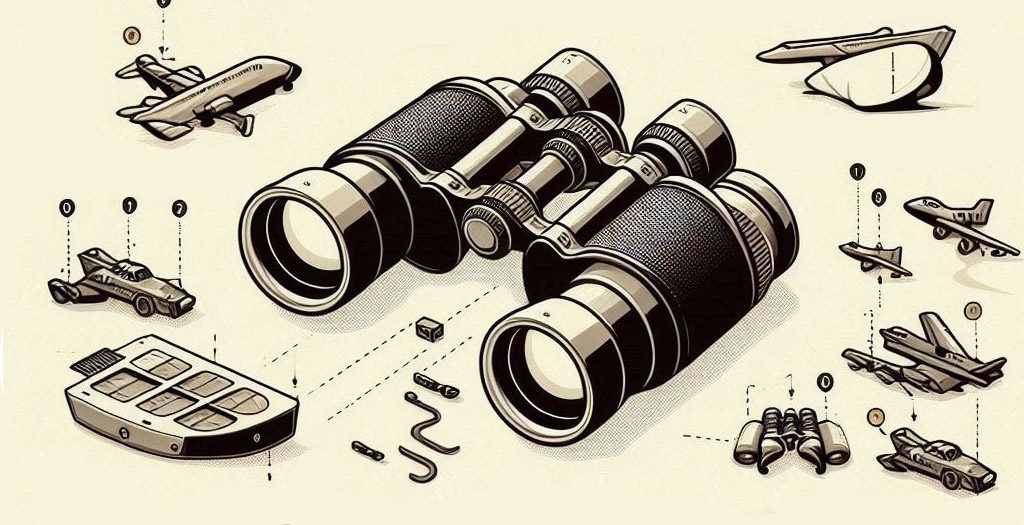


The short answer: With 10x binoculars, an object appears 10 times closer than it does with the naked eye. A simple rule often used by optics experts is the “1000 to 100 rule”: something that is 1,000 yards away will look as if it were only 100 yards away through 10x binoculars.
However, binoculars don’t actually have a strict maximum viewing distance. In theory, you can see objects miles away or even astronomical objects. The real limitation is how much detail the binoculars can resolve, which depends on magnification, optical quality, atmospheric conditions, and the size of the object you’re observing.
For example, with a typical pair of 10×42 binoculars, you might clearly identify a deer at 300 yards (274 meters), read a license plate at around 150 yards (137 meters) under ideal lighting, and even observe major lunar craters on the Moon—238,900 miles away.
The Optical Math: Magnification vs. Distance
A common misconception is that binoculars determine how far you can see. In reality, binoculars determine how much detail you can resolve at distance.
What “10x Magnification” Really Means
If you look at an object 1,000 yards away:
- Naked eye: appears at 1,000 yards
- 10x binoculars: appears roughly like 100 yards
This is why 10x binoculars are popular for open-country hunting, birding, and long-distance observation.
There Is No True Maximum Distance
Technically, you can point 10x binoculars at objects many miles away. But three main factors determine how much detail you can see:
- Resolution of the optics
- Atmospheric conditions (heat haze, humidity, dust)
- Earth’s curvature over very long distances
For example:
- A mountain 20 miles away may be visible.
- But details like trees or animals may be impossible to resolve.
So when people ask “how far can you see with 10x binoculars?”, what they really mean is:
How far away can I still recognize useful detail?
For most real-world situations, that distance is 100–1,000 yards (91–914 meters) depending on the object.
Practical Viewing Examples: What Can You See With 10x Binoculars?
Below is a realistic table illustrating what a typical 10×42 binocular can reveal at different distances.
| Object | Distance | What You Can See with 10x Binoculars |
|---|---|---|
| Songbird (e.g., Cardinal) | 50 Yards (46 m) | Individual feathers, eye color, and fine beak texture become clearly visible. |
| White-tailed Deer | 300 Yards (274 m) | You can clearly identify antlers, body posture, and overall body condition. |
| Human Face | 500 Yards (457 m) | General facial features and clothing are visible, but identifying the person may be difficult. |
| License Plate | 150 Yards (137 m) | Numbers and letters can usually be read in good lighting and with steady hands. |
| The Moon | 238,900 Miles (384,400 km) | Large craters like Tycho and Copernicus and major lunar surface features become visible. |
These examples demonstrate why 10x binoculars are considered a versatile middle-ground magnification for many outdoor activities.
10x vs. 8x: The Great Debate
Many outdoor enthusiasts debate 10x vs 8x binoculars for hunting and birding. The differences come down to magnification, field of view, and stability.
Field of View (FOV)
A typical 10×42 binocular has a field of view of about 315–340 feet at 1,000 yards (96–104 meters at 914 meters).
By comparison:
- 8×42 binoculars: about 390–420 ft at 1,000 yards
What this means:
8x binoculars show a wider area, making them easier for tracking moving birds or scanning forests.
Image Stability
Magnification amplifies hand movement.
- 8x binoculars: easier to hold steady
- 10x binoculars: noticeable shake for some users
In fact, 10x is widely considered the highest magnification most people can comfortably hold without support. Beyond that (12x, 15x), many users prefer a tripod or monopod.
Low-Light Performance (Exit Pupil)
The exit pupil determines how bright the image appears.
Formula:
Exit Pupil = Objective Lens Diameter ÷ Magnification
Examples:
- 10×42: 42 ÷ 10 = 4.2 mm
- 8×42: 42 ÷ 8 = 5.25 mm
A larger exit pupil lets in more light, which is why 8x binoculars often perform slightly better at dawn or dusk.
Specialized Uses: Hunting, Birding, and Stargazing
Hunting (Especially Western Hunting)
In wide-open terrain, 10x binoculars are often the preferred choice.
Advantages include:
- Better ability to spot animals across valleys
- Improved detail at 300–800 yards
- Effective glassing of ridge lines and distant hillsides
Hunters frequently use 10×42 binoculars on a chest harness and may switch to a spotting scope for extreme distances.
Birdwatching
Birders benefit from the extra reach of 10x magnification.
You can:
- Identify plumage patterns
- See wing feather structure
- Observe birds at 50–200 yards (45–183 m) without disturbing them
However, dense forest birding sometimes favors 8x binoculars due to the wider field of view.
Stargazing and Astronomy
Even modest binoculars reveal impressive celestial details.
With 10x binoculars, you can see:
- Large craters on the Moon
- The Galilean moons of Jupiter
- Star clusters like the Pleiades
- The bright haze of the Andromeda Galaxy
While they cannot compete with telescopes, 10x binoculars provide an excellent entry point into amateur astronomy.
Factors That Limit Your Vision
Even the best binoculars have limitations.
Objective Lens Size
Common sizes include:
- 10×42 – balanced brightness and portability
- 10×50 – brighter image for low light
- 10×32 – compact but less bright
Larger lenses gather more light, improving performance in early morning or evening conditions.
Glass Quality (ED / HD Optics)
High-end binoculars often feature:
- ED (Extra-low Dispersion) glass
- HD optics
- Advanced lens coatings
These reduce chromatic aberration, which appears as colored fringes around high-contrast objects.
Better optics produce sharper images, higher contrast, better detail recognition at long distances
Environmental Conditions
Your surroundings often matter more than magnification.
Factors that reduce visibility include:
- Heat shimmer (mirage effect)
- Dust and haze
- Low light
- Humidity
On a hot afternoon in open country, atmospheric distortion can dramatically reduce clarity beyond 500 yards.
Conclusion & Buying Advice
So, how far can you see with 10x binoculars?
- Objects 1,000 yards away appear roughly 100 yards away
- You can identify wildlife at 300–800 yards
- You can observe mountains miles away
- You can even study lunar craters nearly 239,000 miles away
But the true limit isn’t distance—it’s how much detail the optics and environment allow you to resolve.
Who Should Choose 10x Binoculars?
10x binoculars are ideal for:
- Western hunters
- Open-country wildlife watchers
- General outdoor observation
- Entry-level astronomy
They offer an excellent balance of magnification, portability, and versatility.
Pro Tip for Maximum Distance Viewing
If you want to unlock the full potential of 10x binoculars, try using them on a tripod or binocular adapter. Stabilizing the image dramatically improves your ability to see fine details at long range—sometimes revealing features you would otherwise miss due to hand shake.