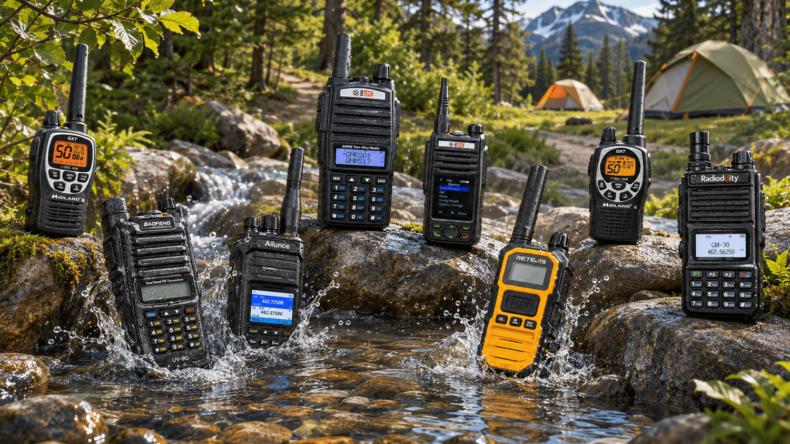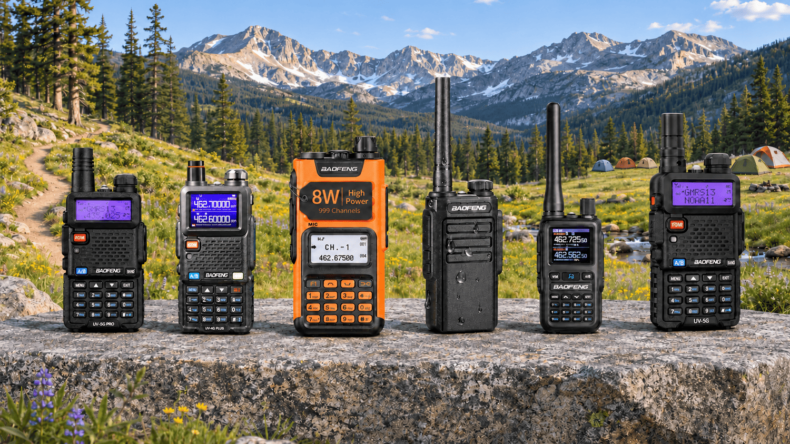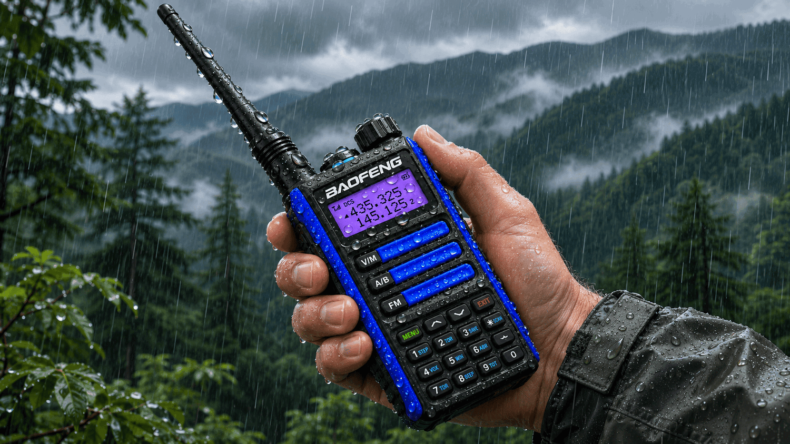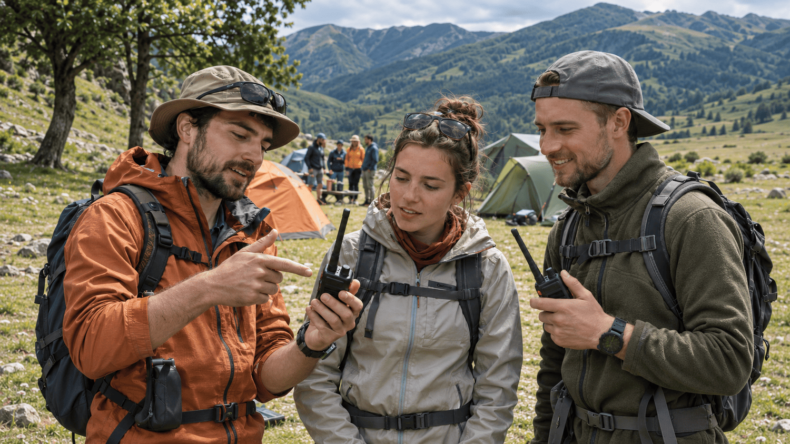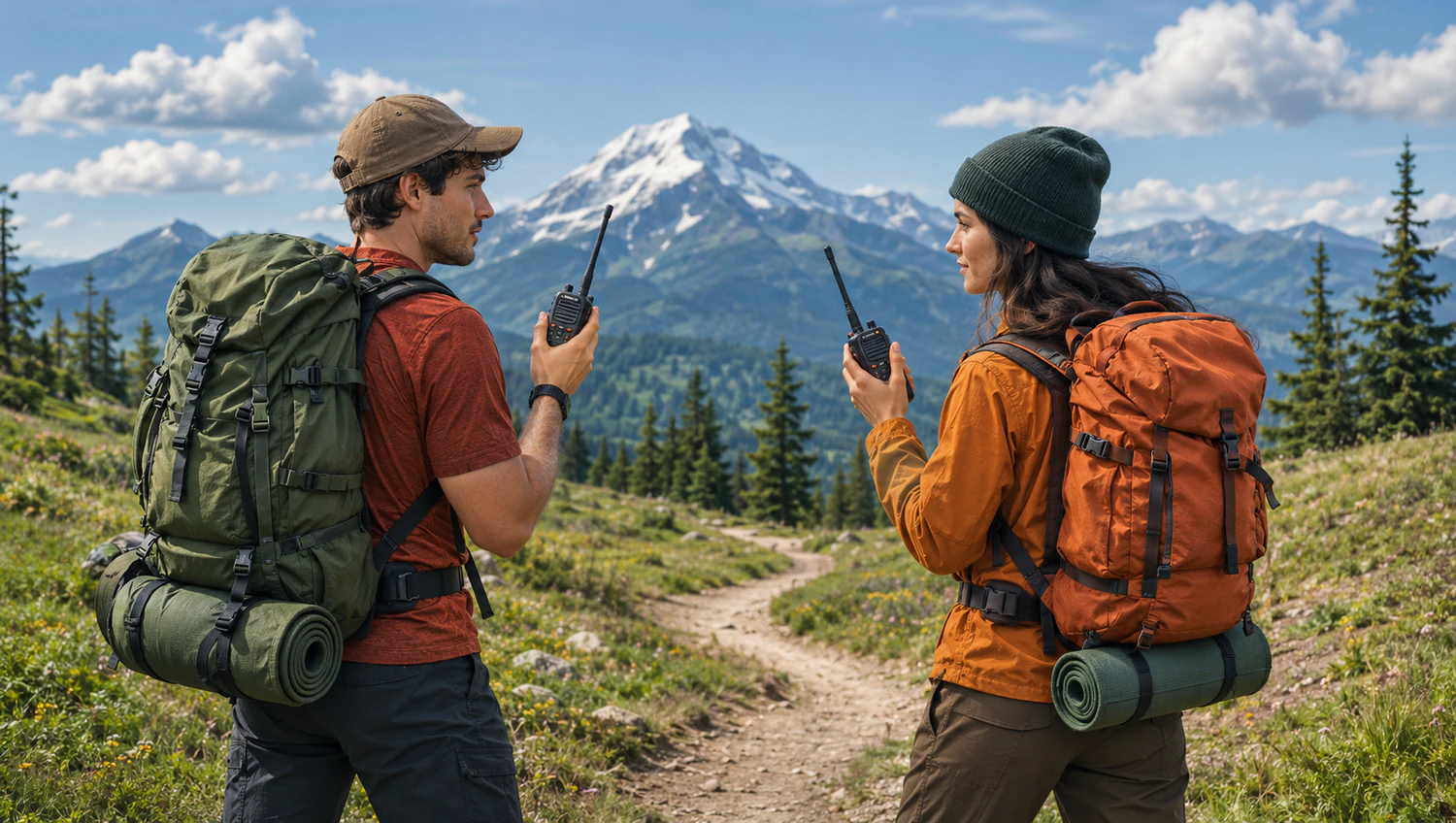
The best walkie talkies for hiking are the ones your whole group can operate, carry securely and keep powered throughout the trip. For most recreational hikers in the United States, the Motorola T470 is our starting recommendation: straightforward FRS voice communication, splash protection and flexible battery options. Choose the Rocky Talkie Mountain Radio when secure attachment and a replaceable lithium-ion battery justify a higher price. Choose the Motorola T605 H2O when floating construction and immersion protection matter. None can guarantee communication across a ridge, and a handheld radio does not replace a separate way to request outside help.
- Most hiking groups: Motorola T470.
- Frequent mountain trips: Rocky Talkie Mountain Radio.
- Wet routes and crossings: Motorola T605 H2O.
- Deciding factor: terrain, power planning and usability matter more than advertised maximum miles.
- Match the exact US FRS version to the radios your group already uses.
- Choose splash protection or immersion protection for your actual route.
- Plan batteries and charging for every participant, including the return trip.
Hiking Walkie-Talkies ON

- ✓ Compare radio kits
- ✓ Check the exact version
- ✓ View current offers
As an Amazon Associate, we earn from qualifying purchases at no extra cost to you.
Radios for Hiking Comparison
Compare protection, power arrangements and practical roles first. N/A means a comparable specification was not confirmed. Price symbols describe the approximate cost per radio from the verified kit price; they are not performance scores. An empty price field means a sufficiently reliable price was unavailable.
| Category | Best Value for Money | Advanced Features | Premium Options | Budget Options | ||||
|---|---|---|---|---|---|---|---|---|
| Model | 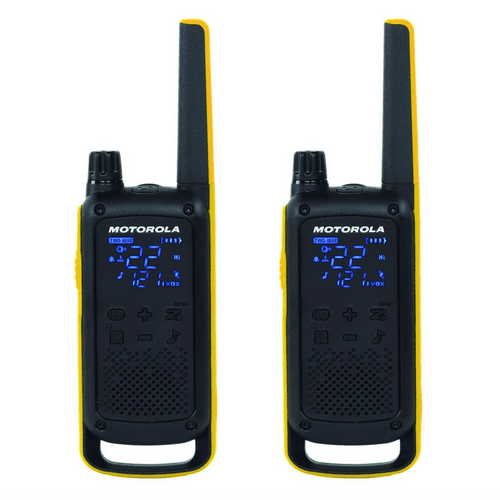 Motorola T470 | 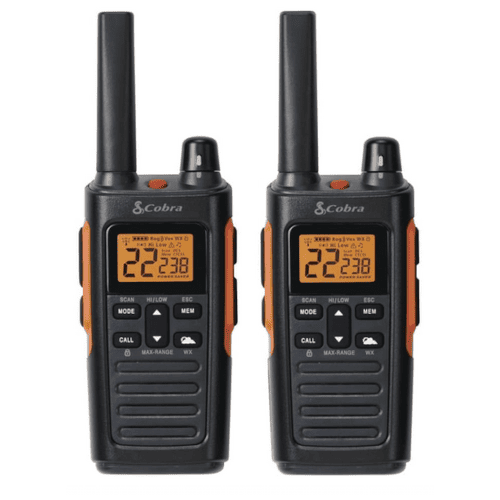 Cobra RX680 | 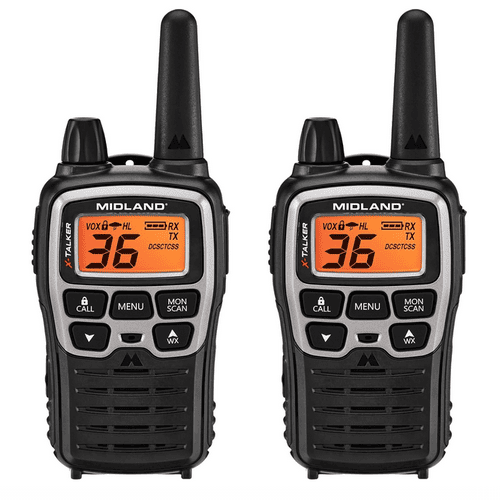 Midland T71VP3 | 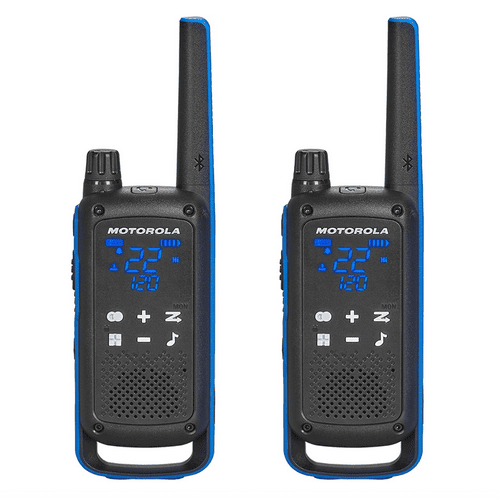 Motorola T802 | 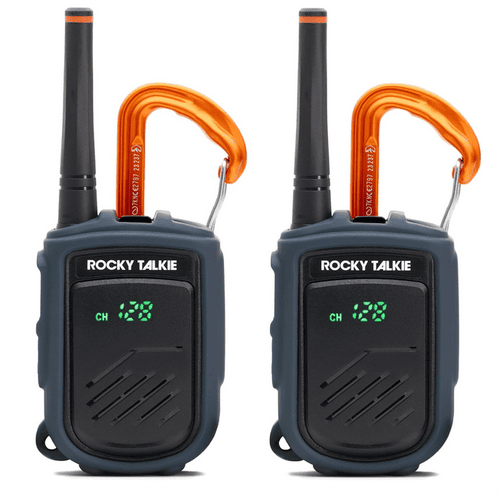 Rocky Talkie Mountain Radio | 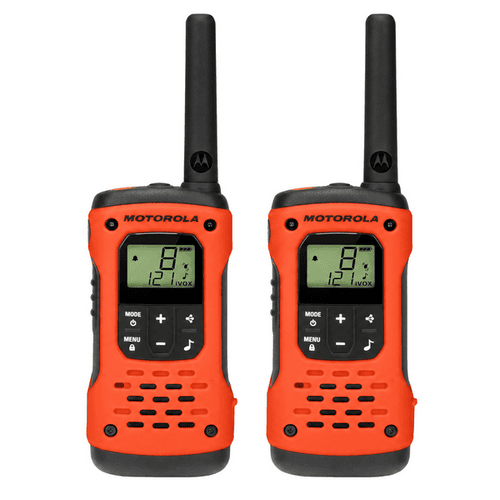 Motorola T605 H2O | 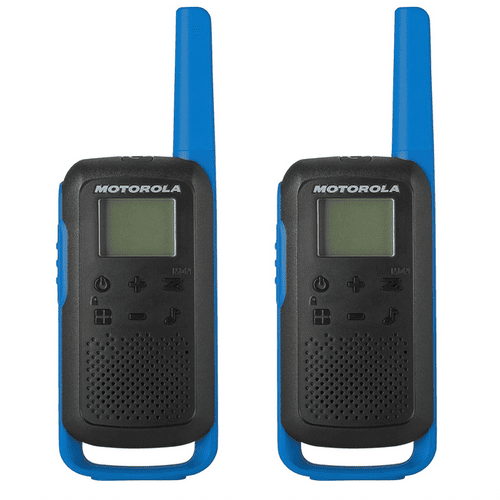 Motorola T270 | 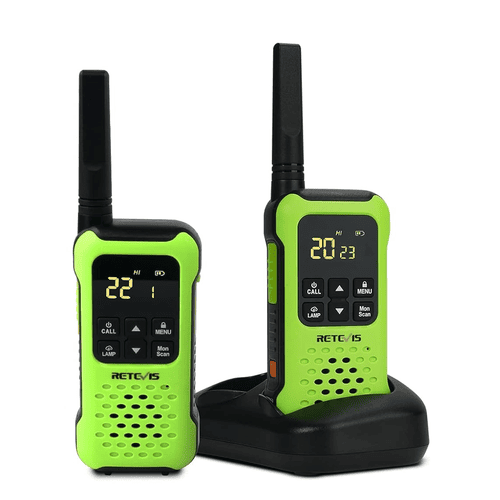 Retevis RT49P FRS |
| Radio standard / version | US FRS | US FRS | US FRS | US FRS | Mountain Radio, FRS | US FRS, orange/black | US FRS | RT49P, US FRS |
| License / authorization | No individual license | No individual license | No individual license | No individual license | No individual license | No individual license | No individual license | No individual license |
| Featured | AA battery backup | Charging dock included | Weather channel scan | App location sharing | Carabiner and leash | Floating waterproof design | Dual power options | Floating IP67 construction |
| Channels / memory | 22 FRS frequencies; 121 codes | 22 FRS frequencies; 60 presets including coded combinations | 22 FRS frequencies; 36 selections including coded presets | 22 FRS voice channels | 128 selections; not 128 distinct FRS frequencies | 22 FRS frequencies; 121 codes | 22 FRS frequencies; 121 codes | 22 FRS frequencies |
| Voice mode | Analog FM | Analog FM | Analog FM | Analog FM; additional app functions | Analog FM | Analog FM | Analog FM | Analog FM |
| Ready-to-carry weight | N/A | N/A | N/A | N/A | 6.1 oz, manufacturer-listed | 8.0 oz with batteries, manufacturer-listed | N/A | N/A |
| Protection | IPX4; splashes | IP54; dust protection and splashes | Water-resistant; IP rating N/A | IP54; splashes | IP56; not submersible | IP67; floating | IP rating N/A | IP67; floating |
| Battery / charging | NiMH pack or AA; micro-USB | Li-ion packs; included dock | Rechargeable packs or AA; micro-USB and desktop charger | NiMH pack or AA; USB-C | Replaceable 1550 mAh Li-ion; USB-C | NiMH pack or AA; USB-C on reviewed orange version | NiMH pack or AA; micro-USB | Rechargeable AA or alkaline AA; micro-USB |
| Weather reception | NOAA with alerts | NOAA with alerts | Weather Scan + Alert | NOAA weather functions | N/A | NOAA with alerts | NOAA with alerts | NOAA with alerts |
| Main trade-off | No immersion protection | Dock adds to charging kit | No verified immersion rating | Advanced functions need a phone | Higher price; not submersible | Heavier; kit contents vary | Limited confirmed weather protection | Older charging port; listing-name ambiguity |
| Price & Offer | $ | $ | $ | $ | $ | $ | $ | $ |
Quick Picks by Use Case
Start with your route and the people carrying the radios.
Licensing & Legal Use
Buy the US FRS version
The selected models are US FRS versions intended for ordinary operation without an individual FCC license. Authorization by rule is addressed in 47 CFR §95.305; the FRS-specific requirements appear in Part 95, Subpart B. This does not authorize arbitrary programmable radios simply because they can transmit on a matching frequency.
FRS has 22 shared frequency channels. Under 47 CFR §95.567, maximum effective radiated power is 0.5 W on channels 8–14 and 2 W on channels 1–7 and 15–22. These are channel-dependent ERP limits, not a promise that every model produces the maximum. Section 95.587 requires an integral, non-removable antenna. Do not modify a radio to bypass those restrictions.
FRS and GMRS share channels, but the equipment and operator requirements differ. A GMRS radio still requires the appropriate authorization; selecting a shared channel does not turn it into an FRS radio. Under 47 CFR §95.1705, a GMRS license can cover specified immediate family members, but it does not automatically cover every friend joining a hike.
These are license-free radios for the reviewed US use case, not universally legal travel radios. PMR446 is a different regional system and is not interchangeable with US FRS. NOAA reception provides weather information where a broadcast can be received. It does not transmit a distress call to a weather station or emergency dispatcher.
How We Selected and Evaluated These Radios
We selected eight US-market FRS models with distinct reasons to buy: affordable voice communication, flexible batteries, desktop charging, phone-assisted location sharing, secure attachment or floating construction. Exact Amazon listings were located, although readable prices and current availability were not consistently available. The selection keeps ordinary hiking groups on one familiar voice-radio service.
We did not add amateur radios or cellular push-to-talk devices to inflate the comparison. A device requiring different operator qualifications or mobile coverage answers a different buying question.
- Version: identifiable US FRS equipment.
- Power: practical recharging and backup arrangements.
- Protection: documented splash or immersion ratings.
- Carrying: attachment, accessibility and confirmed weight.
- Group use: matching voice settings and understandable controls.
- Useful extras: weather reception or location tools with their dependencies.
- Cost: comparable kit prices, normalized per radio.
This is a document-based buying guide, not our own field test. We checked manufacturer descriptions, available specifications, manuals and US rules. We have not measured comparative audio clarity, battery endurance or radio range. Manufacturer runtime claims are not treated as equivalent tests, and missing specifications remain N/A. Recommendations reflect practical fit, not a laboratory ranking.
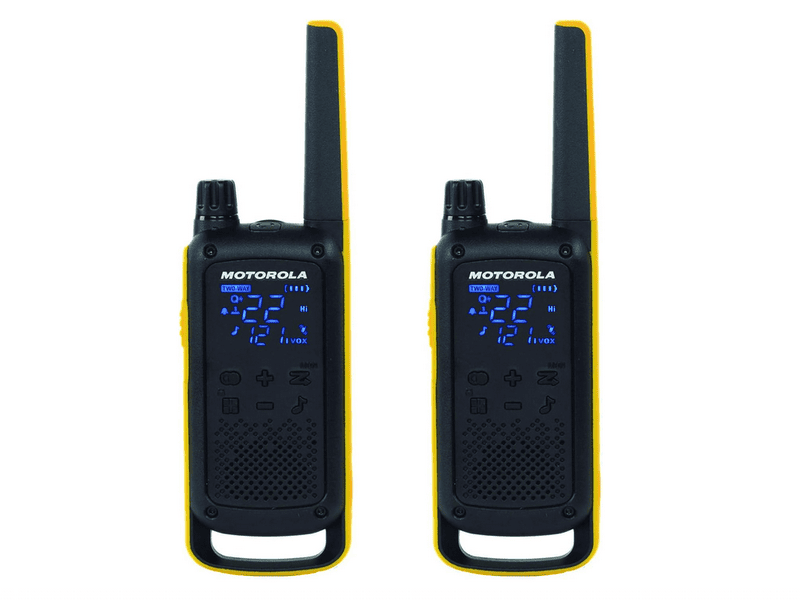
Motorola T470 — US FRS
The T470 is our starting choice for hikers who want ordinary voice communication, replaceable backup batteries and splash protection without paying for smartphone features or a specialized mountain attachment system.
Why We Selected It
The T470 occupies a useful middle ground between a basic family radio and a more expensive specialist model. IPX4 protection addresses splashes, while the choice of a rechargeable pack or AA batteries gives a group a practical backup strategy. Weather reception adds another useful function at camp. These are reasons to choose it for routine hiking, rather than evidence that it transmits farther than other FRS radios. Its main limitation is the absence of immersion protection.
- AA backup lets a group restore power without waiting for a charging session, provided suitable spare batteries are carried.
- Splash protection suits rain exposure better than an unspecified enclosure rating, but does not cover dropping the radio into water.
- A keypad lock helps preserve the agreed channel settings while the radio moves against clothing or a backpack.
Pairs and small groups doing regular day hikes or overnight trips who want a shared voice channel, weather reception and an understandable battery plan without relying on a phone.
Trips where immersion is a realistic possibility, or hikers specifically seeking USB-C charging and a carabiner-based carrying system. Those needs point toward other models here.
Our Verdict
Choose the T470 over the T270 when its documented splash protection is worth the additional expense. Choose it over the T802 when everyone primarily wants to press a button and speak. The T470 is the best radio for hiking in this guide for a typical recreational buyer balancing features and complexity. That is an editorial judgment about usefulness, not a measured range victory. For stream crossings with exposed gear, the T605 H2O has a more relevant protection advantage.
PROs
- Rechargeable pack and AA options
- Documented IPX4 protection
- NOAA reception and alerts
CONs
- Not rated for immersion
- Older micro-USB charging connection
Assessment uses Motorola’s US T470 documentation and the black/yellow two-radio listing. T472 and T475 bundles have different accessories. Comparable ready-to-carry weight was not confirmed; package weight is not substituted.
Cobra RX680 — US FRS
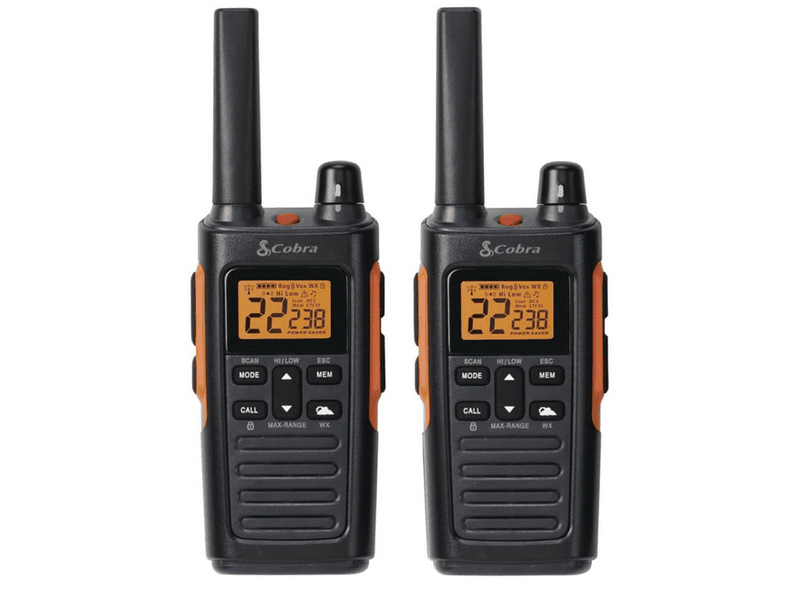
The RX680 suits hikers who want a complete rechargeable pair with a desktop dock, splash protection and weather alerts. Its convenience is strongest when charging happens before departure or back at camp.
Why We Selected It
A charging routine can matter as much as a specification advantage. The RX680 kit includes rechargeable lithium-ion batteries and a dock, making it a sensible option for a pair kept together between trips. Its IP54 rating addresses dust exposure and splashing, while vibration alerts provide another way to notice a call. The trade-off is carrying and powering the charging arrangement on longer journeys. Buyers planning to swap common batteries on the trail should compare the T470 or T71VP3.
- The included dock keeps both radios in one charging location, useful when preparing a shared kit before a weekend trip.
- IP54 protection addresses splashes and dust ingress; it should not be interpreted as permission to immerse the radio.
- Preset channel-and-code combinations offer convenient selections, but do not create additional frequencies or make conversations private.
A regular hiking pair that recharges its equipment at home, in a cabin or at a powered camp and values a convenient kit with weather reception.
Backpackers prioritizing a common disposable-battery backup, or anyone who needs floating construction. A dock does not solve power availability on a remote route.
Our Verdict
The RX680 is a practical alternative to the T470 when its included charging dock fits your routine. We would not choose between them using advertised 35- or 38-mile figures: those numbers do not establish a useful trail advantage. Instead, decide whether you prefer the Cobra charging kit or Motorola’s AA backup flexibility. The RX680’s documented protection is appropriate for splash exposure, while the floating T605 H2O and RT49P address a different problem: a radio actually landing in water.
PROs
- Dock and rechargeable batteries included
- IP54 enclosure rating
- Weather and vibration alerts
CONs
- No immersion rating
- Charging accessories add to the trip kit
Manufacturer specifications and the RX680 two-pack listing support this assessment. The advertised 60 selections comprise standard FRS channels and coded presets. No comparative battery or audio testing was performed.
Midland X-Talker T71VP3 — US FRS
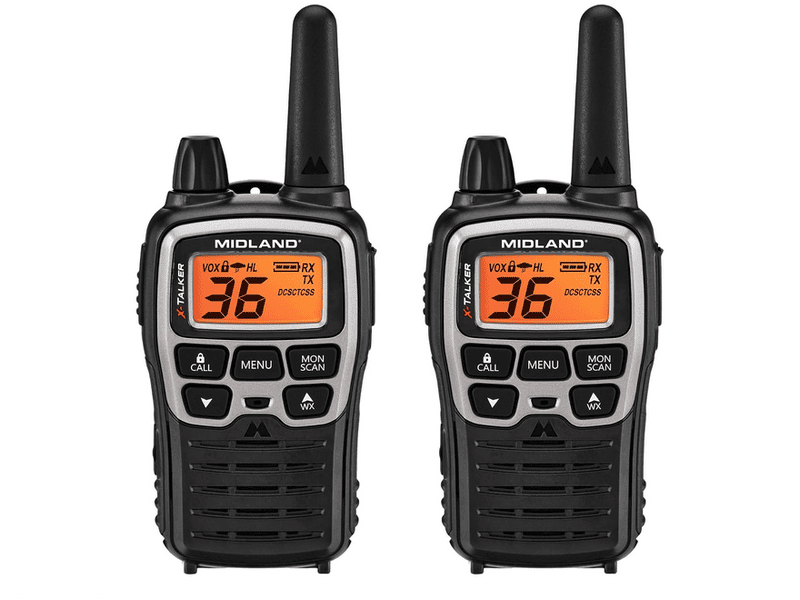
The T71VP3 offers a familiar hiking-radio arrangement: a rechargeable pair, desktop charger and weather scanning. It is an alternative for buyers who want battery flexibility without app-based features.
Why We Selected It
The Midland kit combines a desktop charger with rechargeable packs and the option of AA backup. This fits trips where radios can be charged before departure, then supported with spare cells. Weather Scan + Alert adds value for groups camping overnight. Its role overlaps with the T470, but the included charging arrangement gives buyers a concrete reason to compare them. Neither the larger selection count nor the maximum-distance claim establishes better communication through a forest or across broken terrain.
- The desktop charger provides an organized way to prepare a pair, while spare AA batteries support use beyond a charging opportunity.
- Weather scanning can help locate a receivable weather broadcast; coverage still depends on the route and surrounding terrain.
- Silent operation can reduce unnecessary button sounds at camp without changing the shared-channel nature of the radio service.
Hikers building a two-radio kit around rechargeable use at home and AA backup outdoors, especially when an included desktop charger is more useful than phone integration.
Trips requiring documented immersion protection, or hikers standardizing every device on USB-C. Water-resistant wording should not be treated as a substitute for an IP67 rating.
Our Verdict
Compare the T71VP3 with the T470 on the full kit price and charging arrangement. Midland’s desktop charger is useful if the pair returns to the same storage location; Motorola’s documented IPX4 rating makes its protection easier to interpret. Choose the Midland for the arrangement you will actually use, not for “36 channels” as a supposed capacity advantage. For a wet trek, a floating radio changes the buying decision more meaningfully than a larger number of preset selections.
PROs
- Desktop charger included
- Rechargeable and AA power options
- Weather Scan + Alert
CONs
- Micro-USB connection
- No confirmed immersion rating
This review concerns the T71VP3 FRS two-pack. Its 36 selections include coded presets beyond the standard 22 frequencies. Specifications from similarly named GMRS kits are not applied to this version.
Motorola T802 — US FRS
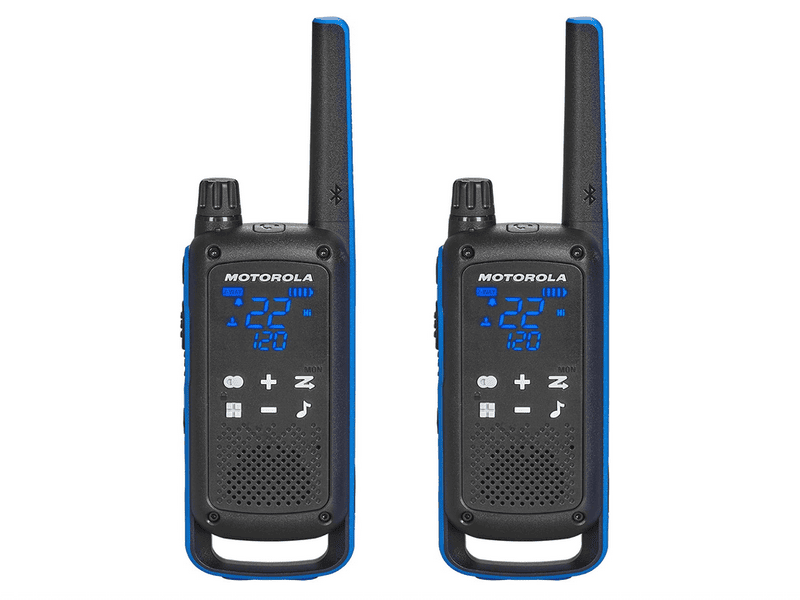
The T802 is for hikers who will use its phone-assisted features deliberately. It combines ordinary FRS voice communication with TALKABOUT app functions, bringing useful possibilities and additional setup and power requirements.
Why We Selected It
Sometimes a voice description of a campsite or junction is not enough. Motorola’s app integration allows compatible users to exchange messages and location information through the radio system without relying on cellular coverage. That distinguishes the T802 from the voice-focused choices here. However, the advanced functions require compatible phones, the app and preparation. Choose it only when the group will maintain that setup. Its ordinary voice function remains useful, but app features do not make blocked radio paths disappear.
- App messaging can convey information that is awkward to repeat by voice, provided compatible equipment and a usable radio path exist.
- Location sharing helps group coordination, but receiving a location does not establish a safe route to the person.
- USB-C charging and AA backup provide useful power options; smartphone consumption must be included in the same trip plan.
A group willing to install and test the app before departure, download relevant maps and maintain phone batteries alongside the radios. Especially useful when sharing locations is a defined requirement.
Hikers seeking the simplest possible shared equipment, or anyone expecting every ordinary FRS radio to receive app messages. Voice compatibility and data compatibility are different questions.
Our Verdict
Choose the T802 over the T470 when your group has a clear use for its location and messaging tools. If those features will remain unused, the simpler model avoids another preparation task. The T802 also offers USB-C charging, but that alone should be weighed against the price of the complete kit. We would prioritize a successful practice session over a feature checklist: every participant should know how to communicate when the phone is unavailable, Bluetooth disconnects or the radio path fails.
PROs
- Phone-assisted location and messaging functions
- USB-C charging
- NiMH and AA power options
CONs
- Advanced functions require a compatible phone setup
- IP54 does not cover immersion
Motorola’s T802/T803 documentation supports the listed functions. The selected kit is T802; the T803 charging-tray bundle is different. App availability, phone compatibility and offline operation should be checked before departure.
Rocky Talkie Mountain Radio — FRS
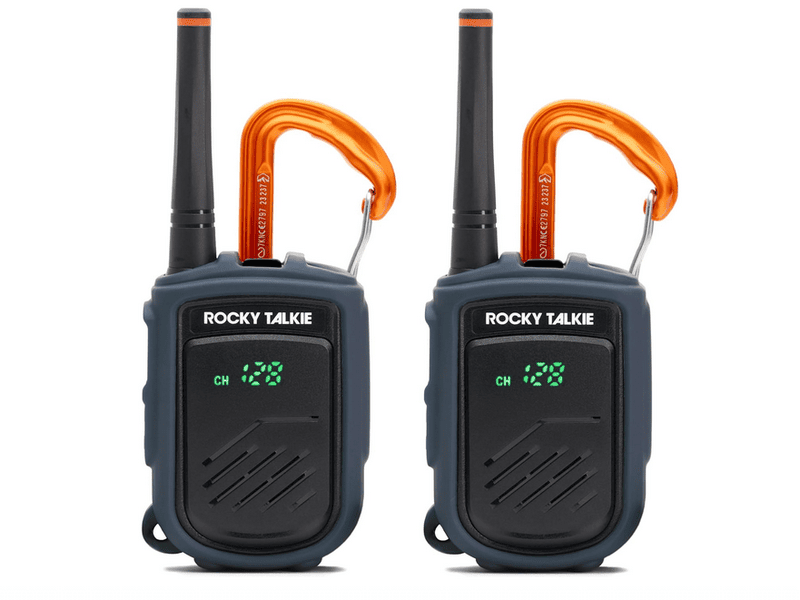
The Mountain Radio earns its place through carrying design and a replaceable battery rather than a long feature list. It suits hikers who value an accessible radio attached securely to their equipment.
Why We Selected It
A radio buried inside a pack is inconvenient when a group is moving. The Mountain Radio’s carabiner and backup leash address attachment directly, while a replaceable lithium-ion battery and USB-C charging support a planned power system. Its controls are focused on radio use rather than phone integration. The higher price makes most sense for frequent outings where that carrying arrangement matters. IP56 protection is useful outdoors, but the model is not submersible and should not be selected as a floating water radio.
- A carabiner and backup leash provide two retention elements, helping keep the radio attached when moving over uneven ground.
- The replaceable battery supports a spare-pack strategy; it does not provide the common AA fallback offered by several alternatives.
- Focused controls reduce the number of functions a new user needs to learn, although a group check remains essential.
Frequent hikers who want a securely attached, readily accessible radio and are comfortable buying dedicated spare batteries. Particularly relevant when carrying design matters more than weather broadcasts or phone integration.
Occasional walkers seeking the cheapest workable pair, or routes where a floating, immersion-rated radio is the priority. Do not confuse this FRS model with the separate Expedition GMRS radio.
Our Verdict
The Mountain Radio is our premium choice for hikers who will benefit from its attachment system on many trips. Compared with the T470, the extra spending buys a different carrying and battery arrangement, not a demonstrated ability to overcome mountains. Compared with the T605 H2O, it favors attachment and focused operation over floating construction. Rocky Talkie advertises several days of battery life, but that is not directly comparable with other brands’ hourly claims without matching use conditions. Plan reserve power rather than treating a day count as guaranteed.
PROs
- Carabiner and backup leash included
- Replaceable lithium-ion battery
- USB-C charging
CONs
- Higher cost for a pair
- Not submersible
- No AA battery fallback
Specifications concern the FRS Mountain Radio, not the Expedition model. Manufacturer-listed weight is 6.1 oz. Its 128 selections should not be interpreted as 128 separate FRS frequencies. Runtime claims were not independently reproduced.
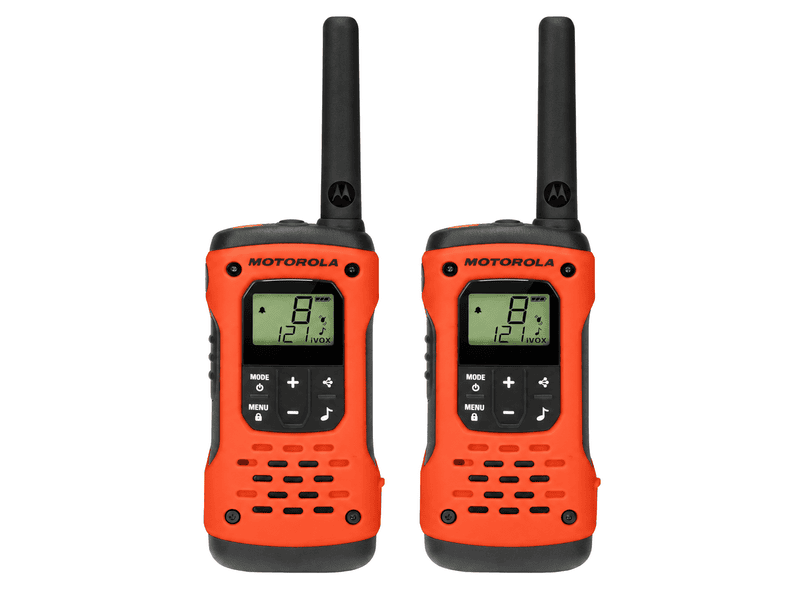
Motorola T605 H2O — US FRS, Orange/Black
The T605 H2O is the more relevant Motorola choice when a dropped radio could land in water. Floating construction and an IP67 rating address that scenario directly, at the cost of extra bulk.
Why We Selected It
Rain protection and recovery after a water drop are different requirements. The T605 H2O combines an immersion rating with a floating design and water-activated light, making it worth considering for trips involving shoreline travel or water crossings. Rechargeable and AA power options also suit longer outings. Its value depends on whether those water-related features address a realistic exposure. For dry trails, the T470 can be the more economical choice; for securing equipment to a pack, the Mountain Radio takes a different approach.
- Floating construction helps retrieval after a drop, although current, darkness and attachments can still make a radio difficult to recover.
- The water-activated light helps make a wet radio visible; it does not transmit an automatic rescue request.
- AA operation offers a backup power route when recharging is unavailable, provided the battery compartment is correctly closed afterward.
Hikers whose routes involve substantial water exposure and who prefer rechargeable operation with an AA fallback. Useful when flotation is a practical recovery feature rather than an occasional extra.
Buyers primarily seeking lightweight radios for dry day hikes, or anyone assuming an IP67 enclosure remains protected with an open charging cover or incorrectly seated battery door.
Our Verdict
The T605 H2O is the stronger fit than the T470 when immersion and retrieval are genuine concerns. It is not automatically the better hiking radio simply because its enclosure rating is higher: extra weight and carrying size still matter. Compare it with the RT49P on the verified kit contents, charging arrangements and current price. We have not established a range or audio advantage between them. Choose the protection you need, and keep the radio secured so that flotation remains a backup rather than the normal carrying strategy.
PROs
- IP67 enclosure and floating construction
- Water-activated light
- Rechargeable and AA battery options
CONs
- About 8 oz with batteries in manufacturer specifications
- Bundle contents differ across listings and documentation
This review targets the orange/black US FRS T605 H2O with USB-C. Manufacturer documentation differs on spare-battery quantities, so extras are not assumed. A reliable current price was unavailable for the selected offer.
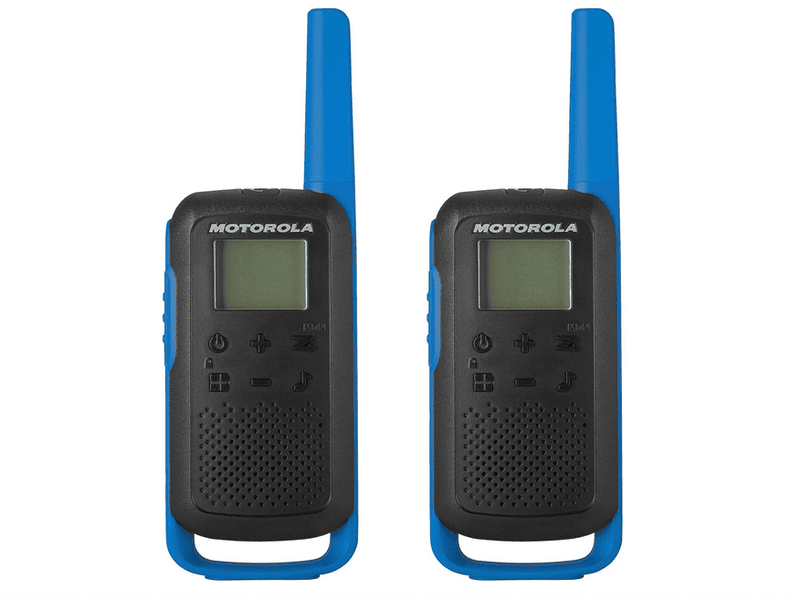
Motorola T270 — US FRS
The T270 is a sensible budget starting point for occasional walkers who want rechargeable radios with AA backup. Its appeal is basic usefulness, while its less clearly documented weather protection limits its role.
Why We Selected It
Not every hiking group needs an expensive radio system. The T270 provides the central functions needed for ordinary voice contact, together with weather reception and two battery approaches. This makes it a useful comparison point against more expensive models: what extra function would improve your particular trip? Its budget role is strongest for occasional use with limited weather exposure. It should not be treated as equivalent to the T470’s documented splash protection or the T605 H2O’s immersion-rated enclosure.
- The included rechargeable packs cover routine use, while AA compatibility provides an understandable backup for an extended day outdoors.
- Weather reception adds a useful function without requiring a phone connection, where the relevant broadcast reaches the route.
- A backlit display helps check settings in low light; confirm the channel before leaving camp rather than adjusting while moving.
Occasional day hikers, family outings and campsite use where a low purchase price matters and the group can protect equipment from sustained wet exposure.
Buyers specifically requiring documented waterproofing, secure specialist attachment or phone-assisted location tools. Those needs justify looking beyond the least expensive option.
Our Verdict
Buy the T270 when it meets the actual task and leaves money for spare batteries and proper carrying arrangements. Move to the T470 for its documented splash protection, or to the T605 H2O when immersion is a realistic concern. We would not replace a functioning T270 simply to chase a larger maximum-range claim on another box. Terrain and group procedure remain central. The T270 is a budget recommendation for an appropriate outing, not a substitute for a more protected radio on every route.
PROs
- Lower verified pair price
- Rechargeable and AA operation
- Weather reception and alerts
CONs
- No confirmed IP rating in the reviewed material
- Micro-USB charging
Specifications concern the US T270 two-pack in black/blue. The T270TP three-pack is a different offer. Manufacturer battery-hour claims are not used as comparable endurance measurements against other models.
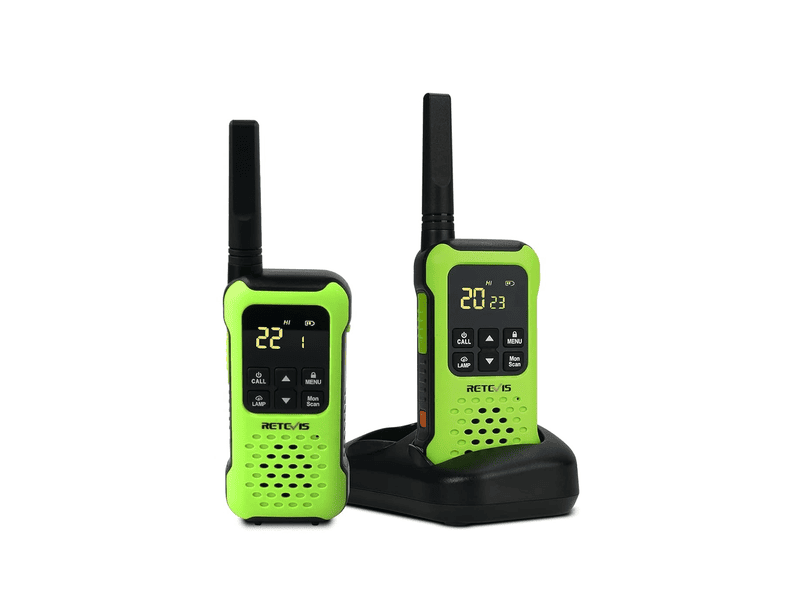
Retevis RT49P — US FRS
The RT49P is the budget alternative for hikers who need floating construction and immersion protection. Its older charging connection and inconsistent marketplace naming make checking the exact version especially important.
Why We Selected It
The RT49P provides a second way to approach wet-route communication without automatically selecting the more expensive category. Retevis specifies an IP67 floating enclosure, weather alerts and AA-based power. Those features address real hiking concerns: a water drop, changing weather and replacement batteries. Its place here depends on the exact US FRS version. Do not transfer these specifications to a similarly named overseas model or assume that every marketplace bundle contains the same charging accessories.
- The floating enclosure provides a recovery advantage after a water drop, subject to correct closure and the fitted accessories.
- Rechargeable AA cells and alkaline backup allow a practical spare-battery plan without relying entirely on a dedicated replacement pack.
- Weather alerts and a flashlight add useful campsite functions, but neither feature establishes contact with outside emergency services.
Price-conscious hikers who need a floating, immersion-rated radio and prefer common battery sizes. Best considered when the exact RT49P FRS model and included charging equipment can be confirmed.
Buyers who want USB-C throughout their equipment or an unambiguous marketplace purchase without checking model details. The older charging port may require another cable in the pack.
Our Verdict
The RT49P is worth comparing with the T605 H2O when immersion protection matters more than brand preference. Compare the actual pair price and accessories before concluding that it is cheaper: a missing charger or a different bundle can change the value calculation. Against the T270, it offers a more relevant enclosure design for wet routes. We have not established a comparative range, audio or durability advantage. Its recommendation is based on documented construction and power options, with the exact listing identity checked carefully.
PROs
- IP67 floating construction
- AA-based power options
- NOAA weather alerts
CONs
- Micro-USB charging
- Marketplace naming and kit details require care
Technical claims refer to the manufacturer’s RT49P FRS model. The researched Amazon listing uses an EZTalk 4 heading while retaining RT49P material. Confirm the model label and pack contents before purchasing that offer.
How to Choose a Two Way Radio for Hiking
A useful walkie talkie for trekking should fit the route, the group and the way you carry equipment. Start with the problems you need to solve, then pay for features that address them.
Outdoor communication works best when everyone understands the same simple routine. Agree on a primary channel, a backup channel, check-in points and what to do after a missed call. Match the actual frequency and tone settings, not just a preset number that may mean something different on another brand.
For a mixed group, analog compatibility is the practical starting point: these radios support ordinary analog FRS voice communication. Turn privacy codes off for the first compatibility test, then add matching codes if useful. CTCSS and DCS filter what opens the speaker; they do not provide confidential conversations or stop interference from other transmitters.
Plan battery life for the whole trip
Battery life depends on how often you transmit, how long you listen, temperature, volume and enabled functions. A “days” claim and an “hours” claim are not comparable without matching conditions. Keep enough reserve for delays and the return journey.
Li-ion batteries offer a rechargeable option in the Mountain Radio and RX680, while several alternatives use NiMH packs or rechargeable AA cells. Common AA backup can be convenient where you cannot recharge. Dedicated spare packs can also work well if you carry the correct ones. Include every cable, charger and power bank when judging the system’s weight. Power-saving features help, but cannot compensate for frequent transmitting or an undersized energy reserve. Follow the manufacturer’s charging-temperature instructions.
Separate water resistance from immersion protection
Water resistance should match the likely exposure. IPX4 and IP54 address splashes; they are not immersion ratings. The T605 H2O and RT49P add IP67 and floating construction, which are relevant when a radio could land in water. The Mountain Radio’s IP56 protection does not make it submersible.
Ingress protection ratings describe specified test conditions, not unlimited waterproofing. An IP68 claim on another radio needs its stated depth and duration checked; none of the selected models is presented here as IP68. Closed port covers, correctly seated seals and undamaged battery doors matter. Durability against drops is a separate question, and an IP rating alone does not prove it.
Choose a carrying system you can reach
Lightweight radios are helpful only if they remain accessible and attached. Check how a clip, leash or carabiner works with your pack straps, jacket and trekking poles. The Mountain Radio directly addresses attachment; other models may require a suitable carrying arrangement for your equipment.
Compare ready-to-carry weight rather than a bare-radio figure. Batteries, microphones and retention accessories can change the result. Do not fill a weight comparison with shipping weights. Try the push-to-talk button with the gloves you actually wear, and check that clothing does not hold it down accidentally. A convenient position also helps you keep the antenna clear of your body.
Understand radio range and power output
Line of sight is a major factor in handheld UHF communication. A ridge, deep drainage or dense wet vegetation can reduce radio range sharply. Increasing power output does not guarantee communication through an obstruction, and this guide does not rank radios by the largest advertised distance.
Antenna quality matters as part of a complete radio design, but we have no comparable measurements establishing an antenna winner here. FRS antennas are integral; do not plan to replace one with an aftermarket whip. Before spending more, consider whether keeping the group closer, calling before terrain changes or relocating safely to a clearer position addresses the real communication problem.
Pay for location tools only when you will use them
The T802’s location-sharing tools can help a prepared group, but they introduce phone, app and battery dependencies. Download maps and test the setup before the trip. If you need to communicate GPS coordinates by voice, agree on the coordinate format so that the receiving person can enter them correctly.
Dual-band functionality and DMR are features of other radio categories, not automatic upgrades for this FRS group. A digital radio is not necessarily compatible with analog FRS voice equipment, and programming matching frequencies does not establish legal authorization. Choose a shared system deliberately rather than assembling a group around unrelated feature lists.
Build emergency communication around the actual destination
An emergency radio for hiking can mean a weather receiver, a group walkie-talkie or a device intended to contact outside assistance. These are different jobs. The models here principally help people within usable radio range communicate with one another. NOAA reception is useful where available, but it is not an outgoing emergency link.
Mountain safety also depends on route planning, weather decisions, navigation and a missed-contact plan. If the route requires a way to reach outside help beyond cellular coverage, assess that requirement separately. Buying a more expensive FRS radio does not create a monitored rescue channel or guaranteed coverage.
Real-World Range and Communication Limits
Maximum-distance advertising usually describes favorable conditions with an unusually clear path. It should not be used to decide how far apart a hiking group can safely spread out.
Two hikers with a clear view between elevated positions may communicate much farther than two people separated by a nearby ridge. Trees, rock, buildings, antenna position and other radio users can change the result. A distance that worked on the outward leg may fail after someone descends into a gully.
Keep the radio accessible, hold it upright and speak clearly after pressing the transmit button. If contact fails, stop and use the group’s agreed procedure. Move only when doing so is safe; do not climb exposed terrain simply to recover a signal. Call before losing visual contact at a ridge or junction, and use planned regrouping points. There is no universal mileage figure that substitutes for these habits.
Before Your First Trip
Set the same primary channel and compatible tone settings. Label each unit, lock the keypad and write down the backup channel. For mixed brands, test actual communication rather than assuming matching preset numbers are equivalent.
Make calls in both directions with the radios attached where they will be carried. Confirm that every user can operate the controls. Test any headset or app separately, then practice ordinary voice operation without the phone.
Charge the correct batteries, pack appropriate spares and check each cable. Inspect seals and close covers. Do not attempt to recharge alkaline cells. Keep charging connections dry and follow the battery instructions for the exact model.
Choose check-in locations and a procedure for a failed call. Tell everyone when to wait, when to return to the last agreed point and how outside help would be requested if needed. Practice the plan before the group separates.
What to Avoid When Buying Hiking Radios
- Choosing by maximum miles: a larger number on the box does not establish better performance on your route.
- Buying the wrong regional version: FRS, GMRS and PMR446 are not interchangeable labels. Check the actual model and radio service.
- Counting presets as extra frequencies: 36, 60 or 128 selections may include coded combinations rather than additional FRS channels.
- Treating privacy codes as security: other users can still hear a transmission, and competing signals can still interfere.
- Comparing unlike prices: check whether an offer includes one radio, a pair or a larger kit, and verify batteries and charging equipment.
- Assuming waterproof means maintenance-free: open covers, damaged seals and incorrectly closed doors can compromise protection.
- Depending on an untested extra: a phone app, voice activation or accessory microphone should be tested before it becomes part of the plan.
Special Cases & Common Questions
What is the best handheld radio for hiking without a license?
For most ordinary US hiking groups, start with the FRS Motorola T470. Choose the Mountain Radio for its carrying system or the T605 H2O for floating protection. The best two way radio for hiking communication is the one that matches the whole group’s equipment, power plan and route exposure.
Will different brands of hiking radios work together?
Usually, compatible US FRS radios can exchange analog voice when the frequency and tone settings match. Preset numbering may differ, so test them together. App messages and location-sharing functions are a separate compatibility question; ordinary voice interoperability does not establish that another brand can receive those features.
Does a more expensive radio provide clearer audio?
Not necessarily. We have not measured comparative audio clarity among these models. Speaker performance, microphone placement, wind and signal strength all affect intelligibility. A higher price may buy attachment design, enclosure protection or app functions rather than a demonstrated improvement in received speech.
Should backpackers choose AA batteries or a rechargeable pack?
Choose the arrangement you can support for the entire trip. AA backup is convenient when replacement cells are available; dedicated packs work well when suitable spares or reliable charging are carried. Include charging accessories in your weight calculation, and do not compare manufacturer runtime claims without checking the stated conditions.
Can I use these radios on an overseas trek?
Do not assume so. This guide evaluates US FRS versions for use in the United States. Other destinations may use different services, such as PMR446, with different equipment requirements. Check the destination’s rules and obtain the correct regional version rather than trying to reprogram a radio to fit.
Can one of these radios call emergency services?
There is no guaranteed monitored emergency connection. A nearby person using a compatible radio might hear you, but that is not assured. Weather reception and alarm buttons do not create a dispatcher link. Decide separately how you will request outside assistance on the intended route.
Final Recommendation
For most hikers buying a practical pair, choose the Motorola T470 and put equal effort into spare power and a group communication plan. Choose the Rocky Talkie Mountain Radio when frequent use and secure attachment justify the premium. Choose the Motorola T605 H2O when floating construction and immersion protection solve a real route requirement. The best two way radios for hiking are not determined by a maximum-mile claim: the right choice keeps everyone on a compatible system, suits the weather exposure and remains usable throughout the trip.
Back to the comparison