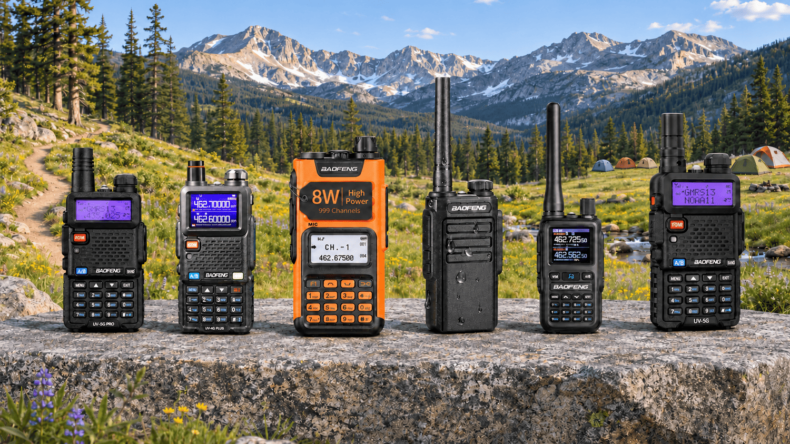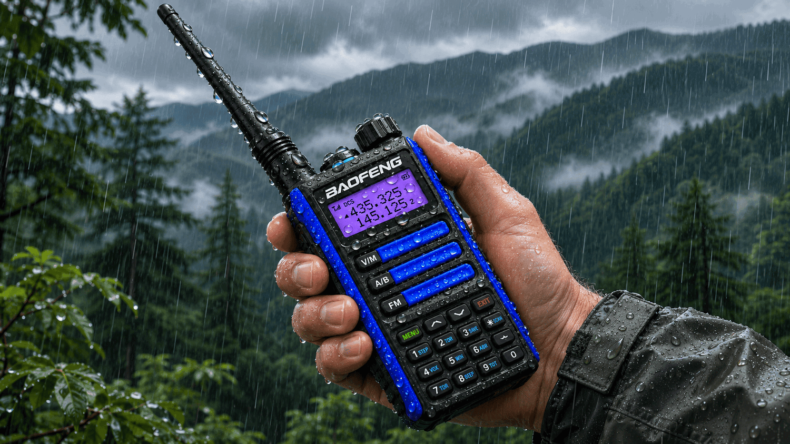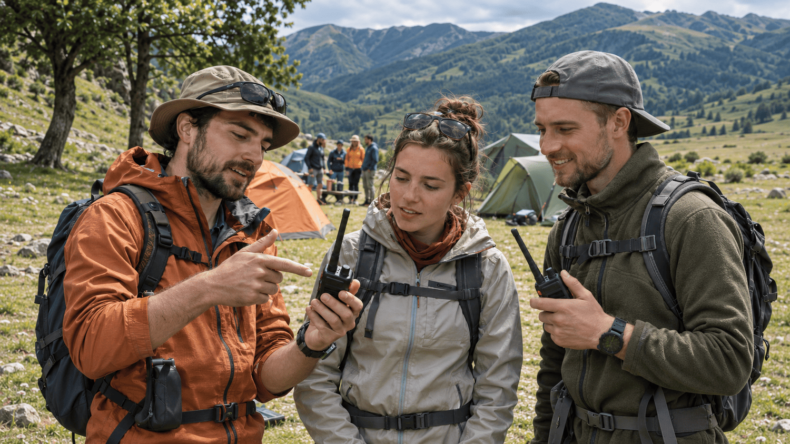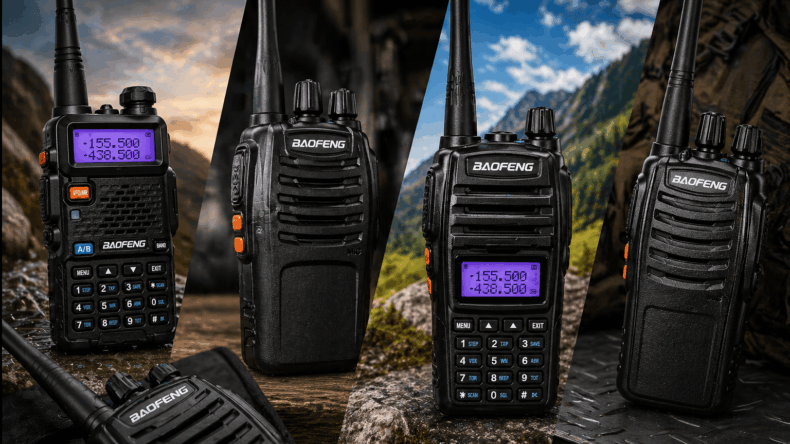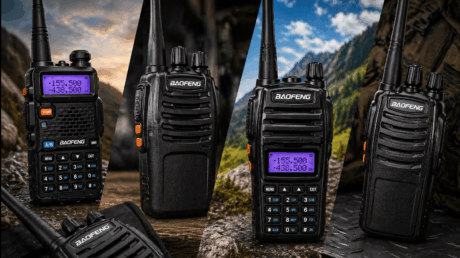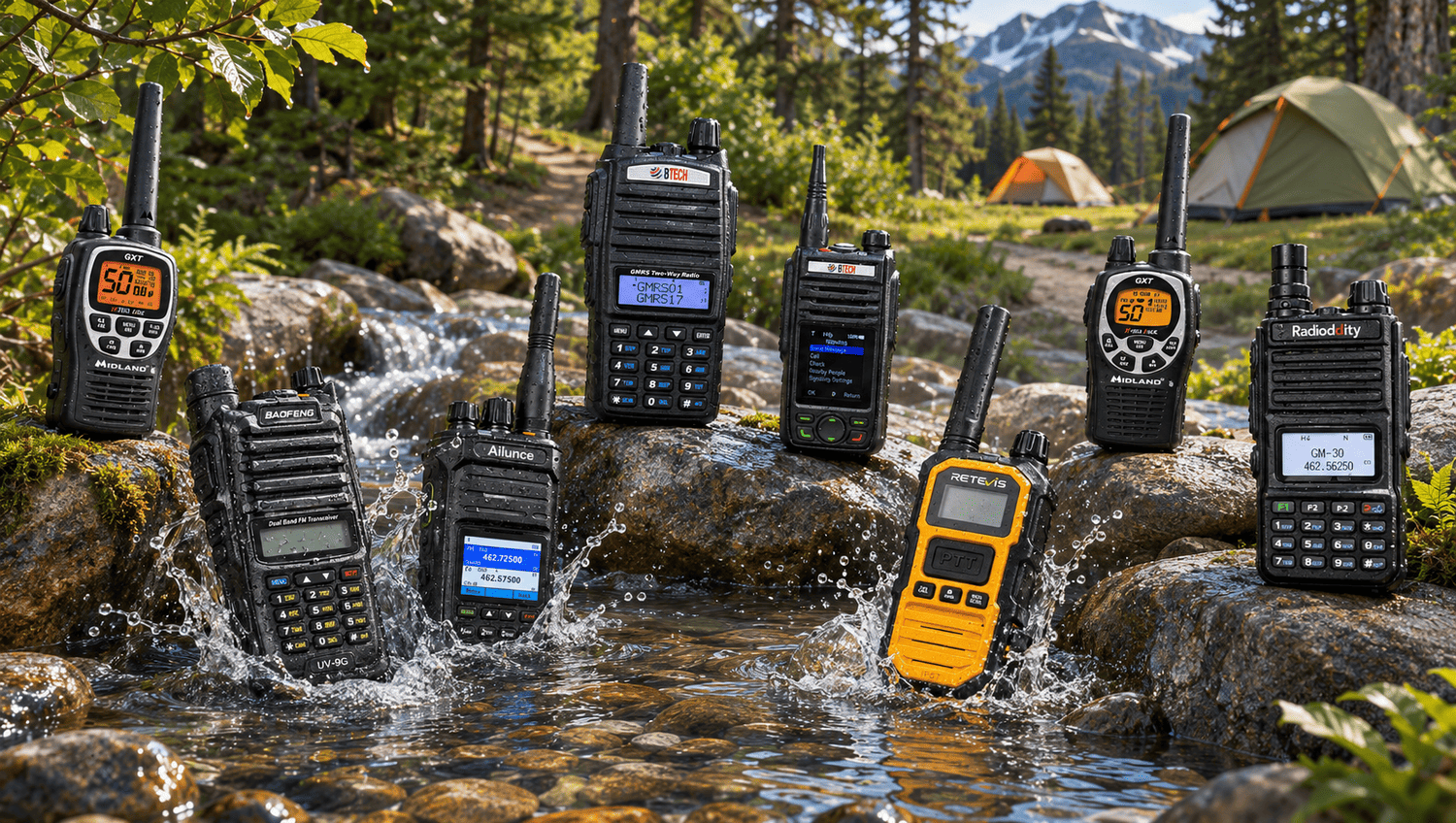
For many families looking for the best GMRS handheld radios, the Midland GXT3000 is a practical place to start: it comes as a pair and supports both direct communication and GMRS repeaters. Choose the Retevis Ailunce HA1G if you want a more configurable radio with IP67 protection, or the BTECH GMRS-PRO if GPS location sharing and phone-assisted setup matter to you. Every GMRS radio in this guide requires an appropriate FCC license for transmission.
- For family road trips: Midland GXT3000.
- For a configurable outdoor radio: Retevis Ailunce HA1G.
- For GPS and app-connected features: BTECH GMRS-PRO.
- For every model: check the exact package and current offer before buying.
- Check whether the offer includes one radio or a complete set.
- Decide whether you need repeater access and protection from water.
- Plan licensing, charging and a common channel for your group.
Shop GMRS handheld radios on:

- ✓ Compare radio kits
- ✓ Check the exact version
- ✓ View current offers
As an Amazon Associate, we earn from qualifying purchases at no extra cost to you.
Compare the best GMRS handheld radios
Compare the features that affect everyday use, from repeater compatibility to charging and waterproofing. Select a model to read its review.
| Category | Best Value for Money | Advanced Features | Premium Options | Budget Options | ||||
|---|---|---|---|---|---|---|---|---|
| Model | 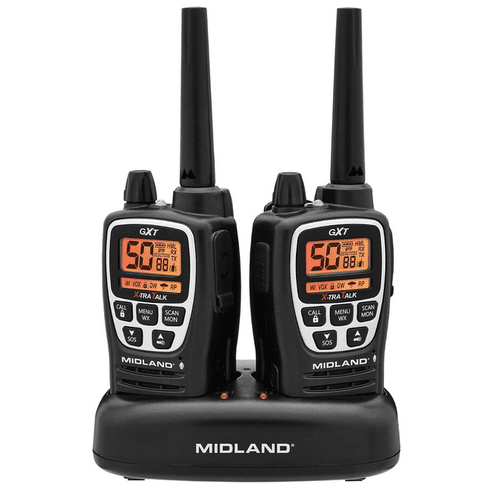 Midland GXT3000 | 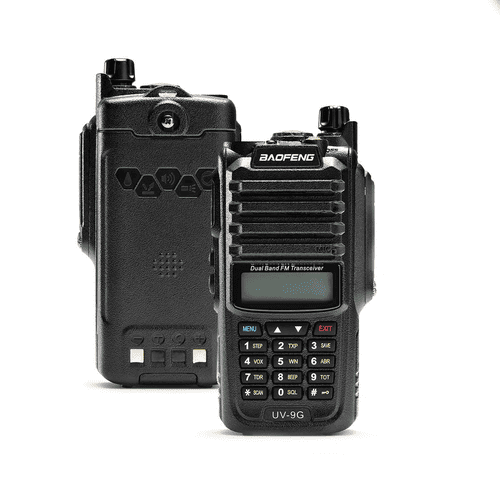 BAOFENG UV-9G | 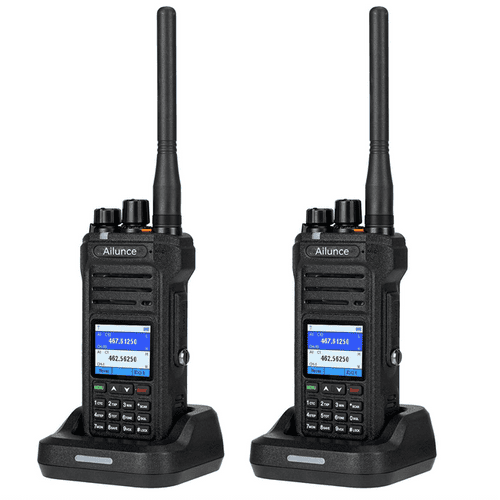 Retevis Ailunce HA1G | 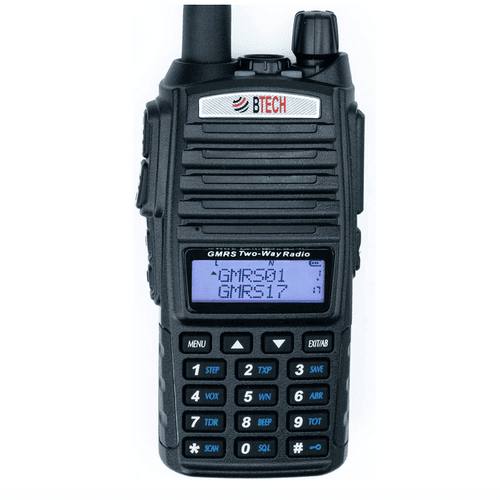 BTECH GMRS-V2 | 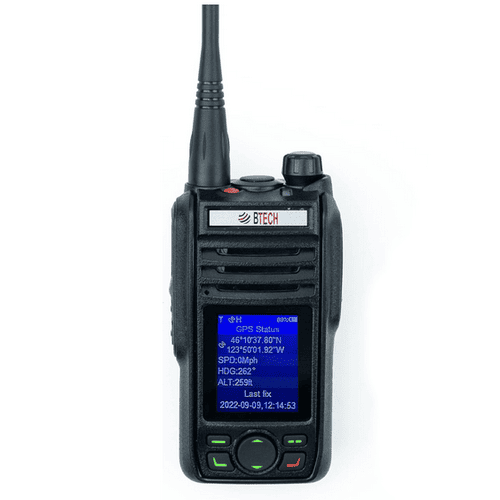 BTECH GMRS-PRO | 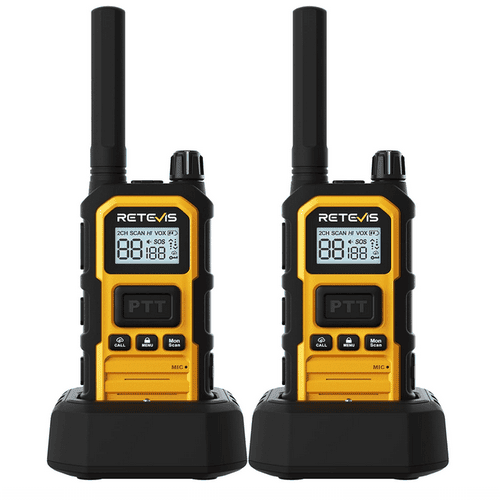 Retevis RB48 Plus | 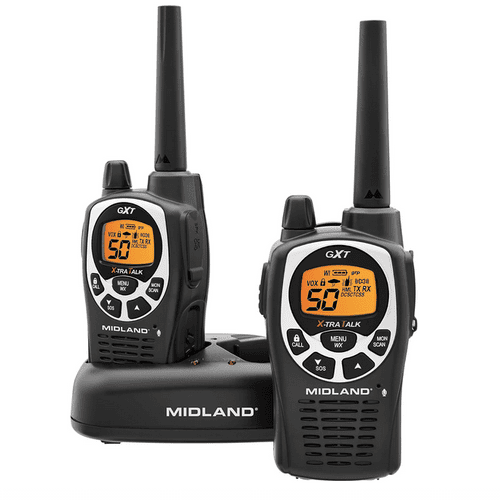 Midland GXT1000VP4 | 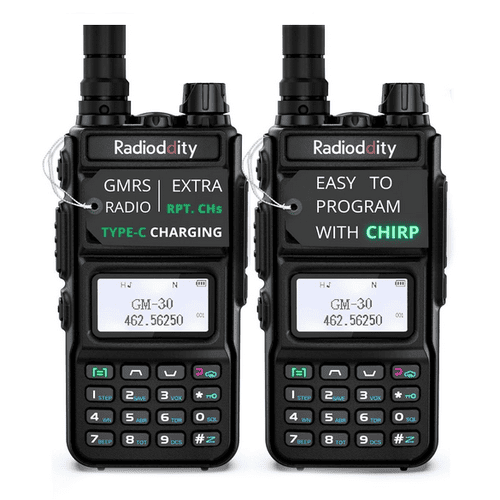 Radioddity GM-30 |
| Radio standard / version | U.S. GMRS | U.S. GMRS | U.S. GMRS | U.S. GMRS | U.S. GMRS | U.S. GMRS | U.S. GMRS | U.S. GMRS |
| License / authorization | GMRS license required | GMRS license required | GMRS license required | GMRS license required | GMRS license required | GMRS license required | GMRS license required | GMRS license required |
| Featured | Family repeater pair | IP67 outdoor pair | Configurable outdoor radio | Custom channel names | GPS location sharing | Large PTT buttons | Simple family pair | USB-C charging |
| Channels / memory | GMRS channels and preset combinations | 30 preset GMRS and repeater channels | 256 memory channels | 200 programmable channels | Programmable memory | GMRS and repeater channels | GMRS channels and preset combinations | 30 preset GMRS and repeater channels; 250 memory channels |
| Repeater support | Yes | Yes | Yes | Yes | Yes | Yes | Not listed | Yes |
| Ready-to-carry weight | N/A | N/A | N/A | N/A | N/A | N/A | N/A | N/A |
| Protection | JIS4 splash resistance | IP67 | IP67 | IP54 | IP67 | IP67 | JIS4 splash resistance | N/A |
| Battery / charging | Rechargeable pack; USB-C charging system | Rechargeable battery | Rechargeable battery; USB-C | Rechargeable battery; USB-C | Rechargeable battery | Rechargeable battery; USB-C or dock | Rechargeable pack or AA batteries | Rechargeable battery; USB-C |
| Main trade-off | Splash-resistant, not submersible | Menu setup takes practice | More setup than a basic pair | Less water protection than IP67 models | Advanced functions cost more | Bulky design and large pack option | No listed repeater support | Water-resistance rating not verified |
| Price & Offer | $$ | $ | $ | $ | $$ | $ | $ | $ |
Quick picks by use case
Start with the way you expect to use your radios.
Licensing & legal use
Who needs a GMRS license?
In the United States, a valid individual GMRS license is required to operate a GMRS station. The license holder may allow eligible immediate family members to operate the holder’s stations under FCC rules. Friends do not become covered simply because they travel with the license holder: check each participant’s authorization before a trip.
“A valid individual license is required to operate a GMRS station.”
47 CFR § 95.1705, Individual licenses required; eligibility; who may operate; cooperative use.
Look for FCC equipment authorization for GMRS under Part 95E on the exact radio and version. FCC certification of one model does not automatically apply to a similarly named amateur radio. A radio’s ability to receive a frequency also does not give its owner permission to transmit there.
FRS radios can communicate with GMRS radios on shared channels when compatible settings are used, but the two services have different equipment and licensing rules. Amateur radio has its own operator licensing and operating rules. Before using a radio outside the United States, check the destination’s rules separately.
How we selected and evaluated these radios
We selected eight U.S. GMRS handhelds for different needs: simple family communication, camping, repeater use and more configurable off-grid communication. The list includes single-radio and multi-radio offers, so check the selected package before comparing prices.
- Ease of use: Can a group choose a channel without extensive setup?
- Repeater support: Can the radio use repeater channels when access is available?
- Weather protection: Is the stated rating suitable for the intended activity?
- Power: How does the radio charge, and can a spare battery be carried?
- Control: Are programmable channels and display options useful for the buyer?
- Package: Does the offer include enough radios and the accessories needed?
This is a comparison of published manufacturer information, manuals and product listings. We did not perform independent bench testing or field tests for this guide. Receiver performance, audio quality and real-world range can vary with conditions; published specifications alone do not establish a winner in those areas.
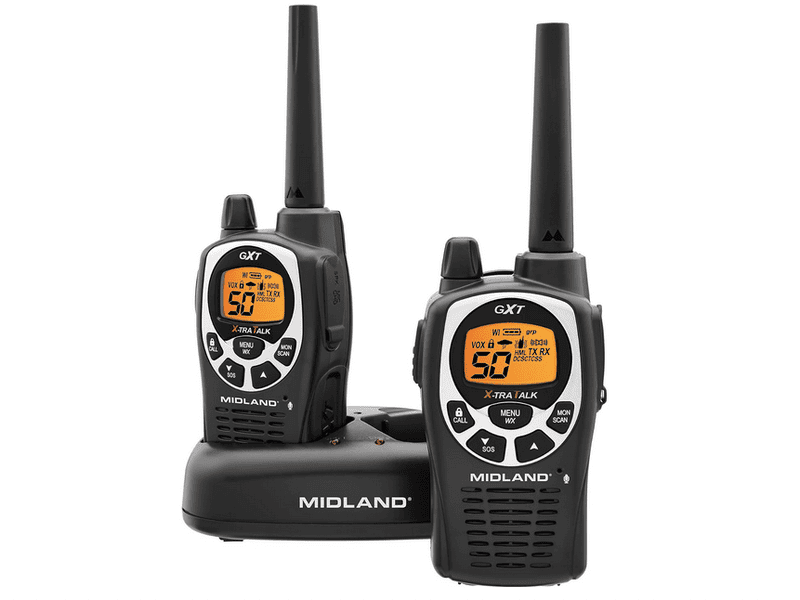
Midland GXT3000
The GXT3000 combines a familiar walkie-talkie layout with repeater access, making it a useful starting point for families who want room to grow beyond direct radio-to-radio calls.
Why We Selected It
The GXT3000 is sold as a ready-made pair and includes rechargeable batteries and a charging system. Repeater channels offer another option when a usable repeater is available and its settings are known. NOAA weather alerts add a way to monitor relevant broadcasts, although reception depends on coverage. JIS4 protection is intended for splashes rather than immersion.
- A paired kit gives two family members matching controls and charging accessories for road trips.
- Repeater support can be useful when a local repeater is accessible and its operator permits use.
- Weather alerts add monitoring capability, but the radio is not a substitute for a dedicated emergency plan.
Families who want two matching radios for camping and occasional repeater use without starting with a highly technical interface.
Buyers who expect frequent immersion or want a radio with GPS location sharing.
Our Verdict
Choose the GXT3000 over the GXT1000VP4 if repeater access matters. It offers a straightforward pair for family use, but its splash resistance is a meaningful limit near water. Compare the actual kit price with the UV-9G pair if IP67 protection is more important than a familiar family-radio layout.
PROs
- Two matching radios
- Repeater capable
- NOAA weather alerts
CONs
- JIS4 is splash resistance
- Repeater coverage is not guaranteed
Based on Midland’s GXT3000 specification sheet and the identified two-radio listing. Check the selected package and its current availability. The JIS4 rating does not apply in the same way when accessories are connected.
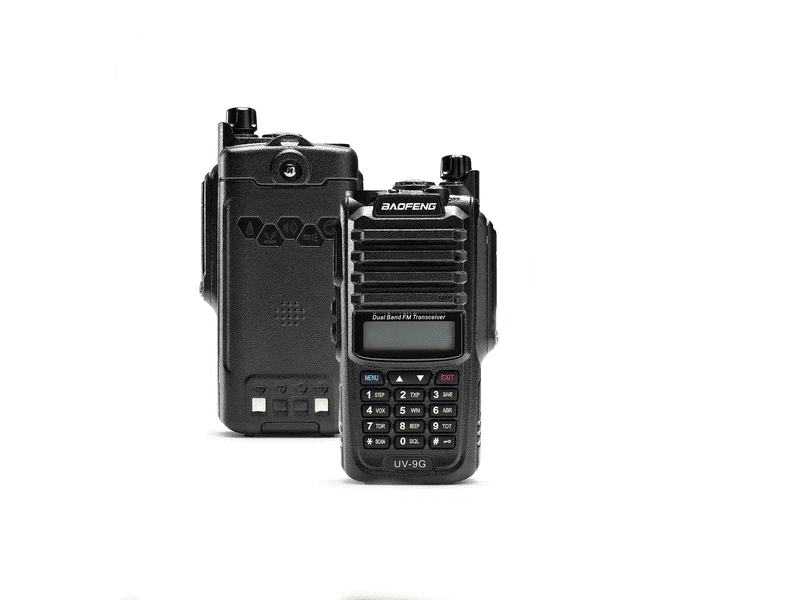
BAOFENG UV-9G
The UV-9G is a GMRS-specific handheld for buyers who want repeater capability and a stated IP67 rating for wet or dusty outdoor conditions.
Why We Selected It
The UV-9G gives outdoor buyers a stated IP67 rating and preset GMRS and repeater channels. The identified offer contains two radios and additional accessories, including a programming cable. Its display and menus provide more settings than a simple family pair, but everyone in the group should practice changing channels and tones before leaving.
- IP67 dustproofing and waterproofing offer a useful specification for camping in wet conditions.
- Preset repeater channels provide a starting point for configuring an accessible GMRS repeater.
- A two-radio offer makes it possible to equip two people, provided each operator is authorized.
Campers and off-road travelers who prefer a pair with a stated immersion rating and are comfortable learning a menu.
Someone who wants the simplest controls or needs GPS messaging between compatible radios.
Our Verdict
Choose the UV-9G when water protection is a priority; choose the GXT3000 when a family-oriented pair and simpler presentation matter more. A longer accessory antenna is not proof of better real-world range, and the included accessories should be checked against the exact offer.
PROs
- Stated IP67 rating
- Repeater channels
- NOAA reception
CONs
- Menu requires practice
- Protection depends on proper assembly
The manufacturer identifies the UV-9G as a GMRS model. Check the exact radio label and listing; do not assume similarly named UV-series amateur models have the same authorization.
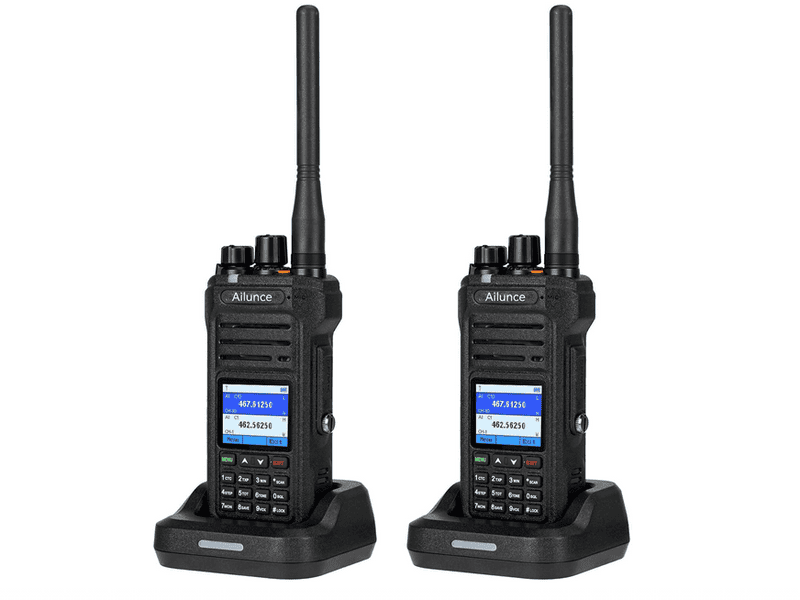
Retevis Ailunce HA1G
The HA1G suits outdoor users who want a display, configurable channels and repeater access in a radio with a stated IP67 rating.
Why We Selected It
The HA1G combines an outdoor-oriented body with a screen and programmable memory. Its repeater capability and NOAA reception make it relevant for overlanding or camping where a group wants more control over its setup. That flexibility is useful only if users spend time learning the menu and checking the channels used by the rest of the group.
- The screen makes it easier to check the selected channel and radio settings before transmitting.
- USB-C charging adds a convenient option when compatible power is available during a trip.
- IP67 protection addresses dust and water exposure under the manufacturer’s stated conditions.
Users who want a configurable outdoor handheld and are prepared to learn its channel and repeater settings.
Groups that need the fewest possible controls or want a complete pair without checking package options.
Our Verdict
The HA1G is a strong fit when the display and configuration options are worth learning. Compared with the RB48 Plus, it favors a more conventional programmable-radio interface rather than oversized push-to-talk controls. Check whether the selected Amazon offer contains one radio or a set.
PROs
- Stated IP67 protection
- Display and programmable memory
- Repeater capable
CONs
- Setup takes practice
- Package options vary
Based on Retevis’s HA1G product information and the identified Amazon listing. Verify the selected package and availability; no independent field test was performed for this comparison.
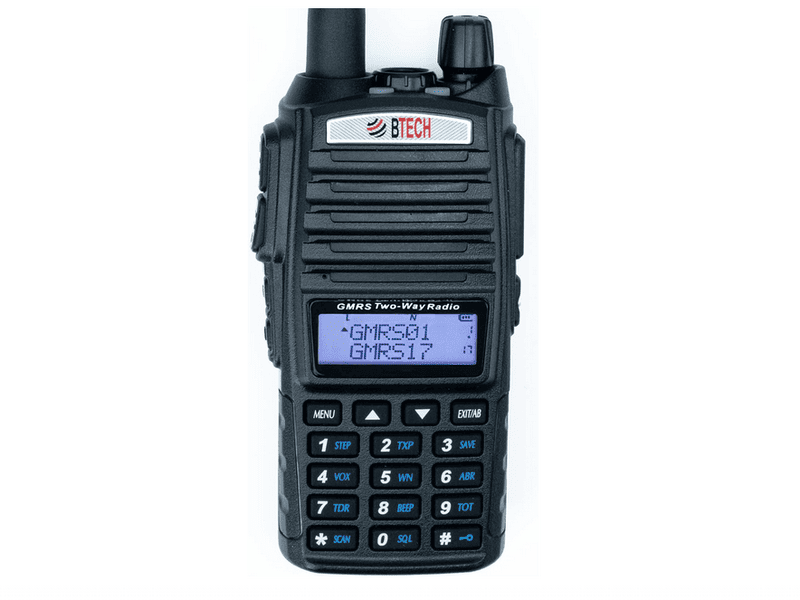
BTECH GMRS-V2
The GMRS-V2 is a flexible handheld for people who want to organize channels, configure repeaters and listen beyond the GMRS band.
Why We Selected It
The GMRS-V2 supports 200 programmable channels and custom channel names, which can make a more complex setup easier to navigate. Its VHF/UHF scanner adds receive options beyond GMRS. Those additional frequencies are for listening where permitted; they are not a license to transmit outside the radio’s authorized service.
- Channel names can help distinguish a local repeater from the simplex channels used by your group.
- USB-C charging adds flexibility when a suitable charging source is available.
- Scanner reception and GMRS transmission serve different purposes and should be configured accordingly.
Users who want to customize a radio plan and listen to additional frequencies without carrying a separate receiver.
Buyers who need submersion protection or want advanced GPS location features.
Our Verdict
Compared with the BTECH GMRS-PRO, the GMRS-V2 emphasizes conventional channel organization and scanning. Its IP54 rating provides a different level of protection from the IP67 models in this comparison. Choose it when customizable memories matter more than GPS sharing or immersion resistance.
PROs
- Customizable channel names
- Repeater support
- VHF/UHF scanning receiver
CONs
- Not rated IP67
- Configuration takes time
BTECH’s specifications and the GMRS-V2 listing identify the features above. The GMRS-V2 is distinct from similarly named mobile radios and from the GMRS-PRO.
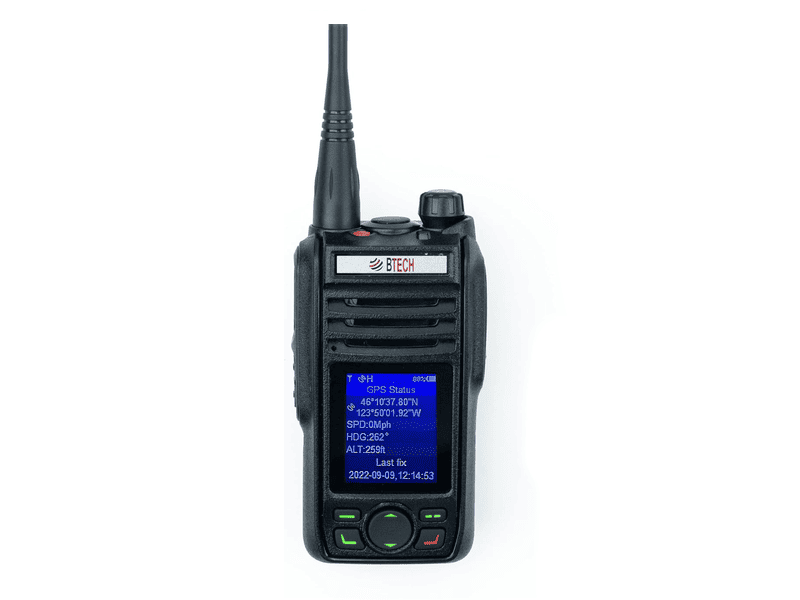
BTECH GMRS-PRO
The GMRS-PRO adds GPS, Bluetooth and supported text and location functions to a repeater-capable GMRS handheld with a stated IP67 rating.
Why We Selected It
Buyers who want more than voice can consider the GMRS-PRO’s GPS and compatible messaging features. Bluetooth and the companion app support setup and additional functions. Standard GMRS voice communication remains useful with compatible radios, but advanced messaging and location features depend on supported equipment and configuration; they are not universal across all GMRS walkie-talkies.
- GPS location sharing can help compatible users exchange position information within radio coverage.
- App-assisted setup provides an alternative to managing every setting on the radio itself.
- IP67 protection is useful for outdoor exposure when the radio is properly assembled.
Users who value compatible GPS and messaging functions and are willing to configure the app and participating radios.
Buyers who only need simple voice communication or expect GPS messages to work with every GMRS radio.
Our Verdict
The GMRS-PRO offers a different reason to spend more than the GMRS-V2: connected features and location sharing. Those features cannot overcome terrain or replace a satellite emergency device. Check that the other radios and phones in your group support the functions you intend to use.
PROs
- GPS and compatible messaging
- Bluetooth and app support
- Stated IP67 rating
CONs
- Advanced features need compatible equipment
- More complex setup
Based on BTECH’s GMRS-PRO product information and its identified Amazon listing. Advanced data functions should be used according to the manual and applicable FCC rules.
Retevis RB48 Plus
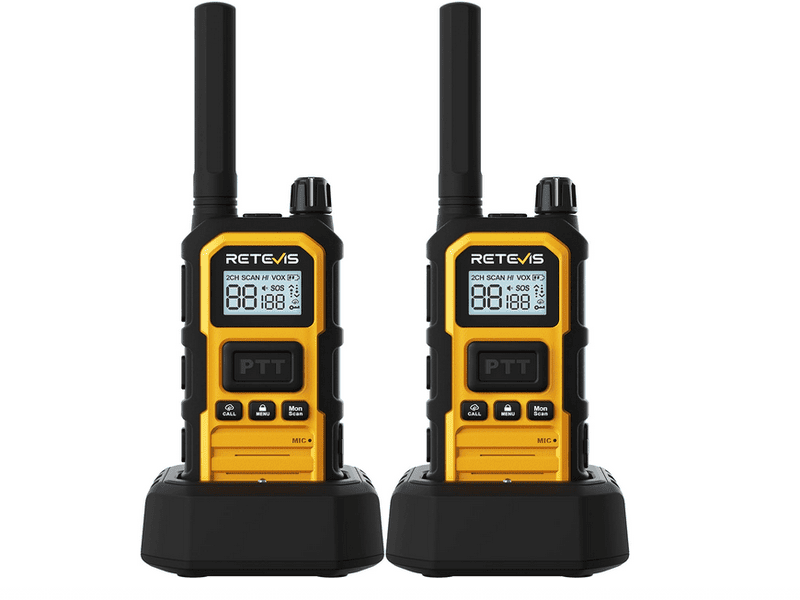
The RB48 Plus is a GMRS handheld with large push-to-talk controls, a stated IP67 rating and repeater capability for users who prioritize a substantial outdoor body.
Why We Selected It
Retevis describes the RB48 Plus as a heavy-duty GMRS radio with front and side PTT buttons. That control layout is worth considering for gloved outdoor use, although fit and ease of use depend on the gloves. The manufacturer also lists repeater capability, a display and USB-C or charging-dock options.
- Large tactile buttons give the user more surface area to locate the transmit control.
- A stated IP67 rating supports its role as an outdoor radio exposed to dust and water.
- Repeater capability adds flexibility when a suitable GMRS repeater is within reach.
Outdoor users who prefer large controls and a substantial body for activities involving gloves or rough handling.
Buyers looking for the smallest possible radio or who do not need the number of units in the selected pack.
Our Verdict
The RB48 Plus earns consideration for its controls and stated protection, not simply because a larger pack may cost more. The HA1G is a better fit if a conventional display-and-keypad layout is your priority. The identified Amazon listing is a four-radio offer, so confirm that quantity before ordering.
PROs
- Large PTT controls
- Stated IP67 rating
- Repeater capable
CONs
- Larger body than some alternatives
- Selected offer contains four radios
Features are based on the RB48 Plus manufacturer page and the identified four-radio listing. Manufacturer durability claims were not independently tested for this guide.
Midland GXT1000VP4
The GXT1000VP4 is a family-oriented GMRS pair for straightforward direct communication, with weather monitoring and an alternative AA battery option.
Why We Selected It
A familiar display and a matched pair make this Midland suitable for families who mainly need direct calls. It receives NOAA weather channels and can use the supplied rechargeable battery packs or appropriate AA batteries. Its JIS4 rating addresses splashes, and repeater operation is not listed for this model.
- Matching radios help a family practice a common channel before leaving home.
- The AA option offers an additional power choice when recharging is inconvenient.
- Weather reception adds information when a NOAA transmitter is within receiving range.
Families who primarily need direct communication and prefer a familiar pair over extensive programming features.
Users who need repeater access or protection against immersion in water.
Our Verdict
The GXT1000VP4 is worth comparing with the GXT3000 if direct communication is your main goal. The GXT3000 adds repeater support; the older model’s AA option may appeal to buyers planning backup power. Check the actual price of each pair rather than assuming the older radio is always cheaper.
PROs
- Familiar family-radio layout
- NOAA reception
- AA backup option
CONs
- No listed repeater support
- Splash resistance only
Based on Midland’s GXT1000 series documentation. The identified Amazon card could not be fully checked for current availability, so verify the exact offer and model label.
Radioddity GM-30
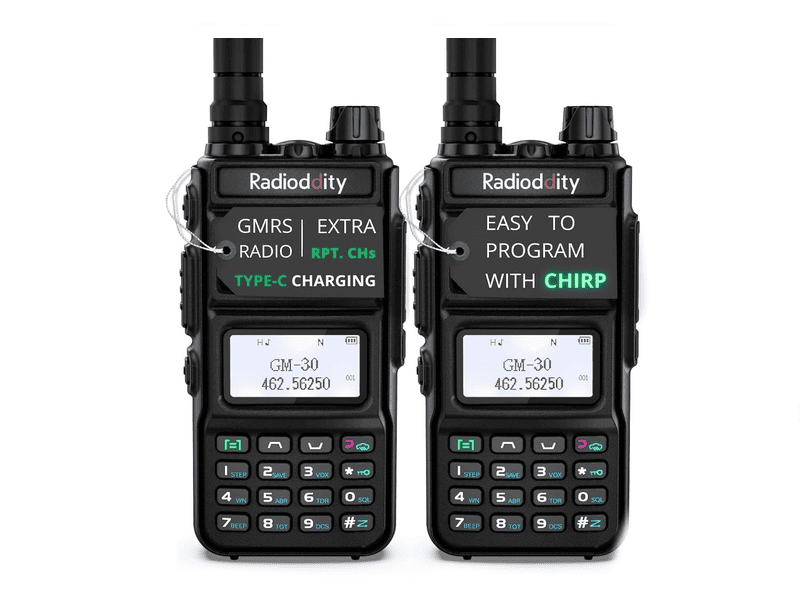
The GM-30 is a configurable GMRS handheld for buyers interested in repeater channels, a display and USB-C charging without paying for GPS functions.
Why We Selected It
Radioddity lists 30 preset GMRS and repeater channels plus programmable memory. The radio can also receive NOAA and scan other supported frequencies. That combination makes it useful for learning a radio plan, but the number of memory slots is not the number of independent GMRS frequencies, and the extra receive bands do not grant transmission rights.
- Preset repeater channels provide a starting point for entering an accessible repeater’s settings.
- USB-C charging provides another way to recharge when a suitable power source is available.
- The display helps users inspect channel information during setup and use.
Buyers who want to learn basic repeater and channel setup and do not need GPS messaging.
Users who require a verified IP67 rating or a fully configured family pair with minimal setup.
Our Verdict
Compare the GM-30 with the GMRS-V2 if programmable channels and scanning matter to you. The right choice depends on the available package and settings you prefer. Check software support for the exact hardware and firmware: compatibility claims do not guarantee that every combination will work without troubleshooting.
PROs
- Preset repeater channels
- NOAA reception
- USB-C charging
CONs
- Water rating not verified
- Programming compatibility can vary
This is the GM-30, not the GM-30 Plus or Pro. Manufacturer information supports the main features; verify the current Amazon offer and exact firmware before relying on software compatibility.
How to choose GMRS handheld radios
The best choice depends on the people you need to reach, the terrain and how much setup your group is willing to do.
Start with the people and the package
For family communication, a pair of matching two-way radios can simplify training and charging. Check whether an offer contains one, two or more radios, and compare the complete cost of equipping everyone. A belt clip and charging dock may be useful, but included accessories vary by package. Friends and other participants must also have the appropriate authorization to transmit.
Choose direct communication or repeater access
Simplex channels connect radios directly. Repeater channels use different transmit and receive frequencies to access a repeater, which may improve coverage when both parties can reach it. Repeater compatibility alone does not guarantee coverage, permission to use a particular repeater or correct settings. Some systems require specific CTCSS tones or split tones; obtain those settings from the repeater operator.
Look beyond the advertised power
Transmitter output and effective radiated power describe different measurements. More watts do not guarantee a particular transmission range or double it. Antenna position, terrain, obstructions and receiver performance matter. A roof-mounted antenna with an NMO mount may suit compatible GMRS mobile radios in a vehicle, but it is a separate installation and should be selected for the radio and applicable rules.
For a handheld, an antenna upgrade is not automatically an improvement. Before buying an aftermarket antenna or whip antenna, check its frequency, connector and manufacturer guidance. An SMA connector alone does not prove a safe mechanical fit. Follow the radio’s equipment authorization and instructions, especially for models with data features.
Match protection to the trip
For camping and backcountry use, compare waterproofing and dustproofing with the conditions you expect. IP67 and JIS4 describe different levels of protection; a splash-resistant body is not equivalent to a submersible one. Inspect covers and seals, and check how connected accessories affect the rating. A shatterproof screen or rugged construction claim should be checked against the manufacturer’s documentation rather than assumed from appearance.
Plan power for the whole trip
Battery capacity alone does not establish battery life. Screen use, transmission time, temperature and settings all matter. For a multi-day battery plan, consider spare batteries, a compatible power bank and the time needed for USB-C charging. Cold-weather performance varies, so protect spare batteries and follow the manufacturer’s temperature guidance rather than assuming a published runtime applies in freezing conditions.
Decide how much configuration you need
Pre-programmed channels simplify the first call; programmable channels and channel names help organize a more involved plan. A programming cable and programming software can make some changes easier, but verify CHIRP compatibility for the exact model and firmware. Frequency copying and wireless cloning are model-specific conveniences, not permission to transmit on copied frequencies.
A dual-channel display or dual receive setting may help monitor more than one channel, but terminology differs between manufacturers and does not necessarily mean simultaneous independent reception. Check priority scanning and scan speed if those functions are essential; do not assume every model here offers them.
Check the features you will actually use
NOAA weather channels and weather alerts are useful only where broadcasts can be received and the relevant alert function is supported. A VHF/UHF scanner or wideband receive can add listening options, while GPS location sharing and group calling require compatible equipment and settings. Squelch can reduce unwanted noise between calls, but CTCSS tones do not encrypt conversations.
Finally, consider size and weight, push-to-talk placement, build quality and charging logistics together. For off-roading and overlanding, try the controls from the driver’s or passenger’s normal position while parked before depending on them during a trip.
Real-world range and communication limits
Hills, dense forest, buildings and a radio carried low against the body can all reduce coverage. An open route with clear line of sight may perform very differently from a valley or urban street.
Published maximum-range figures are not a substitute for testing your own route. A repeater can help only if your radios can reach it and you have the right settings and permission. For emergency preparedness and survival kits, add a separate way to request help when local radio communication is unavailable.
Before your first trip
Check your GMRS license, who may use your station and the FCC identification on each radio.
Choose a primary and backup channel, then match any CTCSS settings. Privacy codes do not make a conversation private.
Charge the radios, pack suitable spares and verify the charging cable and power source.
Test the push-to-talk controls, audio and communication plan in the conditions where the group expects to use them.
What to avoid
- Buying an amateur-radio version because it looks like a GMRS model. Check the exact FCC ID and service authorization.
- Assuming every channel number means the same frequency on every radio. Verify the frequency and tone settings.
- Counting memory slots or channel-and-tone combinations as new GMRS frequencies.
- Choosing a radio solely by a maximum range claim, battery capacity or number of watts.
- Assuming a repeater is open to your group or that a waterproof rating applies with every accessory attached.
Special cases & common questions
Can GMRS radios communicate with FRS walkie-talkies?
Yes, compatible radios can communicate on shared frequencies when channel and tone settings match. Each radio remains subject to the rules for its own service, and GMRS transmission requires the appropriate license.
Do privacy codes keep conversations private?
No. CTCSS and similar tones control when a receiver opens its audio; they do not encrypt a conversation. Other users on the same frequency may still hear your transmission.
Does GPS work without a cellular signal?
A radio can determine a position from satellite signals without cellular coverage when its GPS receiver has a suitable view of the sky. Sharing that position with another user still requires compatible devices, settings and a usable radio path.
Should I measure a new antenna with an SWR meter?
Measurement can be useful when selecting a compatible antenna system, especially on a vehicle. Use equipment rated for the frequency and power, follow the manufacturer’s instructions and do not modify a radio contrary to its authorization.
What does a proper radio power measurement require?
A technician may use suitable test equipment and a dummy load to measure output without radiating a test signal. Checking spurious emissions and other compliance characteristics requires appropriate calibrated equipment and procedures; a simple wattmeter reading does not establish compliance.
Final recommendation
For a family that wants a ready-made pair with repeater capability, start with the Midland GXT3000. Choose the BAOFENG UV-9G when a stated IP67 rating is more important, or consider the BTECH GMRS-PRO if compatible GPS and messaging features justify the extra complexity. Before ordering any GMRS 2 way radios, confirm the exact offer, number of units, license arrangements and the communication plan for your group.
Back to comparison