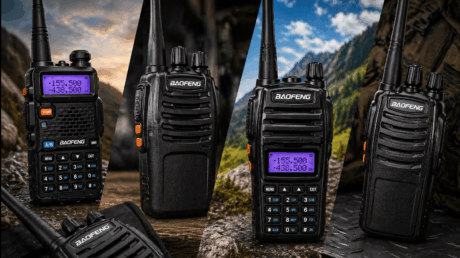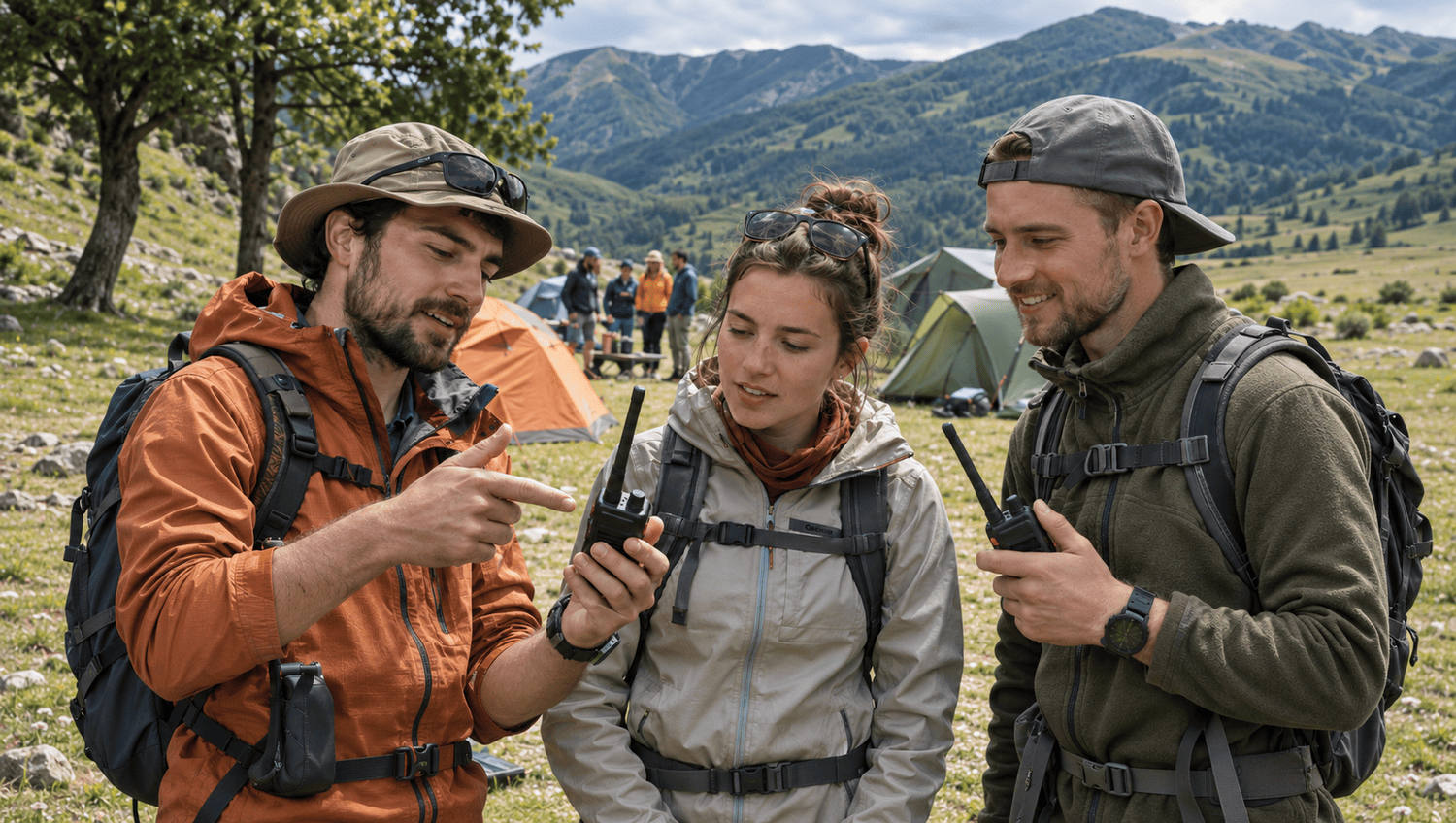
The BTECH GMRS-V2 is our starting recommendation for long range walkie talkies: it combines repeater capability, a removable antenna, and a relatively accessible price. Choose the Rocky Talkie Expedition Radio for a simpler, waterproof outdoor setup, or the Rocky Talkie Mountain Radio when your group needs license-free operation. The important distinction is how you will communicate. Direct radio-to-radio coverage depends heavily on terrain, antenna position, and interference; repeater coverage also depends on an available, accessible repeater. No handheld in this comparison guarantees communication across a mountain, through dense woodland, or over the mileage printed on its packaging.
- Practical GMRS value: BTECH GMRS-V2.
- Waterproof outdoor GMRS: Rocky Talkie Expedition Radio.
- Simple, license-free hiking: Rocky Talkie Mountain Radio.
- Main trade-off: more transmitter power cannot remove terrain barriers.
- Decide whether every operator can legally use GMRS.
- Check terrain and repeater access before comparing advertised miles.
- Plan charging, spare power, and water protection for the whole group.
LONG-RANGE WALKIE-TALKIES ON

- ✓ Compare radio kits
- ✓ Check the exact version
- ✓ View current offers
As an Amazon Associate, we earn from qualifying purchases at no extra cost to you.
Quick Comparison: Six Long-Range Walkie-Talkies
Compare radio service, repeater support, protection, and power arrangements first. Published specifications describe capabilities; they do not establish a measured range advantage between these models.
| Category | Best Value for Money | Advanced Features | Premium Options | Budget Options | ||
|---|---|---|---|---|---|---|
| Model | 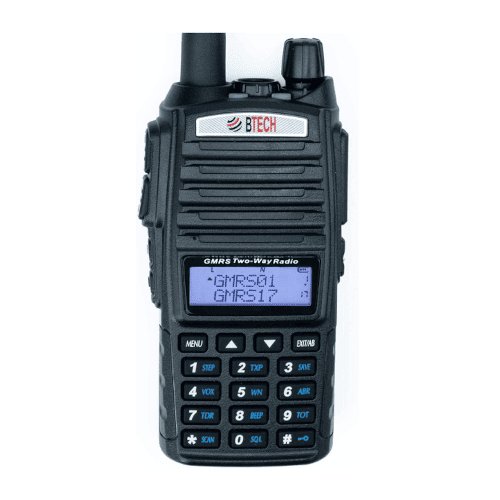 BTECH GMRS-V2 | 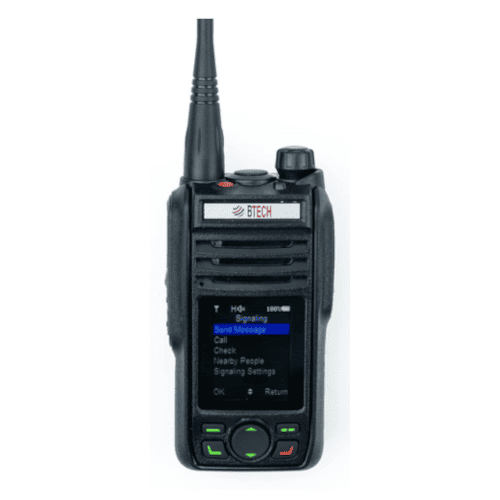 BTECH GMRS-PRO | 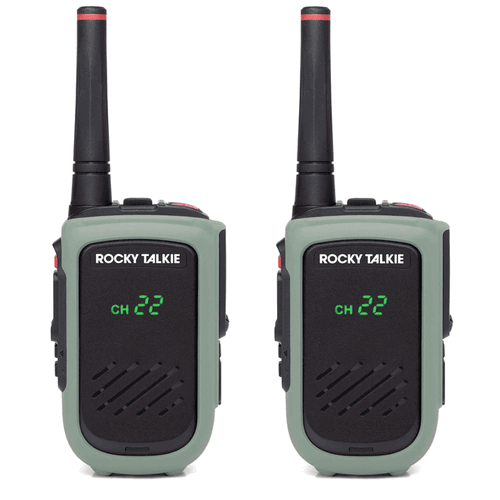 Rocky Talkie Expedition Radio | 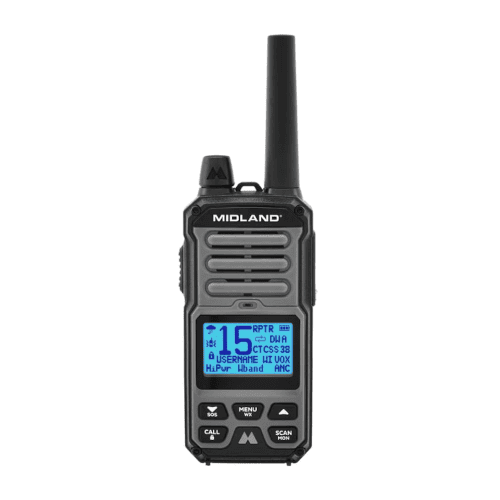 Midland GXT67 PRO | 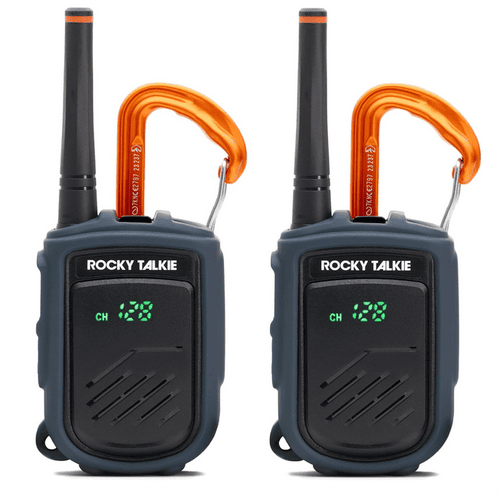 Rocky Talkie Mountain Radio | 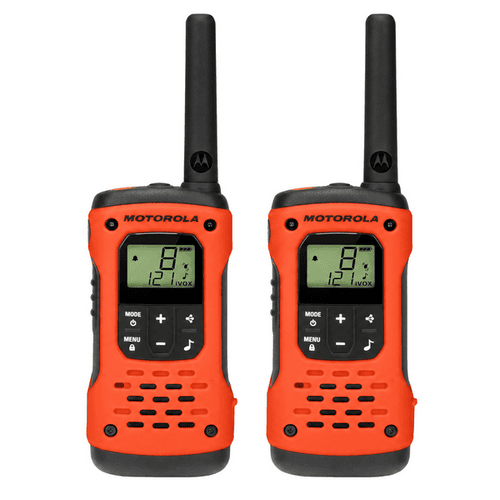 Motorola T605 H2O |
| Radio standard / version | US GMRS | US GMRS | US GMRS, 5 Watt | US GMRS, GXT67 PRO | US FRS | US FRS, orange T605 H2O |
| License / authorization | GMRS license required | GMRS license required | GMRS license required | GMRS license required | No individual FRS license | No individual FRS license |
| Featured | Removable antenna | GPS location sharing | Waterproof repeater access | Configurable repeater channels | Secure carabiner attachment | Floating design |
| Channels / memory | 200 memories; includes GMRS, weather, and receive-only entries | 6 banks of 30 memories; 180 total | 22 shared channels + 8 repeater channels; NOAA receive channels | 22 shared channels; 8 repeater channels; preset and user entries | 22 FRS frequencies; additional preset channel/code combinations | 22 FRS channels; 121 codes per channel |
| Published transmit power | Up to 5 W; channel restrictions apply | Up to 5 W; channel restrictions apply | Up to 5 W; channel restrictions apply | Up to 5 W; channel restrictions apply | Up to 2 W; channel restrictions apply | N/A for exact channel-by-channel output |
| GMRS repeater access | Yes | Yes | Yes | Yes | No | No |
| Ready-to-carry weight | N/A: published weight basis unclear | N/A: complete configuration not verified | 9.1 oz, manufacturer figure | N/A | 6.1 oz, manufacturer figure | 8.0 oz with batteries, manufacturer figure |
| Protection | IP54 | IP67 | IP67 | IP67 | IP56; not submersible | IP67; floats with supplied NiMH battery |
| Battery / charging | Replaceable Li-ion; USB-C and desktop charger | 2600 mAh Li-ion; USB-C battery charging | Replaceable 1800 mAh Li-ion; USB-C | Internal rechargeable battery; charging dock | Replaceable 1550 mAh Li-ion; USB-C | NiMH pack or 3 AA cells; USB-C charging |
| Main trade-off | Menu setup; splash protection only | Added cost and setup complexity | Premium price for a simpler interface | Fixed antenna; battery not user-replaceable | No repeaters; no submersion protection | No repeaters; AA choice can affect buoyancy |
| Price & Offer | $ | $$ | $$$ | $$ | $$ | $ |
Quick Picks by Use Case
Choose the job first, then the interface and power system you can comfortably manage.
Licensing & Legal Use
Choose a service your whole group can use
The BTECH GMRS-V2, BTECH GMRS-PRO, Rocky Talkie Expedition Radio, and Midland GXT67 PRO are GMRS models. Their use requires appropriate GMRS authorization. Under 47 CFR Part 95, Subpart E, an individual license holder may authorize the immediate family members identified in the rules to operate their stations. This does not automatically include unrelated friends joining a camping trip.
A valid individual license is required to operate a GMRS station.
47 CFR § 95.1705, opening provision; family operation is addressed in § 95.1705(c)(2).
The US FRS versions of the Rocky Talkie Mountain Radio and Motorola T605 H2O do not require an individual FRS license when operated within the service rules. They suit group activities where arranging GMRS authorization for unrelated participants would be inconvenient. Operating a GMRS radio on a channel shared with FRS does not turn the equipment into a license-free FRS radio.
FRS requirements appear in 47 CFR Part 95, Subpart B, including channel, power, and antenna restrictions. GMRS requirements appear in Subpart E. Use equipment intended for the selected service; programming a general-purpose amateur radio with matching radio frequencies does not establish GMRS or FRS compliance.
Repeater access also needs preparation: confirm operating settings and the owner’s access conditions. NOAA channels provide weather reception, not a two-way connection to rescuers. For coastal use, these handhelds are not a substitute for appropriate marine communication equipment.
How We Selected and Evaluated These Radios
This shortlist contains six approved US-market handhelds spanning FRS and GMRS. Each offers a distinct buying decision: configurable GMRS value, connected features, protected outdoor GMRS, a sealed Midland design, secure license-free carrying, or a floating family radio. Different pack sizes and colors were not counted as separate models. Selection favored practical outdoor communication over advertised mileage.
- Legal fit: whether the intended operators can use the selected service.
- Communication path: direct operation versus usable GMRS repeater access.
- Antenna arrangement: fixed or removable, with attention to carrying position.
- Power planning: rechargeable battery packs, replacement options, and charging logistics.
- Protection: documented waterproof ratings and practical limits around water.
- Handling: simple controls, attachment systems, and preparation requirements.
- Purchase value: exact version, supplied equipment, and confirmed price where available.
This is a document-based comparison using manufacturer specifications, operating manuals, applicable rules, and identified US listings. We did not conduct field range, receiver, immersion, or battery tests. Real-world performance is therefore discussed through operating conditions and documented capabilities. We do not award a measured range winner, treat owner reviews as controlled experiments, or turn manufacturer battery claims into directly comparable runtime results.
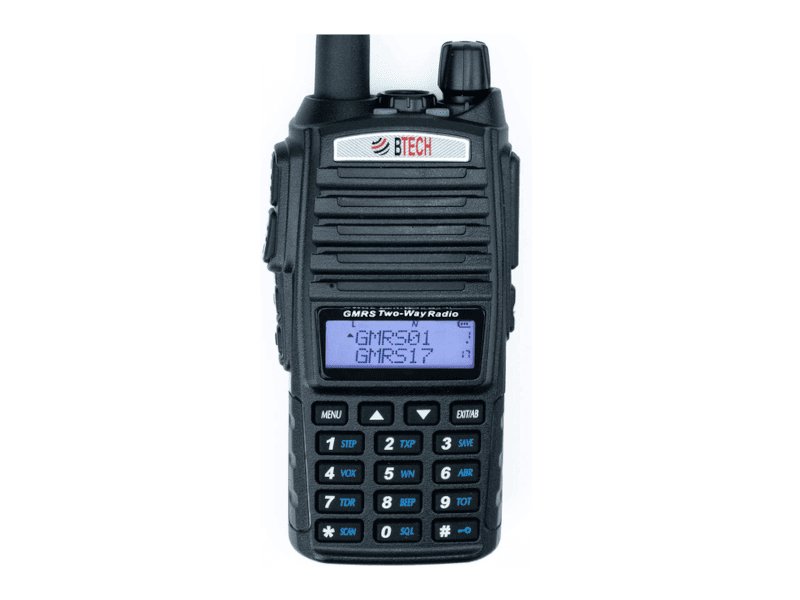
BTECH GMRS-V2
Start with the GMRS-V2 if you want repeater capability and a removable antenna without paying for location sharing or premium waterproofing. Its main investment is learning the settings before your trip.
Why We Selected It
The GMRS-V2 gives a licensed group a useful foundation for both direct voice transmission and repeater operation. Its removable antenna offers flexibility within a suitable GMRS setup, while customizable memories help organize repeaters with different tones. These are more relevant to extending usable coverage than a long list of preset code combinations. The trade-off is a more involved setup process and IP54 protection rather than a submersible enclosure.
- A removable antenna allows a suitable alternative to be fitted, although antenna choice cannot guarantee a range improvement on every route.
- Customizable channel memories help separate local repeaters and direct channels, reducing the need to change several settings during a trip.
- USB-C charging and a supplied desktop charger give you different charging arrangements for a vehicle, campsite, or home base.
Licensed households and interested beginners who will prepare their radios together, check repeater access, and prioritize useful configuration options over a simplified interface or full immersion protection.
Unlicensed groups, paddlers expecting frequent immersion, or users who want to distribute radios with almost no explanation. Consider the Mountain Radio for simpler license-free use.
Our Verdict
Compared with the GMRS-PRO, the GMRS-V2 puts your spending toward conventional radio operation rather than GPS and app-connected features. That makes it our practical starting point when long-distance communication means identifying a workable radio path and possibly using a local repeater. Choose it if you will learn the menus and protect it from immersion. Spending more on the Expedition makes sense when simpler handling and waterproofing matter more than front-panel flexibility; it does not establish that the Expedition will reach farther on the same route.
PROs
- GMRS repeater support
- Removable antenna
- Customizable memories
- Multiple charging arrangements
CONs
- IP54 rather than submersion protection
- More setup than basic FRS models
- GMRS authorization required
Assessment uses BTECH’s GMRS-V2 specifications and identified US listing. VHF and wider UHF scanning are receive-only capabilities, not additional authorized transmission services. No comparative receiver or range testing was performed.
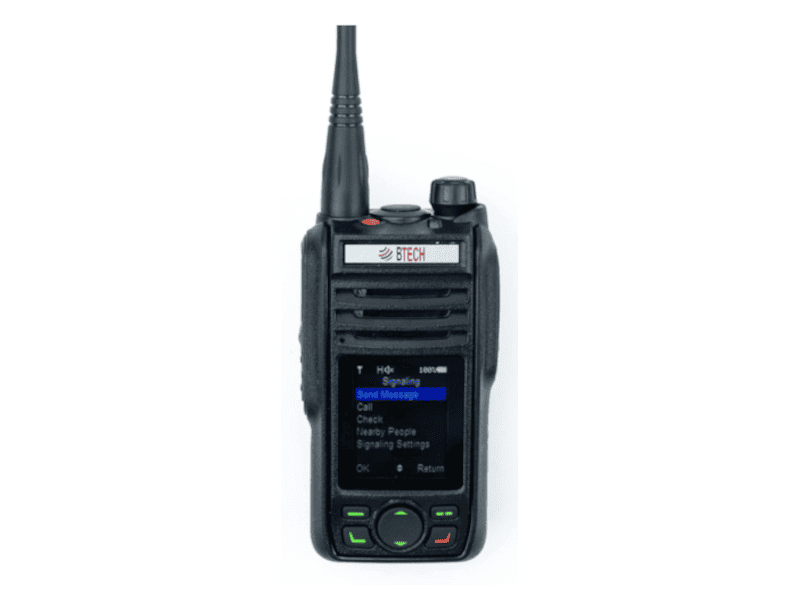
BTECH GMRS-PRO
Choose the GMRS-PRO when compatible location sharing, messages, and Bluetooth features solve a specific group need. Its extra functions add coordination options, not a guaranteed improvement in radio coverage.
Why We Selected It
The GMRS-PRO addresses a different question from a basic walkie-talkie: can your compatible group exchange useful information when describing a location by voice is awkward? Its GPS, messaging, and Bluetooth functions add options for off-grid exploring. IP67 protection also makes the enclosure more suitable for wet conditions than the GMRS-V2’s IP54 housing. However, each advanced function needs compatible equipment and preparation; ordinary FRS radios do not gain those functions simply by sharing a voice channel.
- Compatible location sharing can reduce lengthy verbal directions, provided the group tests the workflow and understands when updates are received.
- App-based configuration offers another way to organize settings, which can help when preparing several radios before a coordinated outing.
- Bluetooth accessory support offers additional audio arrangements, but headset compatibility and practical operation should be checked before leaving home.
Licensed users buying a compatible group setup and willing to practice location sharing, messaging, and app configuration. Particularly relevant when those capabilities will be used regularly.
Buyers who only need occasional push-to-talk communication, or groups expecting every feature to work across unrelated radio brands. The simpler GMRS-V2 may cover their actual needs.
Our Verdict
The GMRS-PRO earns its place through functions the GMRS-V2 does not provide, rather than a documented range advantage. Spend the extra money when compatible data features will improve how your group coordinates. If your priority is handing a wet-weather radio to a partner and keeping operation straightforward, compare the Expedition instead. Before buying several GMRS-PRO units, decide which features everyone will use, confirm accessory compatibility, and practice the complete workflow. A feature that nobody can operate in the field adds little practical value.
PROs
- GPS and compatible location sharing
- Messaging functions
- Bluetooth and app configuration
- IP67 enclosure
CONs
- More preparation and learning
- Higher cost than basic GMRS
- Advanced features need compatible equipment
This is the GMRS-PRO, not the amateur-service UV-PRO. Manufacturer documentation supports the listed functions; data interoperability, accessory performance, and field range were not independently tested for this comparison.
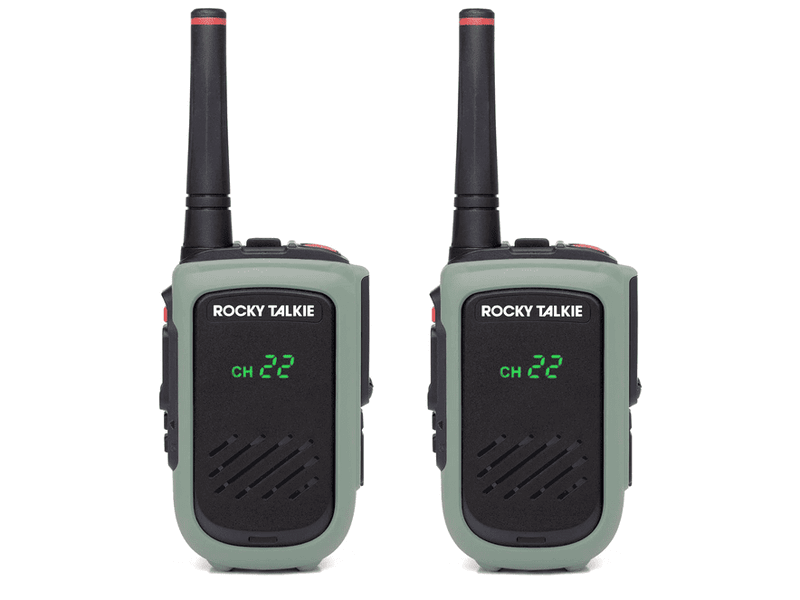
Rocky Talkie Expedition Radio — 5 Watt GMRS
The Expedition combines waterproof construction, repeater access, and a focused outdoor interface. It is the premium choice here for users who prefer straightforward handling over a keypad-driven configuration experience.
Why We Selected It
The Expedition is built around carrying and operating a radio outdoors, with an IP67 enclosure, attachment hardware, a replaceable battery, and GMRS repeater support. That combination makes sense when durability and handling are more important than numerous front-panel settings. Its removable antenna also distinguishes it from the fixed-antenna Midland GXT67 PRO. None of those properties proves superior signal penetration, but they address practical reasons a radio becomes difficult to use on a wet or demanding trip.
- Water protection reduces concern about accidental immersion within the stated limits, provided covers and compatible connections are correctly secured.
- A clip and backup leash provide primary attachment and additional retention, helping keep the radio available during active movement.
- A replaceable battery gives multi-day users another power-planning option, alongside USB-C charging and careful management of transmission time.
Licensed hikers, paddlers, and winter users who prioritize a protected enclosure, secure carrying, and a focused interface. A strong option when several partners need the same manageable setup.
Unlicensed groups or buyers choosing entirely by cost. If immersion protection is unnecessary and you enjoy configuration, the GMRS-V2 offers a less expensive route into repeater-capable operation.
Our Verdict
Choose the Expedition over the GMRS-V2 for its outdoor execution and waterproofing, not because both list different marketing range estimates. Compared with the GXT67 PRO, its replaceable battery and removable antenna provide a different ownership proposition. Those differences matter on repeated trips where power planning and component options are important. The premium is harder to justify for occasional campsite conversation. For regular wet-weather use with appropriate GMRS authorization, however, this is the most straightforward premium recommendation in the approved shortlist.
PROs
- IP67 protection
- GMRS repeater capability
- Replaceable battery
- Removable antenna and backup leash
CONs
- Premium cost
- Heavier than the Mountain Radio
- GMRS authorization required
Specifications refer to the US Expedition 5 Watt GMRS model. Manufacturer battery-life descriptions vary between the product page and manual; no standardized runtime comparison is claimed. Repeater operation requires correct setup and access.
Midland GXT67 PRO
The GXT67 PRO suits buyers who want waterproof GMRS operation and configurable channels in a sealed design. Its fixed antenna and internal battery make it a less flexible choice for component replacement.
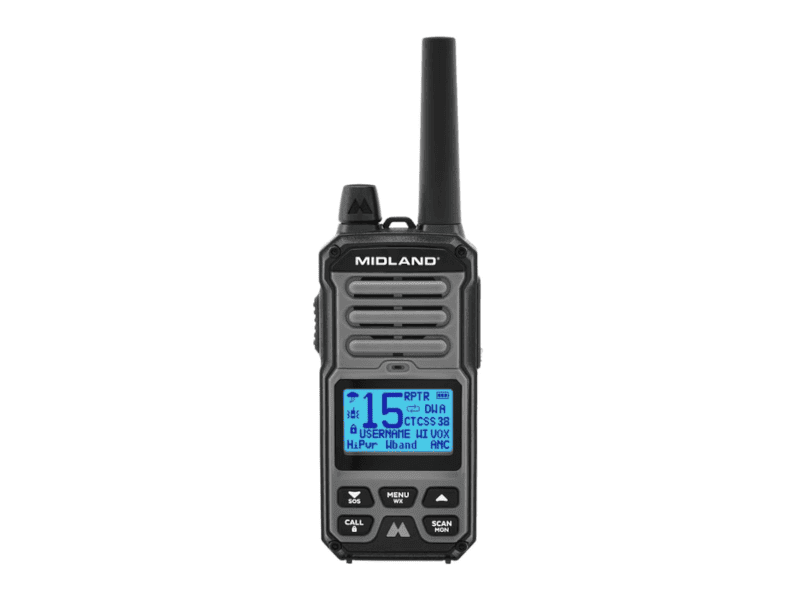
Why We Selected It
Midland’s GXT67 PRO brings together IP67 protection, GMRS repeater capability, and preset or user-defined channel entries. It provides an alternative for users who want a conventional outdoor handheld without an interchangeable antenna system. Its sealed battery arrangement is an important buying distinction, rather than a minor footnote. Plan to recharge the radio as a unit instead of carrying a replacement battery to exchange on the trail.
- Repeater settings and split tones support preparation for compatible local systems, provided you confirm the required parameters and permission beforehand.
- Preset and user-defined entries let you organize frequently used combinations, although extra entries do not create additional radio frequencies.
- The charging dock supports a repeatable home or vehicle charging routine, which matters when the battery cannot be exchanged by the user.
Licensed users who value a protected Midland handheld and can recharge between outings. Suitable when organized channel presets matter more than removable antennas or swappable battery packs.
Extended trips built around exchanging spare batteries, or users wanting to experiment with suitable GMRS antennas. Compare the Expedition or GMRS-V2 before committing to this sealed configuration.
Our Verdict
The GXT67 PRO is a credible premium alternative, but its appeal depends on accepting its power and antenna arrangements. Against the Expedition, the decision is primarily about handling preferences, charging habits, and replaceable components. Against the GMRS-V2, its IP67 enclosure is a more obvious reason to spend extra than the number of listed channels. Buy it for that combination of protection and operating layout after checking the manual. There is no comparable field evidence here establishing that its higher price buys greater direct communication range.
PROs
- IP67 enclosure
- GMRS repeater support
- Configurable channel entries
- Dock-based charging
CONs
- Battery not customer-replaceable
- Fixed antenna
- Premium purchase price
This review concerns GXT67 PRO, not GXT1000 or other Midland GXT models. The manufacturer’s “up to 99” description includes preset and user-defined entries; it does not mean 99 separate GMRS frequencies.
Rocky Talkie Mountain Radio — US FRS
The Mountain Radio is the premium license-free choice for active groups. Its attachment system and simple controls matter more to its appeal than advertised maximum range or a long feature list.
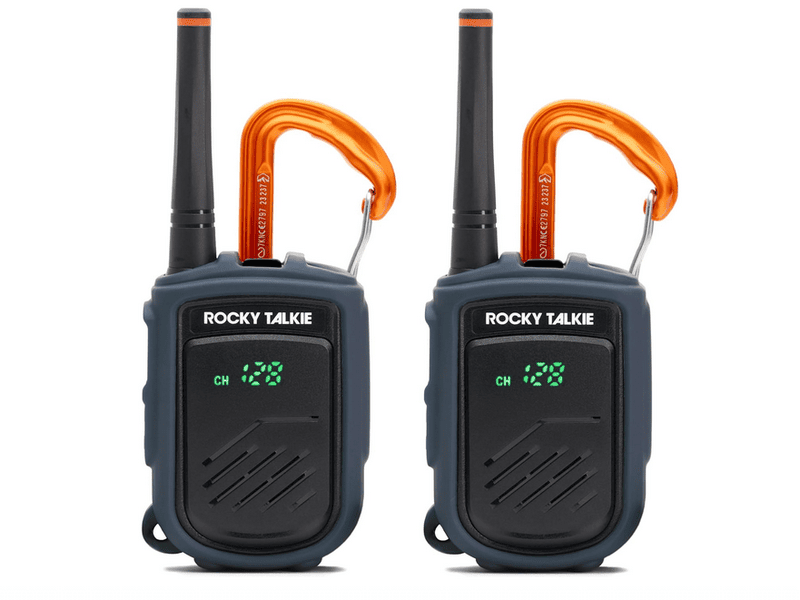
Why We Selected It
For unrelated friends hiking together, the easiest useful radio may be the one everyone can operate without arranging individual licenses. The Mountain Radio combines US FRS operation with a carabiner and backup leash, a replaceable battery, and a relatively lightweight design. It is a practical fit for carrying on a pack or harness. Its IP56 rating covers a different exposure level from the Expedition’s IP67 protection, so do not treat the two as interchangeable around immersion.
- The carabiner and backup leash provide two layers of retention, useful when a dropped radio would be difficult to recover.
- License-free FRS operation simplifies ordinary leisure use with friends, while still requiring everyone to follow the applicable service rules.
- A replaceable battery and USB-C charging support different trip power plans, without relying on disposable AA cells as the primary arrangement.
Hiking and skiing partners who want secure attachment and straightforward operation. Also relevant to groups prioritizing compact radios and uncomplicated preparation over repeaters or location-sharing functions.
Users needing GMRS repeaters, or watersports where accidental immersion is likely. Choose the Expedition with appropriate authorization, or consider the floating T605 for license-free use around water.
Our Verdict
The Mountain Radio makes sense when secure carrying and uncomplicated use justify its premium over simpler consumer radios. Compared with the T605, it emphasizes an attachment system and a replaceable lithium-ion power arrangement rather than flotation and AA backup. Compared with the Expedition, it removes individual licensing from the group’s preparation but also removes repeater access. Choose it because those trade-offs fit your group. Its premium position reflects execution and convenience; we have not established a measured range advantage over the other FRS model.
PROs
- No individual FRS license
- Carabiner and backup leash
- Replaceable battery
- Lower published weight than Expedition
CONs
- No repeater capability
- Not submersible
- Premium price for FRS
This is the US FRS Mountain Radio. Its listed preset positions include channel/code combinations, not additional FRS frequencies. Manufacturer endurance claims are not a standardized comparison with the other models.
Motorola TALKABOUT T605 H2O — US FRS
The T605 H2O is the practical FRS alternative for family outings around water. Its floating design and AA backup deserve more attention than the large range figure on the packaging.
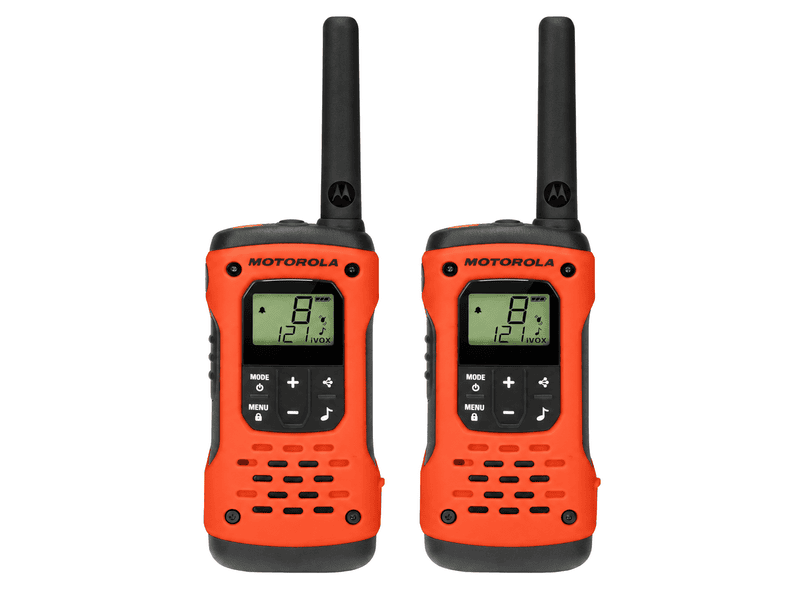
Why We Selected It
The T605 offers a different combination from the Mountain Radio: an IP67 enclosure, flotation with its supplied NiMH battery, and the ability to use three AA cells. That is useful for occasional family adventures where spare household batteries are easier to organize than proprietary packs. The key limitation is that some AA batteries can change flotation behavior. It remains a direct FRS radio, so it cannot use a GMRS repeater to extend the route.
- A floating design can make an accidentally dropped radio easier to retrieve, but only with a battery configuration that preserves buoyancy.
- AA compatibility gives occasional users a backup power option when charging is unavailable, with no promise of identical runtime or flotation.
- The water-activated light assists visibility after a drop, while routine radio checks remain necessary before entering an exposed environment.
Families wanting license-free communication at campsites, lakes, or beaches, with a straightforward backup battery plan. Check the exact twin pack contents and current offer before comparing total cost.
Groups needing repeater coverage, extensive configuration, or guaranteed communication in remote areas. It is also unsuitable as a substitute for required marine radios or an independent emergency communication plan.
Our Verdict
Compare the T605 with the Mountain Radio by how you carry, power, and expose the radio to water. The T605’s main advantages are flotation and AA backup, while the Mountain Radio emphasizes secure attachment and a lithium-ion battery system. The approved budget role should still be checked against the actual offer: a current price was not verified, so no price symbol rating is assigned. Choose the T605 when its water-oriented features fit the outing, rather than treating its advertised mileage as evidence of exceptional reach.
PROs
- No individual FRS license
- IP67 enclosure
- Floats with supplied NiMH battery
- AA backup power option
CONs
- No GMRS repeater access
- Some AA batteries affect flotation
- Current offer price not verified
Features refer to the orange US T605 H2O and current manufacturer USB-C specification. Older or inconsistent retailer descriptions should not override the exact unit’s documentation. Motorola specifies headset use in dry environments.
How to Choose Walkie Talkies for Long Range
A useful purchase matches your group, route, and power plan. Start with those decisions before comparing output power or accessories.
1. Map the communication path
Line of sight is the central limitation of these UHF handhelds. Open countryside and higher elevation can create a clearer path, while urban environments, dense woodland, and challenging terrain introduce signal obstructions. A ridge between two users can matter more than the difference between 2 W and 5 W. For reliable coverage, identify where people will separate and whether those positions can realistically communicate. Weather conditions may affect the outing and equipment exposure, but do not assume that every failed call is a weather problem. Radio interference, body position, and local obstacles also deserve attention.
2. Separate licensed radios from license-free radios
FRS simplifies mixed-group activities because participants do not need individual FRS licenses. GMRS offers repeater options and different equipment possibilities, with licensing responsibilities attached. Neither service is automatically the best choice for every family or club. Decide who will transmit, not just who is buying the radios. PMR446 is not the American license-free alternative to GMRS; it belongs to a different regional framework. Likewise, a receiver that scans VHF does not authorize VHF transmission. Check the exact service version rather than relying on a familiar brand or matching channel numbers.
3. Treat power, antennas, and receivers as a system
High-powered radios cannot compensate for every obstruction. Antenna quality, orientation, connection integrity, and how the radio sits against your body all affect the useful system. High-gain antennas may change the radiation pattern and carrying practicality; they do not provide a universal improvement in every direction. Only consider compatible changes permitted for the equipment and service. Claims about strong receivers should be supported by meaningful sensitivity and interference measurements. Without comparable tests, do not rank signal stability or audio clarity from wattage, speaker loudness, or price alone.
4. Plan battery life around actual use
Battery life depends on transmission time, listening activity, temperature, and enabled features. A manufacturer’s multi-day claim is not equivalent to several days of continuous talking. Rechargeable battery packs are convenient when charging is predictable; replaceable packs offer another option for extended outings. AA support can help with occasional use, but requires its own stock and storage plan. Test chargers, cables, and power banks together before leaving. Respond to low battery levels early, and keep enough energy for the return journey rather than using the entire reserve during the first day.
5. Match protection to the exposure
Water resistance and dust resistance need specific definitions. IP-rated enclosures provide a useful starting point, but an immersion rating does not make a radio suitable for indefinite underwater use. IP67 is relevant to accidental immersion within specified conditions; IP54 and IP56 address different exposure levels. Weather resistance also depends on closed covers and suitable accessory connections. For watersports, consider retention and flotation as separate features. Salt exposure, drops, damaged seals, and an attached headset can introduce limitations that a single protection label does not explain.
6. Choose controls and accessories the group can manage
Simple controls help when users are tired, wearing gloves, or unfamiliar with radios. A lightweight design helps carrying comfort, but should be balanced against the attachment system and battery plan. Earpieces may improve audibility in some settings, while hands-free operation through VOX can trigger unexpectedly in wind or noisy surroundings. Try the actual arrangement during a short practice walk. A twin pack may simplify a two-person purchase; a quad pack only offers value if all four radios, batteries, and charging arrangements suit the group. More units do not improve any individual radio’s range.
Real-World Range and Communication Limits
Advertised maximum range usually describes favorable conditions rather than the route you will actually travel. A clear elevated path and a tree-covered valley are different communication problems, even when the radios are identical.
Direct communication requires a workable path between the handhelds. Repeater communication requires a workable path from each user to the repeater, plus correct settings and access. A repeater heard from a trailhead may not remain reachable after descending into a canyon. Its availability should be checked before relying on it for group coordination.
For hiking, camping, or skiing, run a short route test in representative conditions. Check both directions, speak normally, and repeat the test with radios in their intended carrying positions. Move to a safer, clearer location if communication deteriorates; do not climb into danger to recover a signal. These checks provide local evidence, not a guarantee for the entire trip. Keep rendezvous times and an agreed response to missed calls, especially where phone coverage is absent.
Before Your First Trip
Confirm each operator’s authorization, identify the exact radio versions, and agree on a primary channel and backup. Match actual frequencies and tones when mixing brands; preset channel numbers alone may not be sufficient.
Check voice communication in both directions with the intended batteries, clips, microphones, and headsets. For GMRS repeaters, verify the input/output arrangement, tones, bandwidth, access permission, and a direct channel for fallback.
Charge every unit, test the charging equipment, and distribute spare power. Close covers properly and secure backup leashes. If using AA batteries in a T605, do not assume flotation is unchanged.
Set check-in times, identify sensible regrouping points, and decide what happens if one participant cannot be reached. Teach short messages and a pause before speaking after pressing PTT. Keep the communication plan understandable to the least experienced person.
What to Avoid When Buying a Long Distance Walkie Talkie
- Buying the mileage claim: a large number on the box does not predict performance through the terrain between your users. Ask what operating conditions produced the claim.
- Counting code combinations as frequencies: CTCSS and DCS filter what you hear. They do not add spectrum, prevent interference, or encrypt conversation.
- Assuming a repeater is included: repeater-capable equipment does not provide a repeater, permission to use one, or coverage at every point on your route.
- Confusing reception with transmission: wide scanning coverage does not make a GMRS handheld an authorized transmitter across all those bands.
- Ignoring the exact offer: confirm model, regional version, radio quantity, batteries, cables, and charging equipment. Similar names and product images can conceal important differences.
- Equating protection labels: splash resistance, immersion protection, flotation, and impact durability answer different questions. Choose the properties your outing actually requires.
Special Cases & Common Questions
Can a long-range walkie-talkie work without cell service?
Yes. These six handhelds use direct radio communication, with optional repeater operation on the GMRS models. They do not require a cellular network for ordinary voice calls. However, no cell service does not mean unlimited coverage: a blocked radio path can still prevent communication, and app-related functions have their own setup requirements.
Can FRS and GMRS radios talk to each other?
They can communicate by compatible analog voice on shared channels when frequency, tones, and other relevant settings match. That does not transfer advanced messaging functions or give FRS radios repeater access. It also does not remove the GMRS operator’s licensing requirements. Test the exact combination before distributing radios across a group.
Do privacy codes make conversations private?
No. CTCSS and DCS control which received signals open the speaker; they do not encrypt speech. Other listeners can hear your transmission with suitable settings. A code may reduce unwanted chatter from your speaker, but it cannot clear a busy channel or prevent overlapping users from interfering with one another.
Which model makes sense for water-based trips?
The T605 offers FRS operation and flotation with the supplied NiMH battery. The Expedition offers IP67 protection and GMRS repeaters for appropriately authorized users. Choose by service, retention, and power needs. Neither is a marine distress radio, and an immersion rating does not guarantee flotation or reliable operation while underwater.
Will VOX replace pressing the talk button?
Sometimes, but it needs testing. The T605 and GMRS-V2 list VOX functions; setup and accessory requirements vary. Wind, breathing, or background noise can cause unwanted activation, while quiet speech may fail to trigger transmission. For important instructions, deliberate PTT operation often gives the user clearer control over when the radio transmits.
Should I buy more power or improve the communication plan?
Start with the plan. Confirm who needs to communicate, where they will separate, and whether repeaters are genuinely available. Then choose equipment that supports that arrangement. Higher power may help some marginal links, but it cannot guarantee communication behind major terrain barriers or replace check-ins and agreed regrouping procedures.
Final Recommendation
Choose the BTECH GMRS-V2 for practical GMRS value when you are willing to prepare the settings and do not need immersion protection. Choose the Rocky Talkie Expedition Radio when waterproofing, secure carrying, and straightforward outdoor use justify the premium. Choose the Rocky Talkie Mountain Radio when a mixed group needs simple FRS operation without individual licensing. The right choice is the one your entire group can legally operate, keep powered, and use along a realistic communication path. Check the route and practice together before relying on any of them in remote country.
Back to the comparison