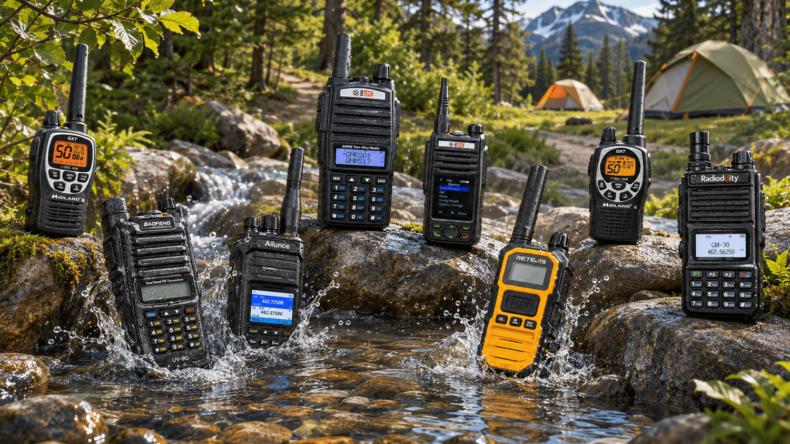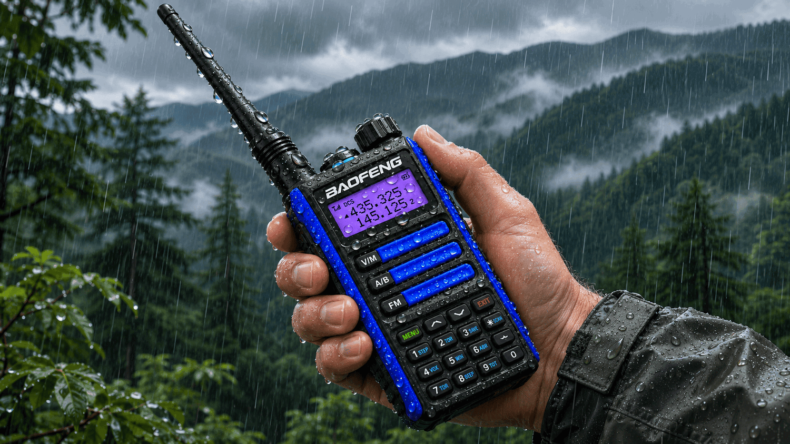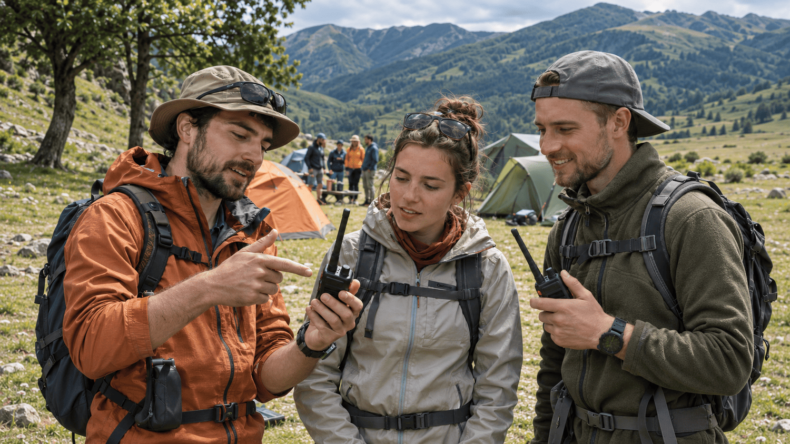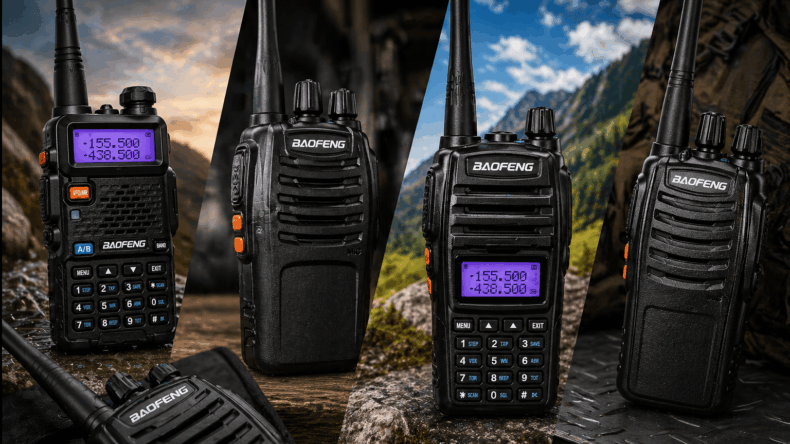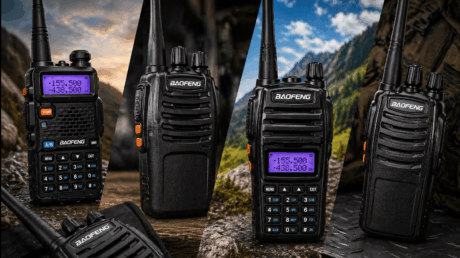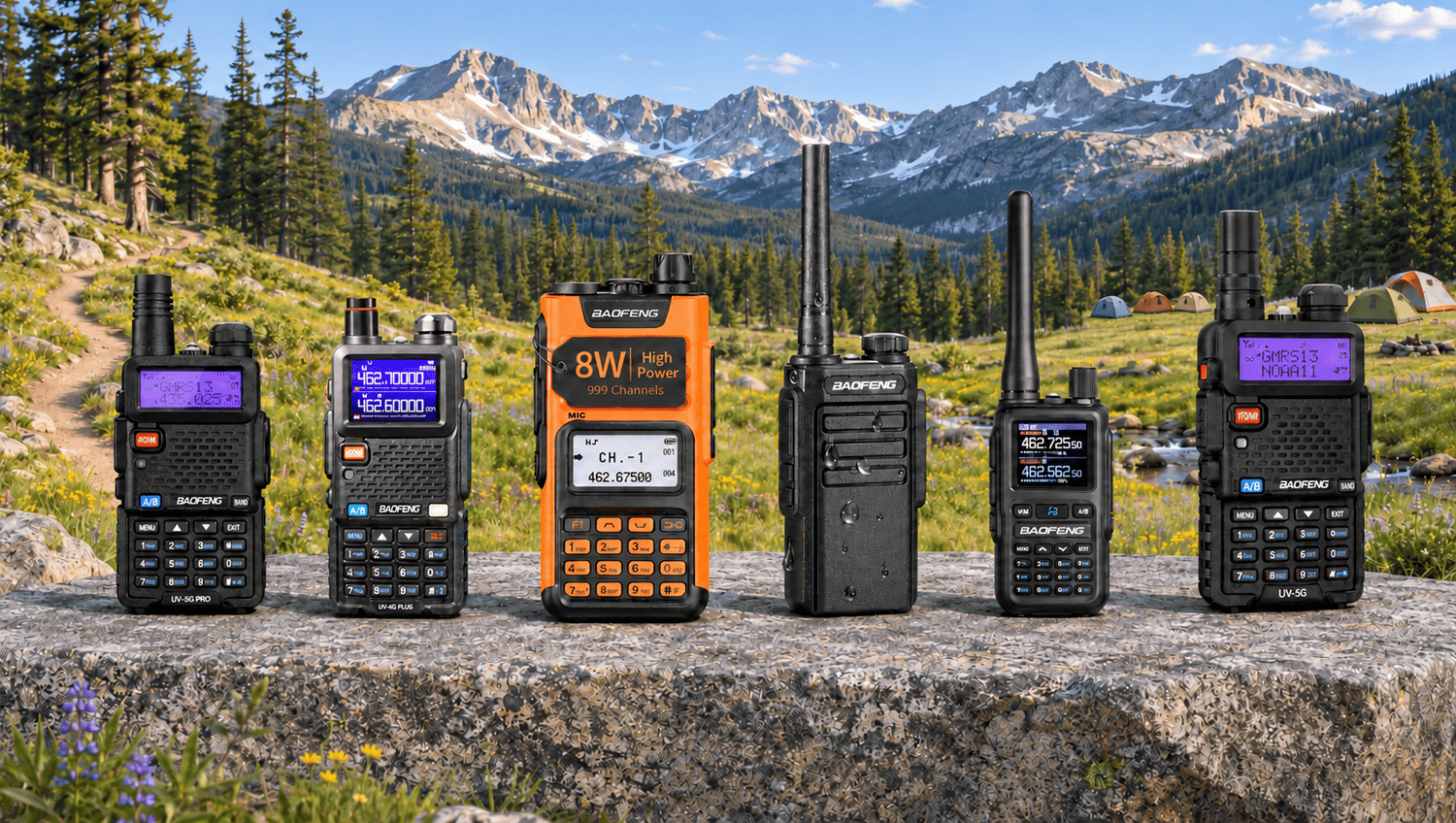
The best Baofeng GMRS radio for most first-time U.S. buyers is the UV-5G (UV-5X) in the two-radio long-antenna kit. It gives you a matched pair, an included programming cable, and room to add a local repeater when you need one. Pick the UV-5G Mini if you want two compact radios you can set up from a phone. For a low-cost pair to use around a campground or property, start with the MP31. The biggest differences are how you charge the radios, how you program them, and which ones suit a repeater-based plan.
- First pair — UV-5G (UV-5X) with long antennas and a programming cable.
- Phone setup — UV-5G Mini with Bluetooth and USB-C charging.
- Budget pair for direct calls — MP31 with IP54 splash protection.
- Charging trade-off — The standard UV-5G and UV-5G Pro kits use desktop chargers.
- Count the radios and chargers in the exact kit.
- Choose between a desktop dock, USB-C charging, and Bluetooth setup.
- Decide whether you need direct channels, access to a local repeater, or both.
Baofeng GMRS radios on Amazon

- ✓ Compare radio kits
- ✓ Check the exact version
- ✓ View current offers
As an Amazon Associate, we earn from qualifying purchases at no extra cost to you.
Compare six Baofeng GMRS handhelds
Compare charging, repeater support, and the main compromise for each radio. The dollar symbols reflect the price tier per radio. Check the linked offer for the kit price. N/A marks a specification we could not verify on a comparable basis.
| Category | Best Value for Money | Advanced Features | Budget Options | |||
|---|---|---|---|---|---|---|
| Model | 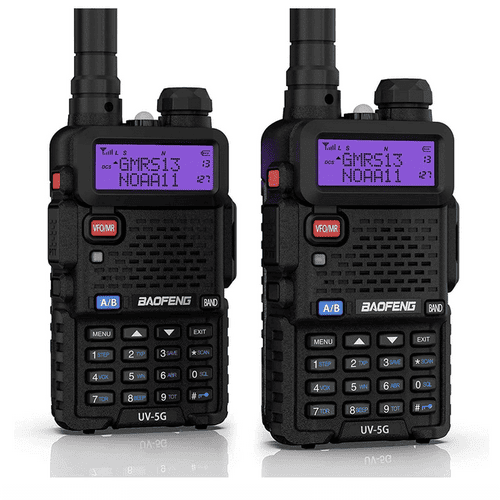 Baofeng UV-5G (UV-5X) | 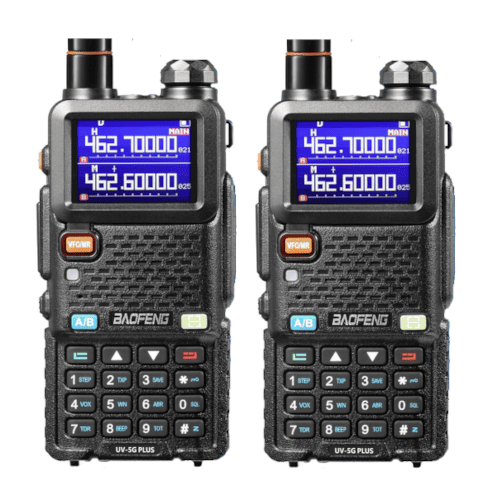 Baofeng UV-5G Plus | 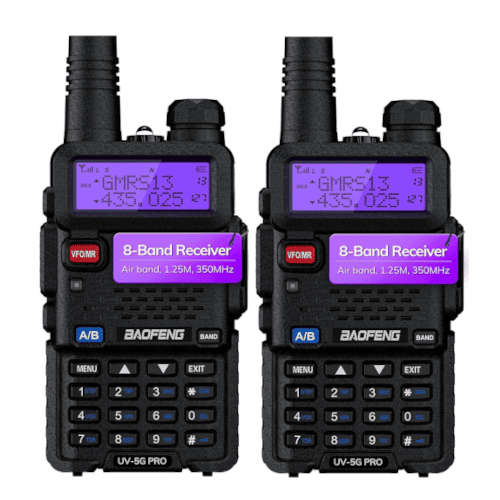 Baofeng UV-5G Pro | 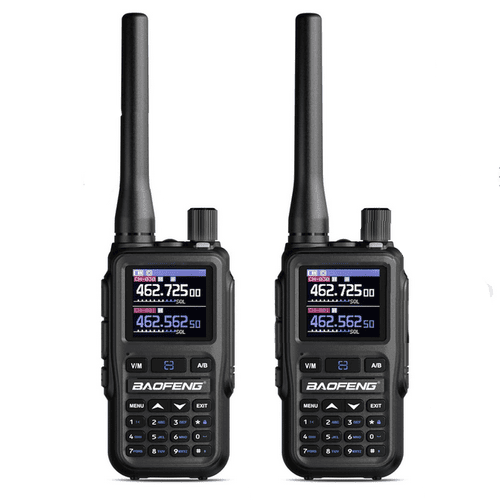 Baofeng UV-5G Mini GMRS | 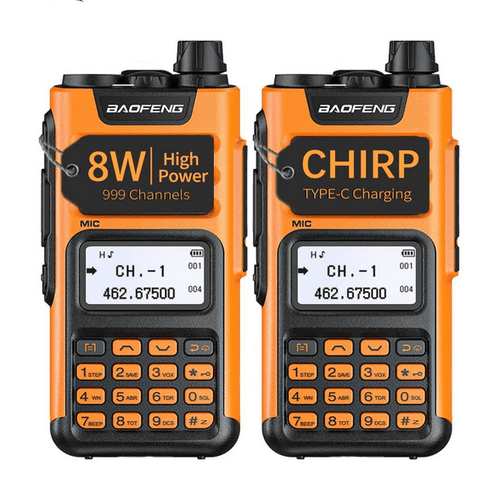 Baofeng GM-15 Pro | 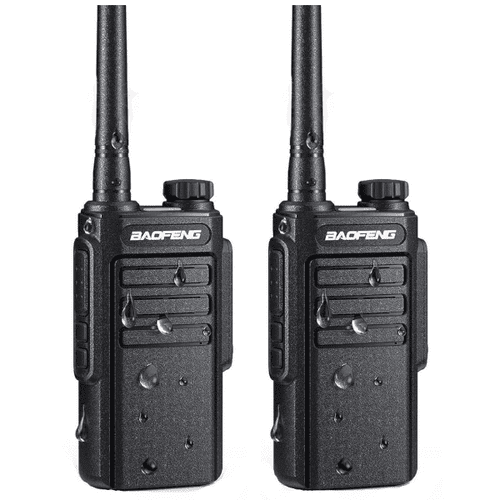 Baofeng MP31 |
| Radio standard / version | U.S. analog GMRS | U.S. analog GMRS | U.S. analog GMRS | U.S. analog GMRS | U.S. analog GMRS | U.S. analog GMRS |
| License / authorization | FCC GMRS license | FCC GMRS license | FCC GMRS license | FCC GMRS license | FCC GMRS license | FCC GMRS license |
| Featured | Long antennas included | 2500 mAh battery | Airband reception | Bluetooth programming | Repeater-ready pair | IP54 splash protection |
| Channels / memory | 22 direct channels + 8 repeater pairs · 128 memories | 22 direct channels + 8 repeater pairs · 999 memories | 22 direct channels + 8 repeater pairs · 128 memories | 22 direct channels + 8 repeater pairs · 999 memories | 22 direct channels + 8 repeater pairs · 250 memories | 22 direct channels · total usable memories N/A |
| Setup options | Keypad and CHIRP | Keypad and CHIRP | Keypad and CHIRP | Keypad, Bluetooth app, and CHIRP | Keypad and PC software | Keypad |
| Ready-to-carry weight | N/A | N/A | N/A | 7.1 oz with battery, per Baofeng | N/A | N/A |
| Protection | N/A | N/A | N/A | N/A | N/A | IP54, per Baofeng |
| Battery / charging | 1800 mAh · desktop dock | 2500 mAh · USB-C | 1800 mAh · desktop dock | USB-C · capacity N/A | 1500 mAh · USB-C or desktop dock | 1500 mAh · USB-C |
| Main trade-off | Dock charging on trips | One radio in the selected offer | Dock charging for the stock battery | Check the exact Mini version | PC software for cable programming | Plan on direct communication |
| Price & Offer | $ | $ | $ | $ | $ | $ |
Quick Picks by Use Case
Start with the job the radios will do on a typical trip.
Licensing & Legal Use
Who can transmit on GMRS in the United States?
GMRS is licensed by the FCC. Before transmitting, apply for a GMRS license or verify that you qualify to operate under an immediate family member’s license with their permission. The rule defines which relatives qualify, including spouses, children, parents, siblings, and in-laws. For ordinary use with friends in another vehicle, each operator needs their own license or coverage through their own eligible family member.
A valid individual license is required to operate a GMRS station.
47 CFR § 95.1705, Individual licenses required; eligibility; who may operate; cooperative use.
Equipment authorization is a separate requirement under 47 CFR § 95.1761. Check the FCC ID for the exact transmitter you buy and its authorization under Part 95E. This matters with Baofeng because several ham and GMRS handhelds have similar names and cases. A GMRS handheld can communicate with an FRS radio on shared direct channels when the settings match. The Baofeng operator still needs GMRS authority to transmit.
Under 47 CFR § 95.1751, identify with the assigned call sign at the end of a transmission or series of transmissions. During a series that runs longer than 15 minutes, identify after the first 15 minutes and at least every 15 minutes thereafter. If you plan to use a repeater, confirm its access rules with the owner before adding it to your trip plan.
How We Selected and Evaluated These Radios
We compared six Baofeng handhelds sold in U.S. GMRS versions. The lineup covers a long-antenna starter kit, a single-radio upgrade, two ways to get a broader receiver, and two entry-level pairs. Each radio earns its place by changing something about how you would buy, charge, carry, or configure it. Several have similar names, so we matched the specifications and equipment authorization to the specific GMRS versions.
- Equipment authorization — The FCC filing must match the radio and intended service.
- Kit contents — Compare how many radios, chargers, antennas, and programming cables come in the selected offer.
- Charging — Check whether the stock battery fits your usual power source.
- Programming — Compare the keypad, supported computer software, and Bluetooth where available.
- Repeater use — Check the transmit authorization and separate it from advertised channel entries.
- Field use — Give weight to documented splash protection, carry weight, and the accessories the buyer will use.
This is a document-based comparison of manufacturer specifications, equipment grants, and offer details. The recommendations reflect kit contents and practical trade-offs. Field range, audio quality, and battery runtime would need comparable tests under the same conditions. Where the available information conflicts, the affected review explains what buyers can verify for that version.
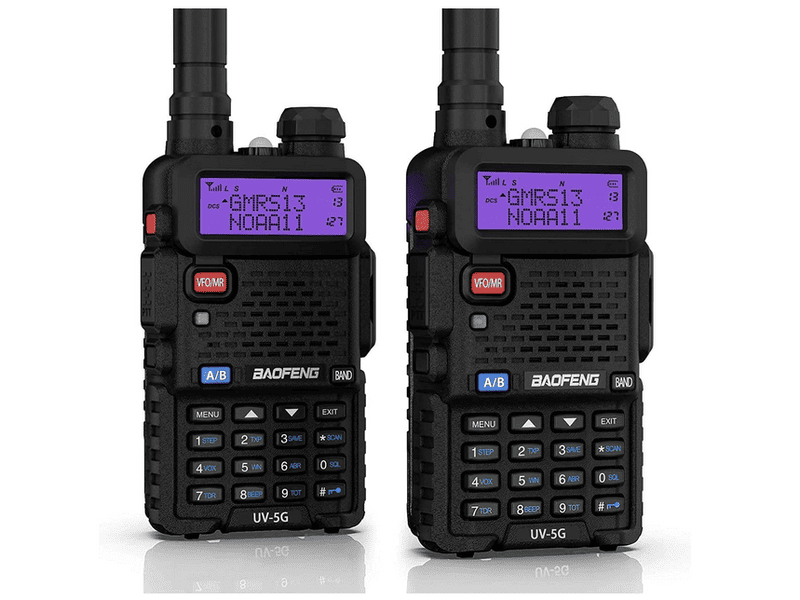
Baofeng UV-5G (UV-5X)
This is the strongest starting kit for two people who want matching GMRS radios, a cable for setting them up together, and a way to use a local repeater later.
Why We Selected It
The long-antenna kit solves a common first-purchase problem. It gives two people the same radio and includes the cable needed to create a shared channel plan. You can name a direct channel for the trip, add a backup, and save the local repeater separately. Because both units have the same controls, you can show a new operator the channel selector and push-to-talk button once before splitting up.
- Use the included cable to keep channel names, tones, and repeater settings consistent on both radios before the trip.
- The kit includes two 15.5-inch antennas, which gives each operator the same antenna option without a separate purchase.
- NOAA weather reception lets you check a local broadcast during a stop, alongside your regular use of GMRS voice channels.
Families and licensed operators who are equipping two vehicles, want matching controls, and can do the initial programming and charging at home before a trip.
Travelers who recharge everything from a power bank and want to leave the charging docks at home. A long antenna can also get in the way when you sit down with the radio clipped on.
Our Verdict
Buy this kit when you need two radios and expect to do most of the programming before you leave. Compared with the UV-5G Plus single-radio offer, it puts both operators on matching hardware from day one and includes the cable and long antennas. The kit makes financial sense when you would buy those accessories separately. If you mainly need one additional handheld and charge gear in the car between stops, the UV-5G Plus is the better fit for that job.
PROs
- Two matching radios
- Two long antennas and a programming cable
- Documented CHIRP support
- GMRS repeater support
CONs
- Stock batteries charge in docks
- 15.5-inch antennas can be awkward inside a vehicle
These kit details apply to the UV-5G (UV-5X) long-antenna pair. Baofeng identifies this U.S. GMRS version with FCC ID 2AN62-UV5G. Check the model and FCC ID together when comparing similarly named UV-series radios.
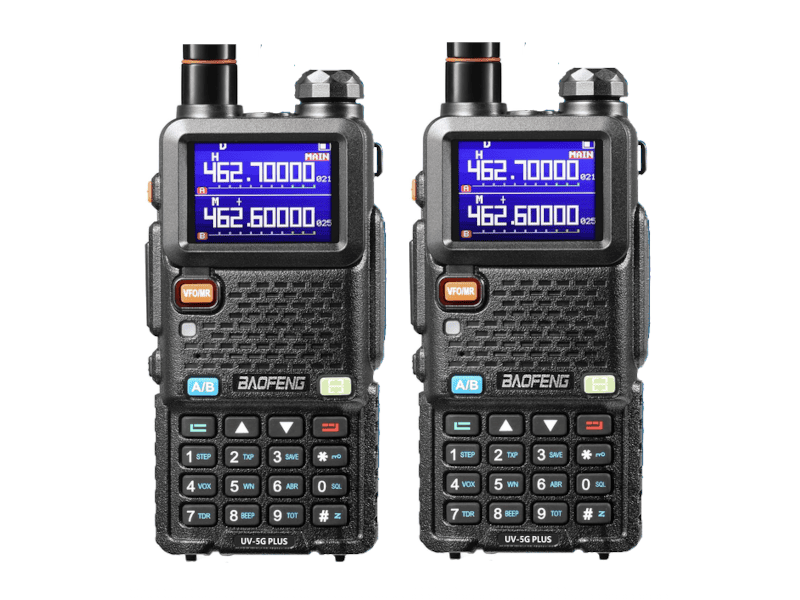
Baofeng UV-5G Plus
The UV-5G Plus is the pick for adding one radio to an existing GMRS setup. Its 2500 mAh USB-C battery and 999 memory slots suit regular travel and a growing channel list.
Why We Selected It
The Plus makes sense for a buyer who already has one working GMRS handheld and wants another for a second driver or vehicle. The stock battery has a USB-C port, so you have a charging option between stops even when the dock is back at home. CHIRP and the larger memory bank make it easier to save named channels for different areas and bring up the ones you use most often.
- The USB-C port on the battery gives you another place to charge when a desktop dock would be inconvenient.
- Save a separate memory entry for each local repeater’s name and access tone, even when multiple repeaters share a frequency pair.
- Use CHIRP to maintain an editable channel plan on your computer and recover your preferred settings after a reset.
Existing GMRS users who want to add one full-size handheld, keep several repeaters and direct channels organized, and charge from a USB source on longer trips.
Two first-time buyers who need a complete pair from one order, or anyone who expects to edit the channel plan from a phone at camp.
Our Verdict
Compared with the UV-5G Pro, the Plus gives up airband reception and gains USB-C charging on the stock battery and a larger memory bank. That is the better exchange if your main job is running GMRS with an existing group and keeping the radio charged on the road. The selected offer includes one unit, so compare two units at checkout if you need a pair. Buyers who value phone-based programming should compare the Mini kit at the same time.
PROs
- 2500 mAh stock battery
- USB-C charging on the battery
- 999 memories and CHIRP support
- Available as an individual radio
CONs
- Two units are needed for a pair
- Computer and cable needed for CHIRP
The selected offer is the U.S. UV-5G Plus single-radio kit with a 2500 mAh USB-C battery. FCC ID 2AJGM-5GPLUS identifies the GMRS authorization. Battery capacity describes the pack. Actual runtime depends on use.
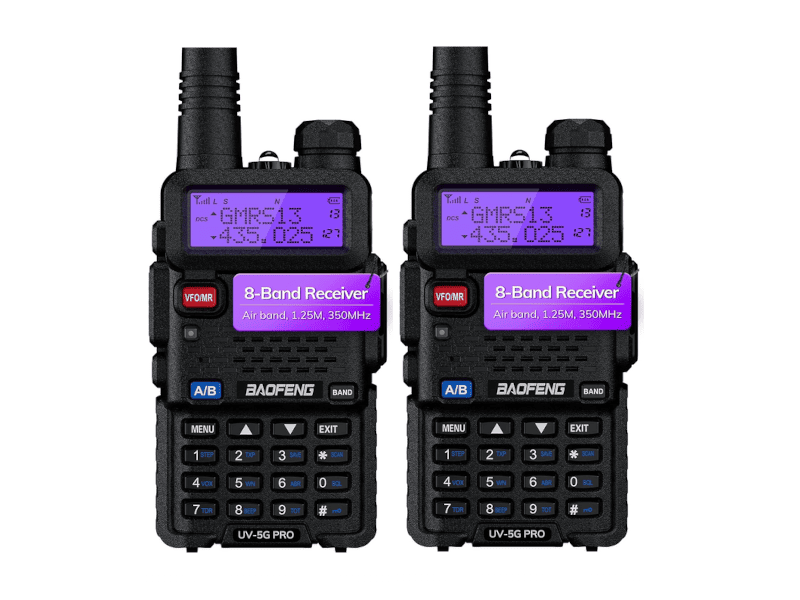
Baofeng UV-5G Pro
Choose the UV-5G Pro pair if you want to talk on GMRS and listen to local aircraft traffic on the same handheld. The selected kit includes a cable for computer setup.
Why We Selected It
The Pro makes the most sense when you want to listen outside GMRS. Its receiver covers civil airband as well as NOAA weather, and the two-radio kit includes a programming cable and long antennas. Build a short list of GMRS channels for both drivers, then save the frequencies you want to monitor in clearly named entries. The stock batteries use desktop chargers, which suits a setup you can recharge at home.
- Airband reception adds local aviation listening while the radio’s two-way communication role remains on the U.S. GMRS service.
- The programming cable in the two-pack lets you build matching channel lists without purchasing that accessory separately.
- With 128 memories, you can keep the group’s direct channels, repeater entries, and a set of listening frequencies organized by name.
Licensed GMRS users who also follow aviation traffic or enjoy scanning, prefer a computer-managed channel plan, and want a pair with the programming cable already in the kit.
Buyers who want quick USB-C top-ups on the stock batteries or expect to revise channels from a phone. The wider receiver adds little if you only make direct voice calls.
Our Verdict
The Pro is worth choosing over the standard UV-5G when you will use airband reception and prefer the included cable. Both kits make sense for a two-radio setup you can program at home. The UV-5G Mini also receives airband and offers USB-C and Bluetooth, so compare it if most of your time is spent away from a charging dock. Choose the Pro when the wired setup and supplied antenna kit fit the equipment you plan to take.
PROs
- Civil airband reception
- Programming cable in the selected pair
- 128 memories with CHIRP support
- GMRS repeater support
CONs
- Desktop docks for the stock batteries
- Wired rather than phone-based programming
The kit details apply to the UV-5G Pro long-antenna pair. Baofeng associates the Pro with FCC ID 2AJGM-UV5G. The filing distinguishes the GMRS transmitter authorization from the receiver authorization that covers additional bands.
Baofeng UV-5G Mini GMRS
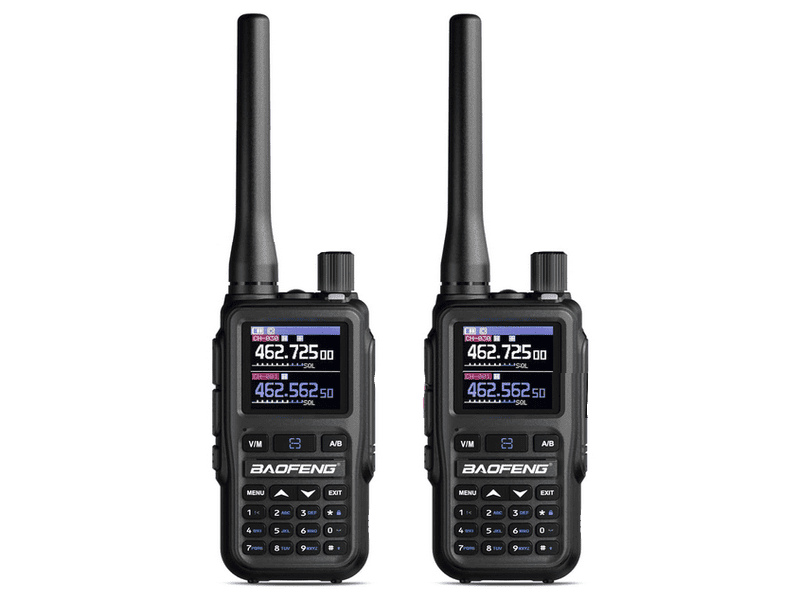
The UV-5G Mini is the most convenient pair here for phone-based setup. It suits people who want compact GMRS handhelds, USB-C charging, and the option to enter a repeater without bringing a laptop.
Why We Selected It
Bluetooth programming gives the Mini a clear role within the UV-5G family. If you find a permitted repeater for a different area or need to change a channel name, you can use the phone app to edit the radio in the field. The keypad and computer options give you other ways to set it up. USB-C charging also fits a trip where a power bank or vehicle USB port is your usual source.
- The phone app lets you update a channel plan where carrying and opening a laptop would be awkward.
- Keypad programming gives you a way to adjust supported settings when you leave your phone behind or its battery runs down.
- NOAA weather scanning lets you check broadcasts manually, a useful distinction when you are counting on a separate weather alert.
Campers and off-road travelers who want two portable radios and expect to make occasional channel changes away from a desk. Set up and pair the app before leaving.
Buyers who need a documented ingress rating for regular wet use or depend on automatic NOAA weather alerts. Check the exact model name before buying accessories.
Our Verdict
Choose the Mini over the UV-5G Pro if you regularly change settings in the field or charge your radios through USB. Both can receive airband and work with GMRS repeaters, so the deciding factor is how you want to set up and power the pair. The Mini’s app is worth paying for when it saves you from bringing a computer or editing several settings at the keypad. If you program the radios once at home and already use desktop docks, the Pro kit remains a good fit.
PROs
- Bluetooth channel programming
- USB-C charging
- Compact body with a full keypad
- Airband and NOAA reception
CONs
- NOAA weather checks are manual
- Ingress protection rating unverified
These details apply to the UV-5G Mini GMRS two-pack, FCC ID 2AJGM-5GMINI. Baofeng lists the MINI-5G separately. Use the full model name when checking the offer, matching a photo, or ordering accessories.
Baofeng GM-15 Pro
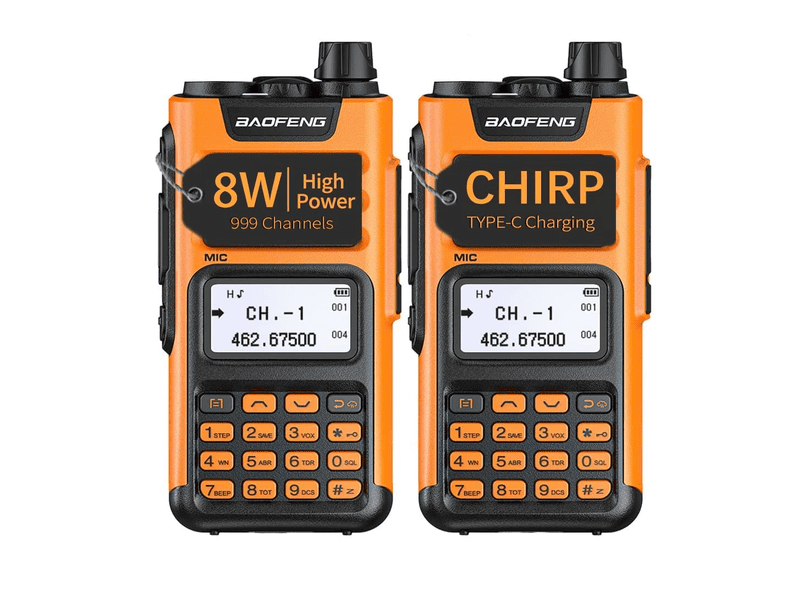
The GM-15 Pro is the budget pair to check when repeater access and USB-C charging matter. Its keypad and computer software are enough to set up a few local channels.
Why We Selected It
The GM-15 Pro fills the gap between a simple direct-use pair and the more flexible UV-5G models. Its equipment authorization covers GMRS repeater input frequencies, and the green kit includes two radios with USB-C charging options. If you only need to program a couple of local repeaters and a backup direct channel, the keypad or compatible PC software can handle that job without making phone-based setup a purchase requirement.
- Program the same repeater and fallback direct channel on both radios so the group can change over using agreed names.
- Use USB-C when you are away from the desktop chargers, which can stay at home for day-to-day charging.
- Two matching controls and displays make it easier to walk another operator through a channel change before the group separates.
Buyers looking for a two-radio kit with USB-C and a specific repeater they can already access, especially if their channel plan rarely changes after initial setup.
People who want to manage several radios through one established CHIRP workflow or make frequent changes from a phone. Compare the UV-5G Mini if that is part of your regular use.
Our Verdict
Choose the GM-15 Pro over the MP31 when a local repeater is part of your plan. For direct calls around a property or campground, the MP31 is the simpler purchase and has a manufacturer-stated splash rating. Compare the green GM-15 Pro two-pack against the UV-5G Mini pair at checkout. If they cost about the same and you expect to adjust channels often, the Mini’s Bluetooth setup is worth considering. For an occasional repeater user, the GM-15 Pro covers the essentials.
PROs
- Two radios in the selected green kit
- GMRS repeater support
- USB-C and desktop charging options
- 250 memories
CONs
- Cable setup uses compatible PC software
- Ingress protection rating unverified
The green two-pack lists 1500 mAh batteries and FCC ID 2AJGM-GM15PRO. The FCC filing specifies effective radiated power by frequency. Its figures and the wattage in the listing title use different descriptions, so we left wattage out of the comparison.
Baofeng MP31
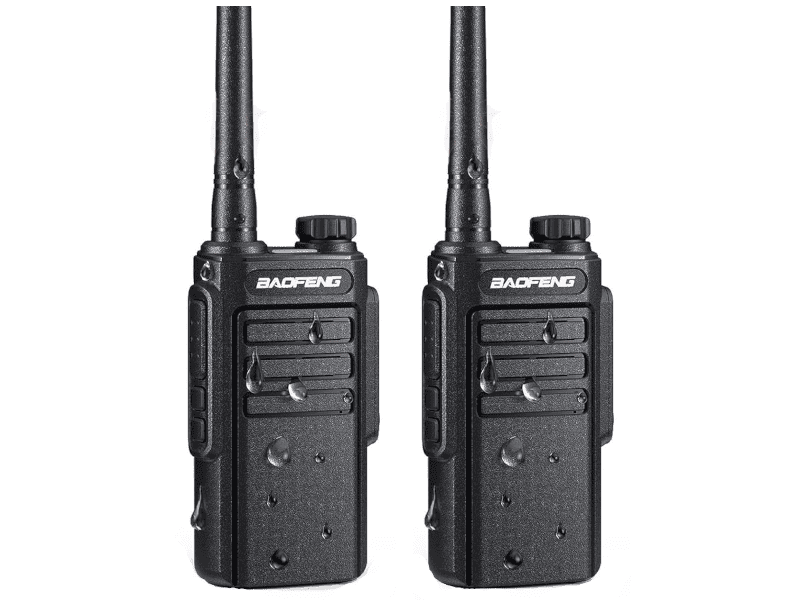
The MP31 is a practical first pair for short, direct calls around a campground or property. Its USB-C charging is convenient, and Baofeng rates the case IP54 for splash protection.
Why We Selected It
The MP31 pair is designed for everyday check-ins. Give one radio to each operator, agree on a direct channel, and use the same charging setup for both. The manufacturer’s IP54 rating is relevant for occasional splashes around camp. The equipment authorization verifies direct-channel transmit frequencies for this version. Baofeng also advertises repeater entries, but the grant for this FCC ID omits the GMRS repeater input frequencies, so the MP31 belongs in the direct-use category.
- The two-radio kit lets you equip both ends of a direct link with the same controls and charging accessories.
- USB-C charging gives you a practical way to top up both radios at camp using the supplied charging cables.
- The IP54 rating covers splashes. Use a dry pouch where the radio could be dropped in water or exposed to a downpour.
Licensed families or operators who need a low-cost pair for routine check-ins between campsites, vehicles at the same stop, or people working around the same property.
Groups that depend on a repeater or need equipment rated for immersion. For a repeater-based plan, choose a radio with authorization covering the corresponding transmit frequencies.
Our Verdict
The MP31 makes sense when you already know where you will use the radios and can test a direct channel there. For campsite coordination, you get the two radios, USB-C charging, and documented splash protection in one inexpensive kit. Step up to the GM-15 Pro if the local repeater is the reason you are buying GMRS. If all you need is a quick call from one end of the campsite to the other, the MP31 covers that job with fewer decisions at setup.
PROs
- Two-radio starter kit
- Manufacturer-stated IP54 splash protection
- USB-C charging
- 22 direct channels
CONs
- Repeater input frequencies absent from the FCC grant
- IP54 covers splashes only
These details apply to the MP31 pair with FCC ID 2AJGM-MP31. Baofeng supplies the IP54 rating and kit specifications. The direct-use recommendation follows the transmit frequencies listed in the equipment grant.
How to choose the best Baofeng GMRS radio for your group
Start with the people you need to reach, where they will be, and how you will power the radios. Those choices narrow the lineup faster than advertised wattage or memory count.
Decide how many people need a radio
For two drivers or a family split between two campsites, start with a pair. Matching radios simplify the handoff because you can teach both operators the same controls. If you already own a compatible handheld and only one person needs a radio, the single UV-5G Plus gives you more flexibility at checkout. Check the exact Amazon variant before comparing prices. In this group, the UV-5G Plus listing is one radio, while the UV-5G (UV-5X), UV-5G Pro, and UV-5G Mini offers selected here are pairs.
Pick the channels you will actually use
Start with one direct channel and a backup everyone can find. A repeater is worth programming when you have confirmed coverage and access, especially if the route separates vehicles with terrain. Check the repeater owner’s details for the correct receive frequency, transmit offset, and any access tone. Store the repeater and direct fallback under distinct names so nobody has to decipher a frequency while driving or moving camp. For a close-range direct plan, the MP31 covers the basic job.
Match the charging method to your trip
The UV-5G and UV-5G Pro kits work well when you have somewhere to leave their desktop chargers. The Plus, Mini, GM-15 Pro, and MP31 give you USB-C charging options for the selected versions. Test your specific cable and power source before packing, especially if you rely on a USB-C-to-USB-C cable. A USB-C port alone gives you no guarantee of support for every charger. Compare battery capacities as specifications and plan actual charging around your own mix of standby, reception, and transmitting.
Choose the programming workflow you can repeat
If your whole group needs the same named channel list, use a supported computer workflow and save a backup for each model. The standard UV-5G and the Pro include a cable in the selected long-antenna kits. If you expect to add a repeater or fix a setting while away from the computer, the UV-5G Mini’s Bluetooth app is the more convenient option. Learn the keypad basics too. Every operator should be able to find the main and backup channel without opening the programming app.
Separate listening features from communication features
Buy the UV-5G Pro or Mini for airband reception only if you expect to use it. These radios use GMRS for two-way communication, while airband and NOAA are listening features. A large memory bank helps when you maintain named entries for multiple trips or repeaters. For a family using two direct channels, a clean channel list matters more. Keep the frequently used entries together so nobody has to scroll past listening channels to find the backup.
Match the case and antenna to how you carry the radio
The MP31’s manufacturer-stated IP54 rating covers splashes. If you expect immersion, look for documented immersion protection on the exact radio and accessory setup. Inside a vehicle, check how a long antenna sits next to the window or headrest. On foot, see whether the belt clip, antenna, and microphone position make the controls easy to reach. Weight is useful when the measurement includes the battery and identifies the accessories. Packaging weight tells you little about what you will actually carry.
Real-World Range and Communication Limits
A handheld can reach farther across clear, open terrain than between two vehicles on opposite sides of a ridge. Trees, buildings, terrain, and the position of the radio inside a vehicle can all reduce the margin you have for a readable signal. Move to a spot with a clearer path, keep the antenna upright, and try the same call again before concluding that you need a different radio.
Test the actual places you plan to use. At camp, try from the parking area, tents, and any buildings people will enter. In a convoy, check from inside both vehicles at a realistic separation and repeat the call where terrain blocks the view. If you intend to use a repeater, test it from the low point of the route as well as the high point. Agree on the direct backup channel and a meeting point before the group separates. This gives everyone a plan if a radio drops out or the repeater becomes unavailable.
Compatibility & Programming
Match the model name and FCC ID to the GMRS version you ordered. Then verify the contents of each box and identify the correct charger and cable for every radio.
Give the direct channel and its backup names both operators will recognize. Add a repeater only after you have the owner’s access settings. Save a backup of the configuration before editing it.
Check that each operator can hear the other on the main and backup channels. If one side stays quiet, confirm the frequency, channel width, and receive tone settings before you change power or antennas.
Ask everyone to find the backup without help, then have each operator make a short identified call. Bring the charging cables you tested and make sure the group knows where to meet if radio contact drops.
What to avoid when buying a Baofeng GMRS radio
- Buying by the case shape. Similar-looking Baofeng radios can belong to different services. Look for the full GMRS model name and the matching Part 95E authorization before you commit to a listing.
- Treating memory slots as extra frequencies. Hundreds of memories let you save names, tones, and other settings. Compare direct channels and repeater pairs separately when deciding how the radios will work together.
- Buying from a wattage claim alone. Seller figures and FCC filings can describe power differently. For your actual route, a clear path, radio position, and a usable repeater are more informative than the biggest number in a listing title.
- Comparing a pair with a single unit at face value. Open the chosen variant and count the radios, charging accessories, and programming cables. Decide what the complete setup for both operators will cost.
- Assuming every advertised repeater entry supports transmission. Verify the exact version. This is why we recommend the MP31 for direct use and the GM-15 Pro when you plan to transmit through a repeater.
Special Cases & Common Questions
Can I mix Baofeng GMRS models in the same group?
Yes. Use the same direct frequency, compatible bandwidth, and matching tone settings. Saved channel names can differ between radios, so verify the frequency behind each label. Start with receive tone filtering off during the first check if one operator can hear the other only intermittently.
Can the UV-5G Mini still be used if my phone dies?
Yes. You can select a saved channel and make calls using the radio’s own controls. The phone app is one way to change settings. Set up your main and backup channels in advance, then practice finding them on the keypad with your phone put away.
Can I use the same CHIRP file on the UV-5G and UV-5G Plus?
Keep a separate configuration image for each model. You can recreate the same channel plan by copying compatible memory entries into a fresh read from the destination radio. Check the correct model selection first, then confirm the tones and offsets on the destination before transmitting.
Do CTCSS or DCS tones make our calls private?
No. They control when a receiver opens its speaker. Anyone listening on the same frequency without that filter can still hear the transmission. Before you make a call, check whether the frequency is busy, especially if your group uses a receive tone that mutes other traffic.
Does NOAA reception mean the radio will alert me to severe weather?
Only when the exact model supports an automatic alert mode and you have configured it correctly. The UV-5G Mini can receive and scan NOAA weather broadcasts, and Baofeng specifies that weather checks are manual on this model. Keep a separate alert source if you need unattended warnings.
Final Recommendation
Choose the UV-5G (UV-5X) long-antenna kit if you need two matching radios and want the cable included for setup at home. Choose the UV-5G Mini GMRS if you would use Bluetooth to change settings in the field and want USB-C charging on a compact pair. If your use is limited to direct calls around camp and you want to keep the cost down, choose the MP31. Before checkout, confirm the kit quantity and exact model. Then set one direct channel and one backup that every operator can find.
Back to comparison