

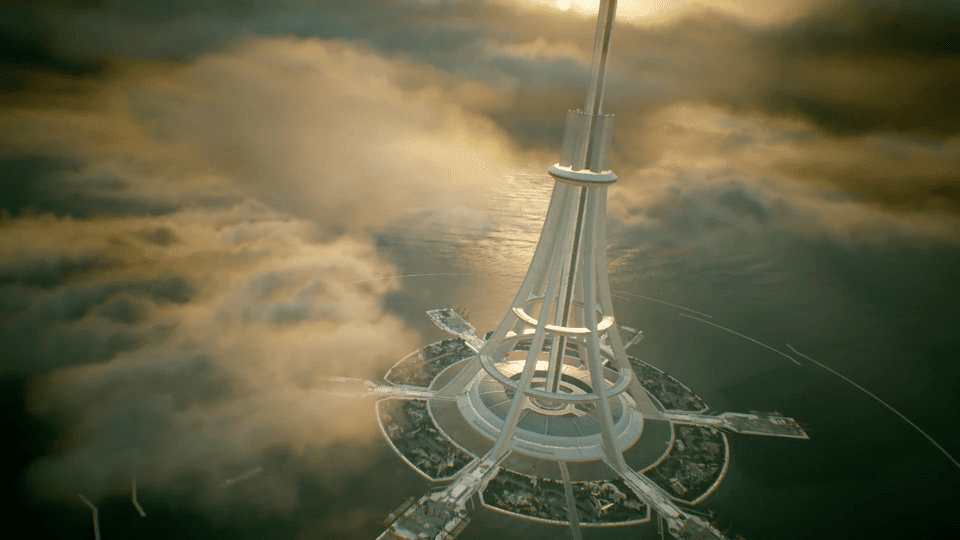
←
⟶
We’re continuing our investigation into the space elevator.
Chapter 8. Down to Earth: Yuri Artsutanov’s revolutionary reversal
The concept Konstantin Tsiolkovsky proposed in 1895 had one fundamental weakness: it assumed building the tower from the bottom up. From the standpoint of classical structural mechanics, any structure of that kind would be crushed by its own colossal mass — it would be like trying to build a giant tower out of wet spaghetti: it would collapse under its own weight instantly.
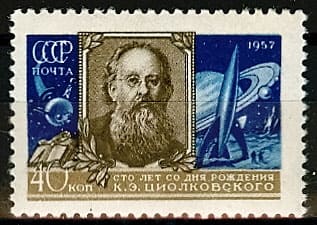
The idea hit a dead end for more than half a century, until in 1960 a young Soviet engineer from Leningrad, Yuri Artsutanov, figured out how to turn the problem on its head — quite literally. Picture a child swinging a rock on a string. As long as the rock is spinning, the string stays taut, pulled by centrifugal force. Earth is the child, and the satellite in orbit is the rock. The elevator’s cable doesn’t stand on the ground — it hangs in space, held taut by the rotation of the planet itself.
Artsutanov proposed abandoning the idea of a supporting tower on the ground altogether. Instead, the starting point should be an artificial satellite in geostationary orbit — about 36,000 kilometers above sea level, where the satellite’s rotational speed exactly matches Earth’s, making it appear to “hang” over a single point on the equator. From this satellite, a sturdy cable should be lowered down toward the planet at the same time as another cable is released upward, deep into space, as a counterweight to hold the center of mass in place.
This maneuver completely changed the physics of the problem: the structure shifted from a state of compression to one of tension. The centrifugal force of the planet’s rotation pulled the cable taut, like a string, turning it into an ideal guide rail for climbers.
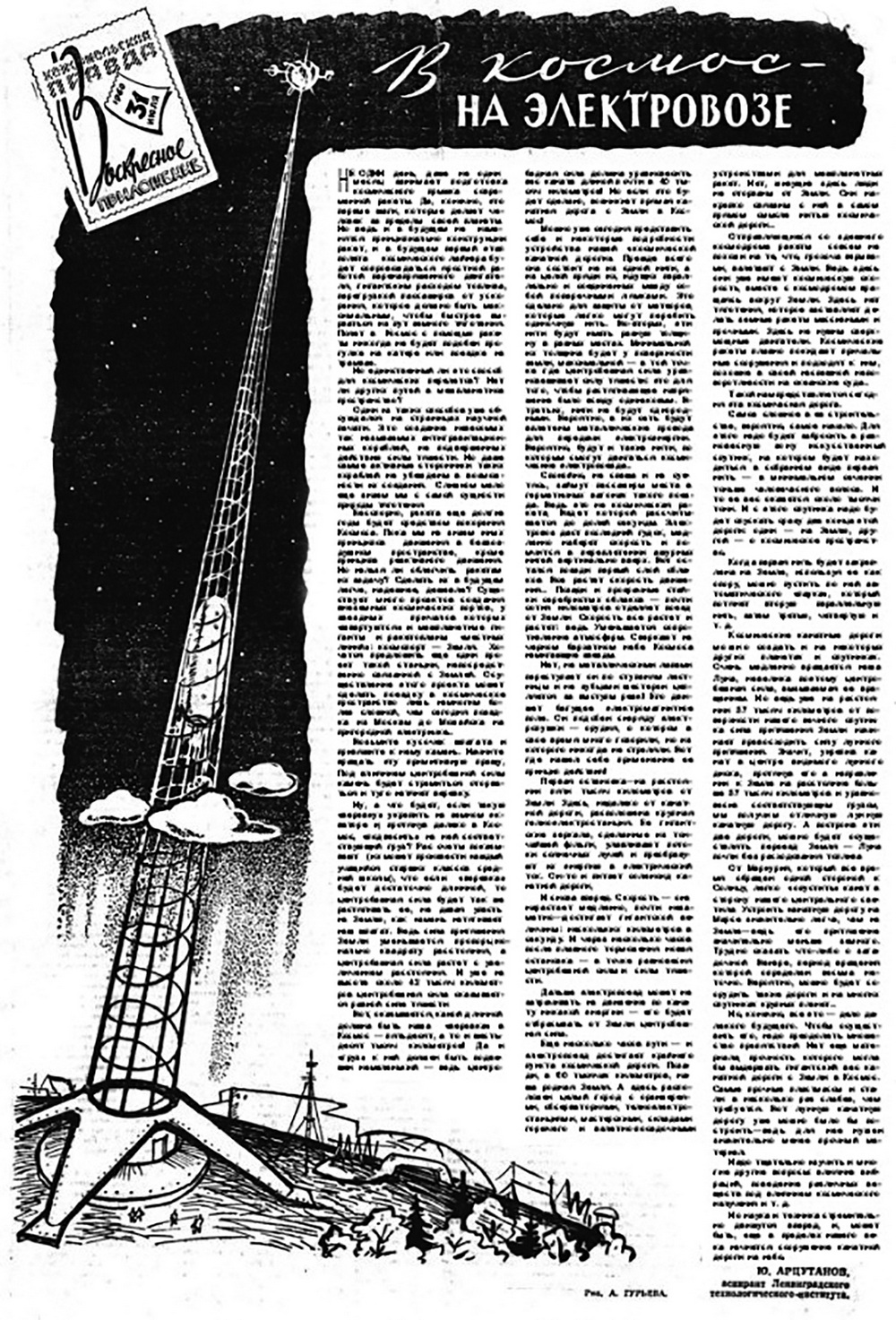
Artsutanov published his calculations on July 31, 1960, in the popular newspaper Komsomolskaya Pravda, in an article with the eye-catching title “Into Space by Electric Train.” He showed that the cable needed a variable cross-section — as thick as possible at geostationary orbit, where the load peaks, and tapering down toward the surface of the Earth.
By replacing the supporting tower with a cable held taut by centrifugal force, Artsutanov shifted the space elevator from the realm of engineering absurdity into that of a theoretically solvable mechanical problem — the single most important paradigm shift in the history of the whole project. It’s the reason engineers still say a space elevator can be built at all — not from the ground up, but hung from orbit. Why the engineer chose to publish this era-defining discovery in a mass-market youth newspaper rather than a peer-reviewed academic journal remains genuinely unclear to this day — and that choice hid his work from the world scientific community for years.
Chapter 9. Jerome Pearson’s independent discovery
The history of science has no shortage of examples where revolutionary ideas seem to be floating in the air, arising simultaneously in different corners of the planet. That’s exactly what happened in the mid-1970s, when the space-elevator concept was rediscovered from scratch — this time on a different continent, with no awareness whatsoever of the earlier Soviet publications.
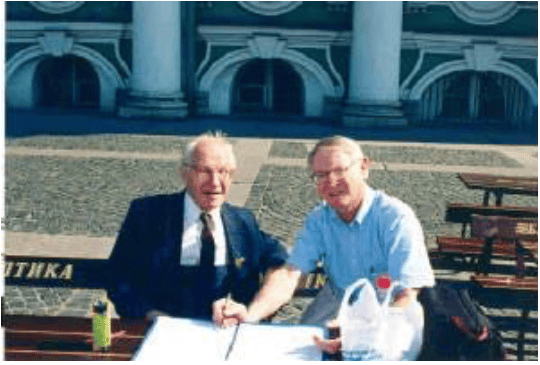
In 1975, the American aerospace engineer Jerome Pearson, who worked on orbital mechanics problems at the U.S. Air Force Research Laboratory, arrived at exactly the same conclusions as Artsutanov. Pearson carried out a detailed analysis of the behavior of long tether systems in space and mathematically justified the structure he called “the Orbital Tower.”
Unlike his colleague in Leningrad, Pearson published a full technical paper in the prestigious international journal Acta Astronautica, and thanks to that, the project finally gained full recognition within the world scientific community. The American engineer conducted a deep stability analysis of the system: he calculated how gravitational perturbations from the Moon and Sun would affect the cable and modeled wind loads within Earth’s atmosphere. His work made the space elevator a legitimate topic for discussion at international astronautics congresses.
In this way, Jerome Pearson secured the project its official academic recognition: his rigorous mathematical models proved to the engineering community that the idea didn’t violate the laws of physics and deserved serious consideration. One puzzle remains: whether Pearson’s thinking crossed paths with any earlier mentions of the idea in U.S. technical periodicals, or whether his conclusion emerged as a completely isolated product of pure engineering.
Moon elevator by Jerome Pearson
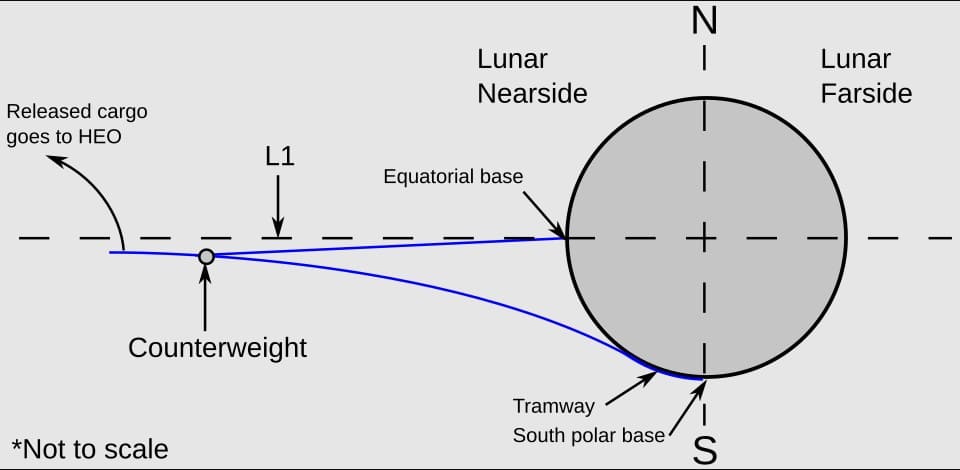
The diagram illustrates two concepts of a lunar space elevator: an equatorial elevator (top) and a polar elevator (bottom). The tether extends from the Moon’s surface through the Earth–Moon L1 Lagrange point to a counterweight beyond it, keeping the cable under tension.
Chapter 10. How science fiction made the idea a cult classic: Arthur C. Clarke and “The Fountains of Paradise”
Even the most flawless formulas in academic journals often go unnoticed by the wider public unless a great storyteller takes up the cause. The space elevator gained real mass popularity and cult status as a technological myth in 1979, when the famous English science-fiction writer and futurist Arthur C. Clarke published his novel “The Fountains of Paradise.”
Clarke approached the book with maximum scientific rigor — he personally consulted with Jerome Pearson to make sure the technical description of building the elevator at the fictional equatorial base of Taprobane (modeled on the island of Sri Lanka) would be flawless. Working in parallel and completely independently of Clarke, the American scientist and writer Charles Sheffield wrote a novel called “The Web Between the Worlds” with an identical plot. This caused a brief moment of confusion in publishing circles, but the two authors quickly resolved the matter, acknowledging it as an honest coincidence of ideas.
Clarke’s novel won the prestigious Hugo and Nebula awards, instantly turning the term “space elevator” into a household concept. The book didn’t just entertain readers — it laid out a detailed scenario of how cheap, rocket-free access to orbit would transform Earth’s economy.
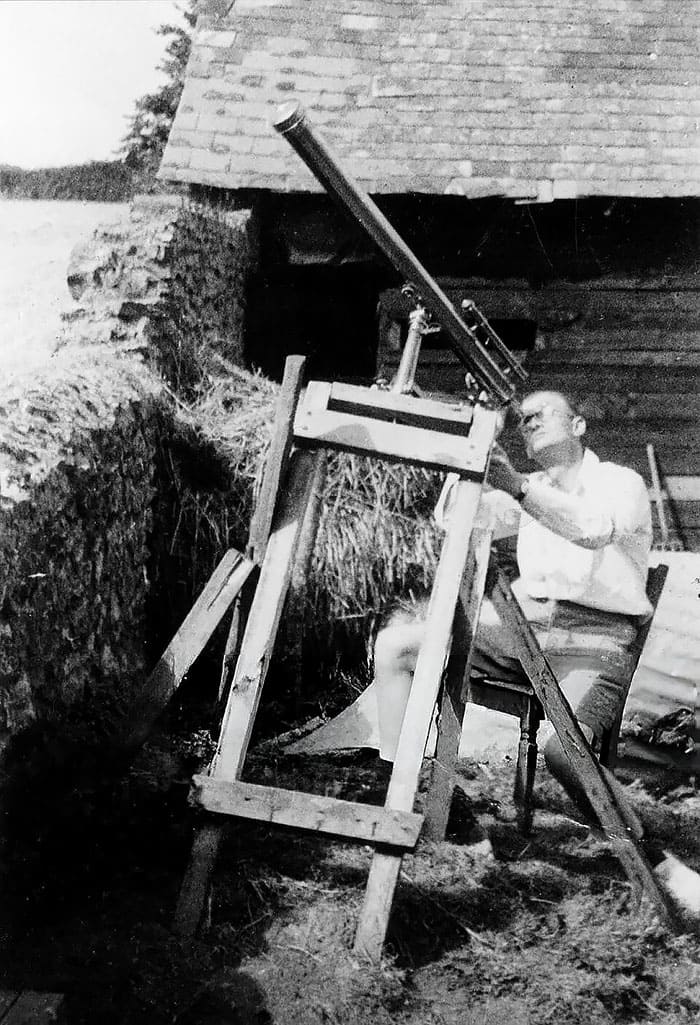
When Clarke was later asked when humanity would actually build such an elevator, he gave his now-famous prophetic answer: “About fifty years after everyone stops laughing.”
The turn of the 1970s into the 1980s completely changed the project’s status in popular culture: thanks to science fiction, the space elevator went from being the eccentric obsession of a few engineers to a widely recognized symbol of humanity’s future expansion into space.
Chapter 11. The Carbon-Nano Breakthrough That Made the Space Elevator Possible: Sumio Iijima and Molecular Threads
Despite Pearson’s elegant mathematics and Clarke’s vivid imagery, by the end of the 20th century the project ran into a solid wall: materials science. The core problem was stark: no substance on the planet could withstand the tensile stress that would occur in a 36,000-kilometer cable. Steel, titanium, aluminum, and even kevlar would snap under their own weight long before reaching orbit. What was needed was a material of an entirely different order of strength.
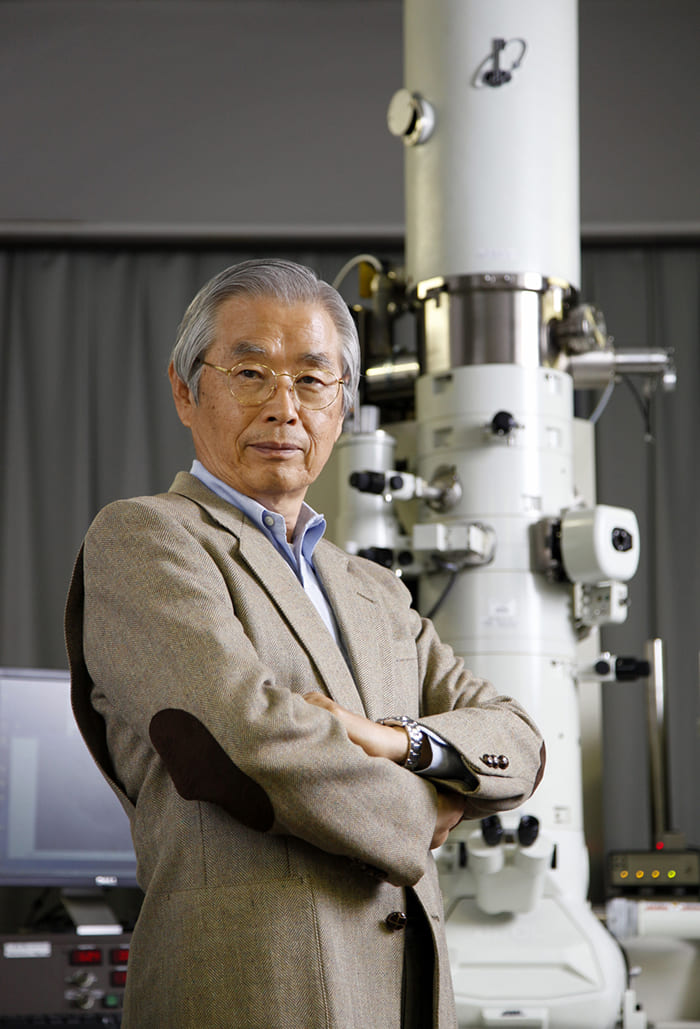
The solution came from fundamental solid-state physics. In 1991, the Japanese physicist Sumio Iijima published a landmark paper in the journal Nature that set off a real boom in nanotechnology. He described in detail carbon nanotubes (CNTs) — elongated cylindrical structures made of rolled-up hexagonal lattices of carbon atoms.
Carbon nanotubes exhibited extraordinary physical properties: their theoretical tensile strength exceeded 100 gigapascals at an astonishingly low density — meaning a thread of this material could withstand colossal loads while being a hundred times stronger than steel and many times lighter. For the first time in history, engineers had in hand a real material whose characteristics matched the strict requirements of the theoretical calculations for a space cable. Iijima’s discovery is usually the moment cited when people ask whether a space elevator is possible in the first place — for the first time, a real material existed that was strong enough on paper.
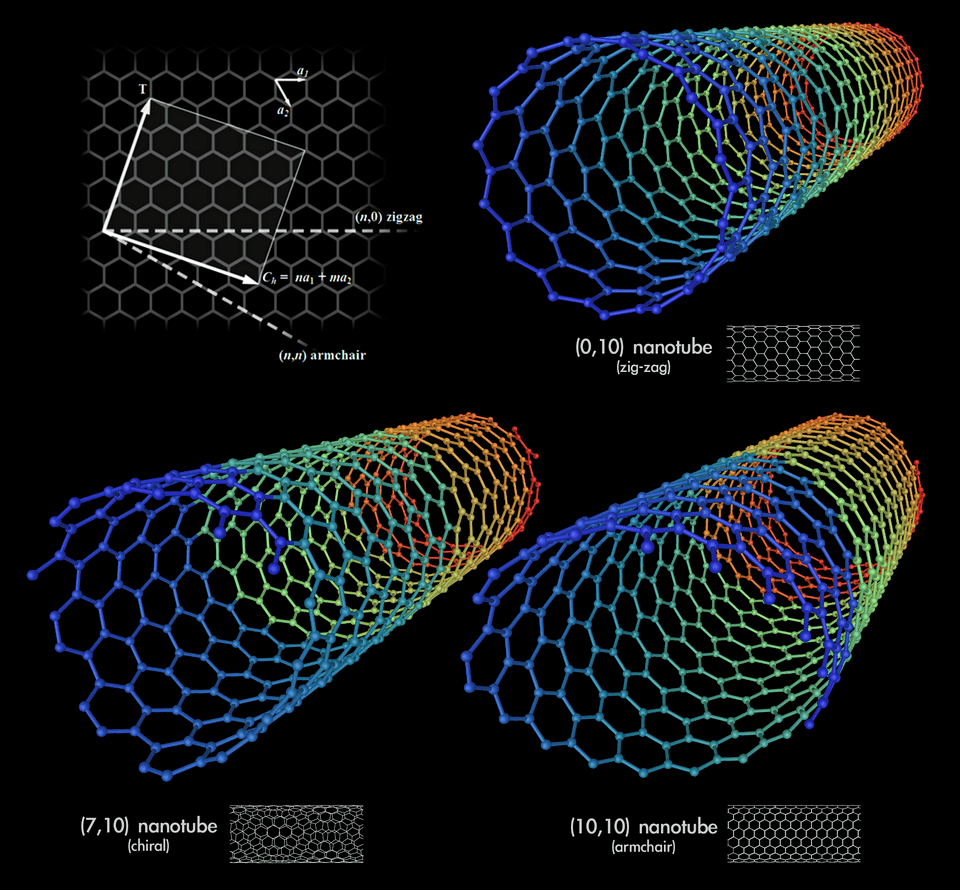
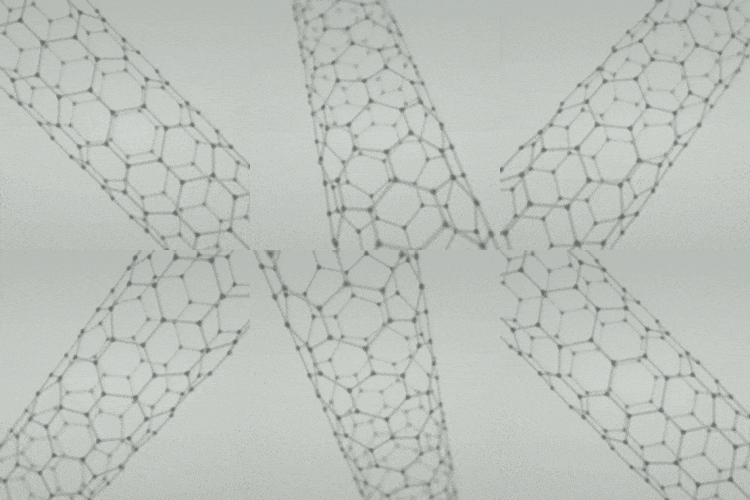
The 1991 discovery saved the project from being forgotten in the archives of theoretical physics: it filled the concept’s biggest gap, providing the materials-science foundation for a super-strong thread linking Earth to space. Even so, science still hasn’t developed an industrial method for continuously growing defect-free nanotubes of kilometer length — laboratories still manage to produce only microscopic structures, whose strength drops the moment anyone tries to weave them into a full-length cable.
Chapter 12. Blueprints for NASA: Bradley Edwards and the first real elevator design
At the turn of the millennium, the concept took its final step — from a set of science-fiction assumptions to a detailed engineering plan. From 1999 to 2003, the American physicist Bradley Edwards led a large-scale study funded by NASA’s Institute for Advanced Concepts (NIAC), aimed at producing the first comprehensive engineering roadmap for a space elevator in history.
Edwards didn’t just re-verify the physics of the cable — he worked out all of the supporting infrastructure in detail. His scenario looked pragmatic:
- first, a base spacecraft is put into orbit and carefully lowers a thin carbon “seed ribbon” down to Earth.
- Then, mechanical climber robots begin ascending this initial ribbon from the ground, gradually winding new layers of carbon nano-ribbon onto the base cable, building up its strength to industrial-scale levels.
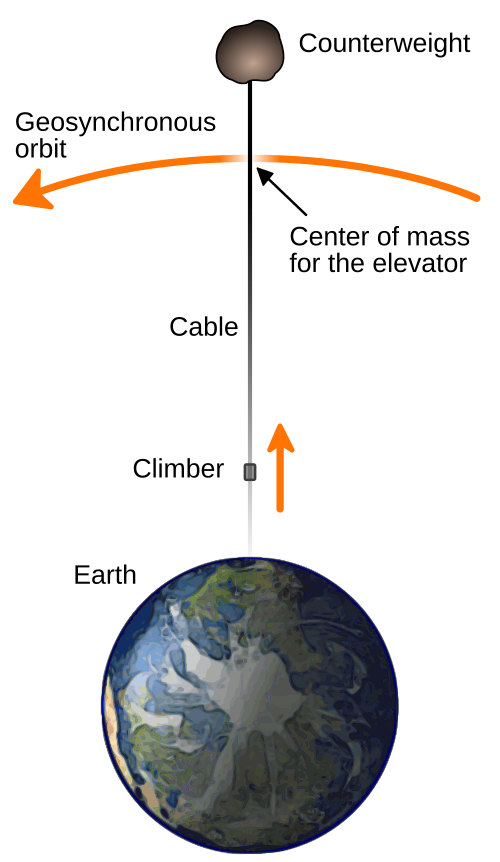
The project described the power supply system in detail: the climbers would draw power from Earth via powerful infrared lasers focused on their photovoltaic panels. Edwards calculated where to place a floating launch platform in the equatorial Pacific Ocean, analyzed the risks of collision with space debris, and proposed mechanisms for protection against lightning strikes. The project’s final estimated cost came to about 10 billion dollars — a figure comparable to the budgets of major modern space programs.
Bradley Edwards’s research turned the space elevator from a speculative hypothesis into a structured engineering plan — the project stopped being a matter for the distant future and broke down into concrete technological steps. That said, the real long-term degradation effects of the carbon ribbon under exposure to atomic oxygen in the upper atmosphere and to the harsh radiation of the Van Allen belts remain poorly studied — meaning the operational lifespan of such a system could end up needing significant revision.
Sourses:
- Wikimedia Commons — Yuri Artsutanov and Jerome Pearson meeting for the first time outside the Heritage Museum in St. Petersburg in August 2006. David Raitt
- Bryan Derksen, Lunar space elevator, CC BY-SA 3.0
- Basroks, Carbon nanotube (single-walled zigzag), CC BY-SA 3.0
- Mstroeck on en.wikipedia, Types of Carbon Nanotubes, CC BY-SA 3.0
- 齋藤千絵 名城2010Fとともに, CC BY-SA 3.0
- Booyabazooka at English Wikipedia., Space elevator structural diagram, CC BY-SA 2.0
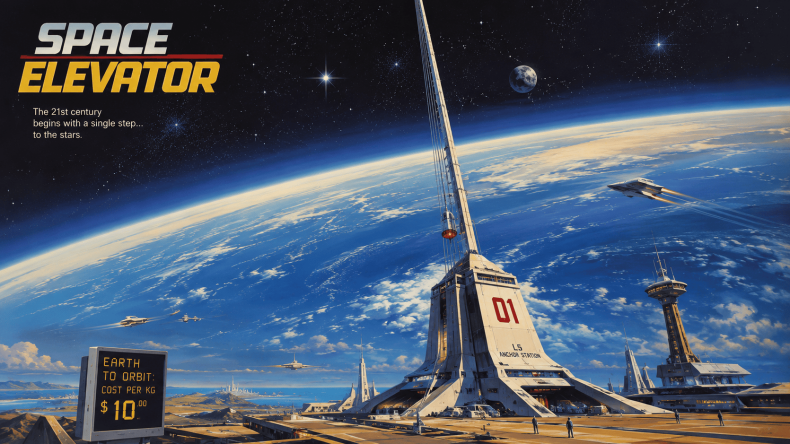
- Bandai Namco Entertainment America, International Space Elevator (Ace Combat 7), CC BY 3.0








Es un artículo muy interesante!