
←
⟶
Chapter 13. The major engineering dead ends: why aren’t we in orbit yet?
The turn of the millennium brought not just an understanding of the underlying physics, but also a harsh collision with the brutal realities of space. This is where the question shifts from could a space elevator actually work to what would actually break first — debris, radiation, or the atmosphere itself. It turned out that even if the problem of the super-strong cable were fully solved, engineers would still have to contend with an entire complex of planetary hazards — each one capable of instantly destroying a multi-billion-dollar structure.
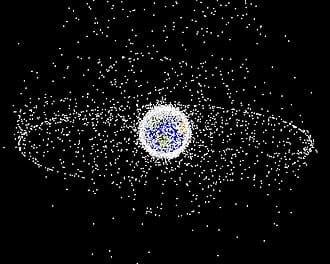
The first and most tangible threat is space debris. Hundreds of thousands of fragments from old satellites and rocket stages orbit at enormous speeds in low Earth orbit. A collision between the taut cable and even a tiny fragment weighing just a few grams would be equivalent to an artillery shell exploding. To avoid disaster, modern concepts propose making the lower anchor platform mobile: a massive ocean-going base ship would need to constantly maneuver in equatorial waters, steering the cable away from the trajectories of tracked debris — much like moving a guitar string.
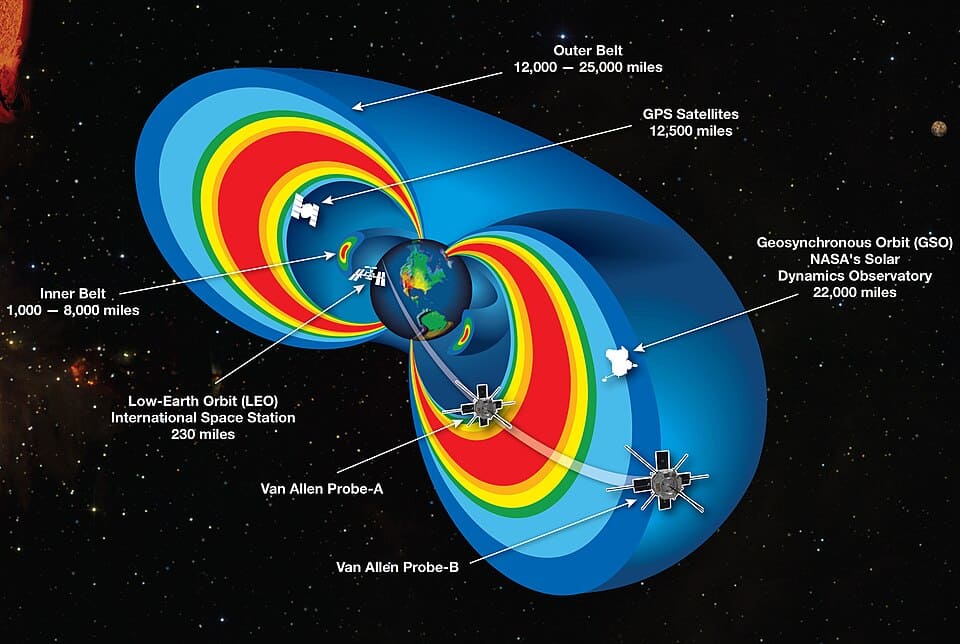
The second problem is the Van Allen radiation belts. The cable inevitably passes through zones of high concentration of energetic charged particles, which creates enormous difficulties for climber electronics and makes rapid human transit impossible without heavy lead or electromagnetic shielding. On top of this, the cable is under constant bombardment from atomic oxygen in the upper atmosphere and harsh ultraviolet radiation in the vacuum of space, causing accelerated degradation of carbon structures.
The 21st-century space elevator isn’t simply a cable and a cabin — it’s a dynamic, constantly maneuvering defense system, forced every second to withstand an aggressive space environment and human-made orbital pollution. And here physics is ahead of experiment: scientists simply don’t yet have precise data on how long macro-structures made of nanomaterials behave under the simultaneous stress of extreme temperature swings (from –150°C to +120°C) and constant tension in a vacuum.
Chapter 14. The Obayashi initiative and international consortia
Despite the skepticism, pragmatic business interests and international engineering associations have moved toward long-term planning. The key player in this field in the 21st century has been the Japanese construction corporation Obayashi Corporation. Is Japan building a space elevator? Well, in 2012, the company officially unveiled an ambitious project under which a working space elevator is meant to be operational by 2050. It has published the most detailed roadmap of anyone, though “building” is still a strong word for where things stand.

The plan is broken into clear stages and relies on international cooperation under the aegis of the International Space Elevator Consortium (ISEC). Obayashi’s engineers built the project around a cable with a total length of 96,000 kilometers. How fast a space elevator would go? According to their calculations, robotic maglev climbers would carry cargo and passengers to the geostationary station in seven days, traveling at speeds of around 200 km/h.
The project calls for creating a giant counterweight at the far end of the cable — this could be a small asteroid captured and towed to Earth, or a dedicated orbital station with a mass in the thousands of tons. International expert groups publish analytical reports every year, coordinating research into laser power transmission for climbers and the standardization of orbital safety.
Well, now the project of the space elevator has stopped being the domain of lone dreamers: major multinational businesses and specialized consortia have drawn up roadmaps, turning a science-fiction concept into an official strategy for developing the planet’s transport infrastructure over the coming decades.
One question, however, still has no answer: how long are these commercial giants willing to fund fundamental research without any interim profit, should the technological breakthrough in materials science end up being delayed? It raises the obvious question of how close we actually are to a space elevator on Earth — and the honest answer, as the next chapter shows, may be: closer on the Moon than here.
Chapter 15. A detour: the Moon and Mars elevators
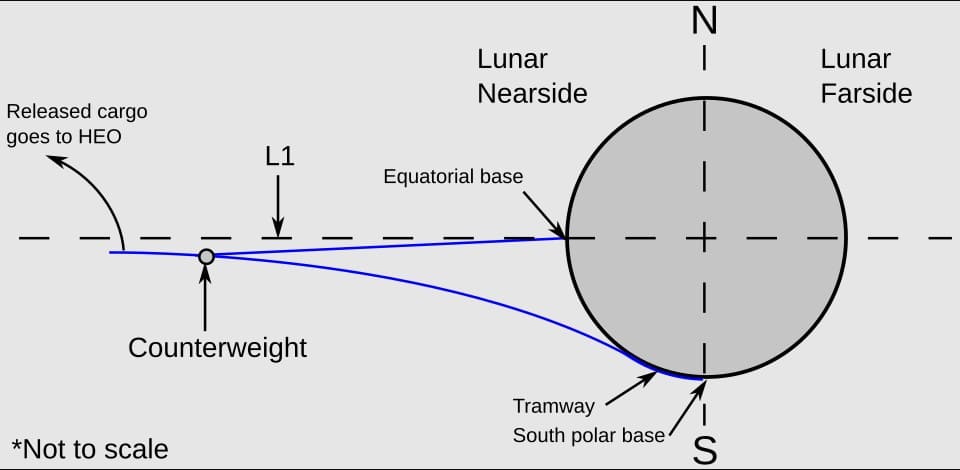
While the Earth-based project is bogged down by our planet’s colossal gravity and dense atmosphere, scientists have turned their attention to celestial bodies with far gentler conditions. That’s how the concept of the Lunar Space Elevator Infrastructure (LSEI) was born.
On the Moon, gravity is just one-sixth of Earth’s, and there’s no atmosphere at all. That changes the rules of the game entirely: mathematical calculations show that a moon elevator wouldn’t need carbon nanotubes at all. Its cable could be made today, using existing, commercially available high-strength polymers — Kevlar, Dyneema, or M5 fiber.
The lunar elevator’s cable would stretch from the Moon’s surface through the L1 or L2 Lagrange point of the Earth-Moon system, where the gravitational pulls of the two bodies balance each other out. Such an elevator would make it incredibly cheap to bring resources mined on the Moon — such as the rare isotope helium-3 — into Earth orbit, and to supply future crewed bases, without burning through enormous amounts of rocket fuel for launch and landing. Similar projects are being developed for Mars. Its elevator could be anchored to its moon Phobos.

A Moon elevator is technically achievable at today’s level of technology, and there’s a good chance humanity will build its first extraterrestrial transport staircase on the Moon, working out the mechanics there before tackling Earth’s gravity. That said, the dynamic stability of a lunar cable under the passage of massive climbers hasn’t been studied yet — whether this might trigger dangerous resonant oscillations capable of shifting the anchor point on the lunar surface is something only practice will show.
Chapter 16. Economics and Geopolitics of the Space Elevator: How Will the World Change?
If a classic rocket launch is always a colossal explosion, with 90% of the mass being fuel burned to deliver a tiny payload, then a space elevator works on the principle of an ordinary railway. Energy is spent only on lifting the cabin, and when cargo descends back to Earth, the system can be switched into a regenerative mode, feeding electricity back into the grid.
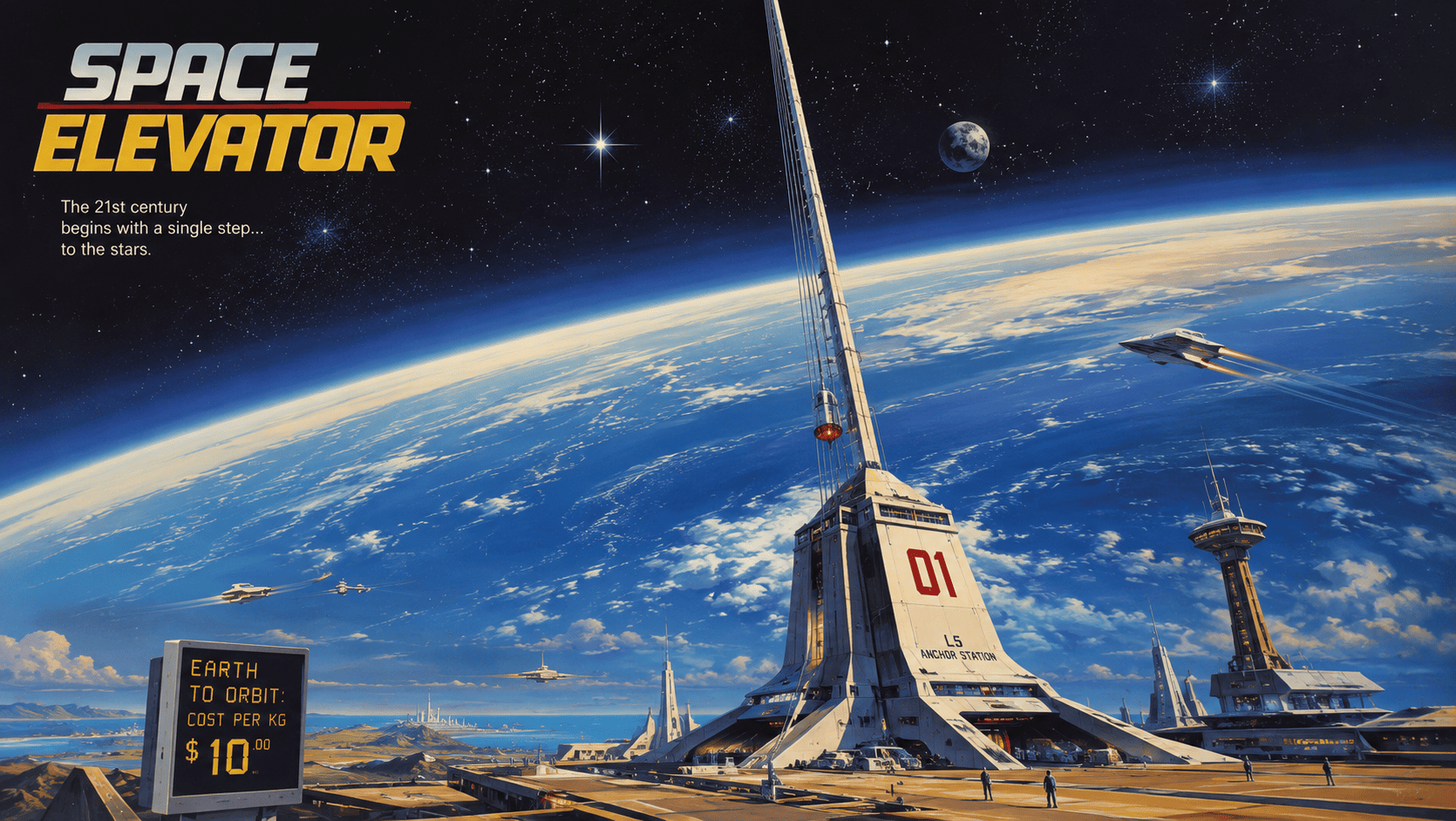
Today, launching one kilogram of cargo into geostationary orbit using the best reusable rockets costs several thousand dollars. A space elevator could bring that figure crashing down to $10–50 per kilogram. That would make the industrialization of space widely accessible: manufacturing unique medications and perfect crystals in zero gravity, deploying gigantic orbital solar power stations, and assembling interplanetary spacecraft would become routine economic operations.
However, such a breakthrough inevitably generates geopolitical tension. The elevator’s anchor point on the equator would automatically become the planet’s main transport hub — a 21st-century equivalent of the Suez Canal. Whichever country or consortium controls this “port” would gain absolute economic and military dominance in near-Earth space. The international community would have to develop an entirely new kind of space law to turn the elevator into a neutral, demilitarized zone open to all.
Launching the first space elevator would completely reshape the global economy and geopolitics: access to the resources of the Solar System would stop being an exclusive club for superpowers, sparking a technological boom comparable to the discovery of the New World. But international law still doesn’t have an answer for how to regulate an object that exists simultaneously within a specific country’s sovereign airspace and in neutral outer space — meaning humanity could well run into a genuine legal deadlock at the construction stage.
Chapter 17. When will the space elevator doors open?
Having traveled a long road — from the ancient sacred ziggurats of Mesopotamia, through the bold thought experiments of the late 19th century, to the rigorous nanotechnology labs of today — the idea of the space elevator has proven remarkably resilient. It never died under the weight of skeptics; it simply crystallized, turning from a poetic dream into a dry engineering blueprint.
The answer to the question “when?” no longer lies purely in the realm of theory. The laws of physics fully endorse this project. So the question was never really can we build a space elevator — it’s when materials science catches up to the blueprint. The key marker for the start of construction is the emergence of an industrial technology for producing long, defect-free macro-threads of carbon or graphene. As soon as materials science takes that final step, building this giant transport artery will become simply a matter of funding and political will.

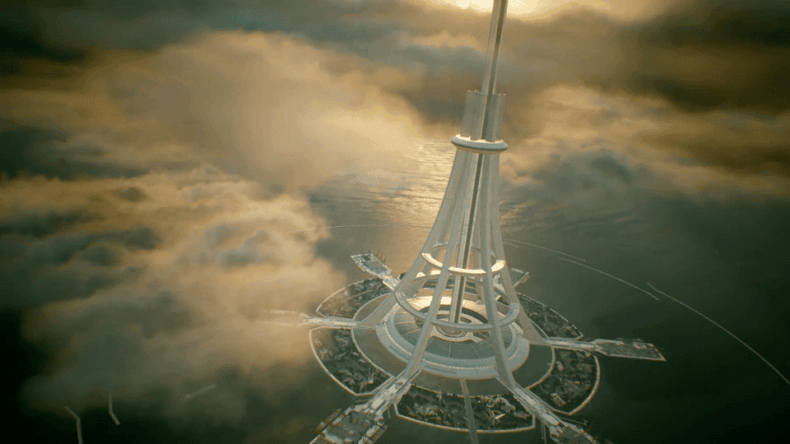
Humanity is destined to build this staircase. Our planet is only the cradle of the mind, but a civilization cannot live in its cradle forever. And when the first climber gently lifts off from a floating platform in the Pacific Ocean and rises through the clouds toward the stars, we’ll understand that the sky is no longer a boundary. It will have become the beginning of a new, truly cosmic chapter in human history — a story whose author we don’t yet know: will it be the combined effort of all humanity under the aegis of the United Nations, or the bold breakthrough of a single private corporation that got there ahead of its time?
Sources:
- Klapi, Doctor Emmett Brown Back to the Future Cosplay, CC BY-SA 4.0
- ISEC image on home page ISEC home page www.isec.org