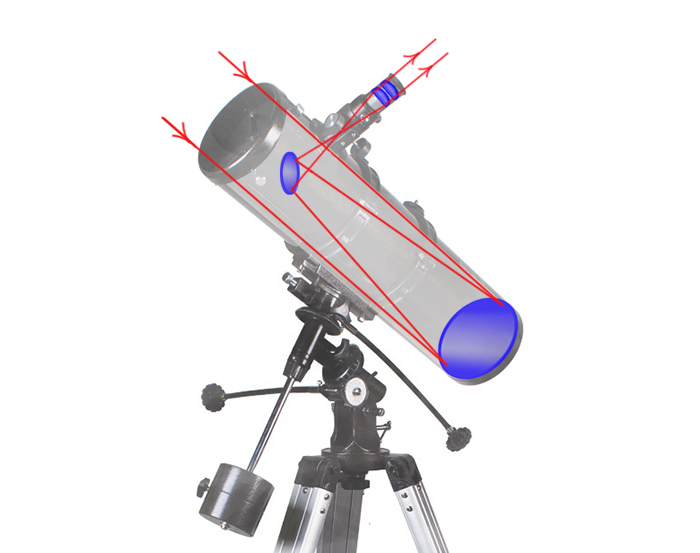
In 1668, just 59 years after Galileo introduced the refracting telescope, Isaac Newton built the first successful reflecting telescope. His design was inspired by ideas proposed earlier by Scottish astronomer James Gregory in Optica Promota (1663).
Newton’s breakthrough solved a major problem of refracting telescopes: chromatic aberration — the color distortion caused by lenses bending different wavelengths of light at slightly different angles.
Instead of lenses, a reflecting telescope uses mirrors to gather and focus light. This simple shift changed astronomy forever.
Today, every major professional observatory in the world relies on reflecting telescopes.
How a reflecting telescope works
A reflecting telescope uses a primary mirror instead of a large objective lens.
Here’s the basic process:
- Light enters the open end of the tube.
- It strikes a large primary mirror at the back.
- The mirror reflects and focuses the light toward a focal point.
- A secondary mirror redirects the light into the eyepiece (or camera).
Because mirrors reflect light rather than refract it, reflectors do not suffer from chromatic aberration.
Another key advantage:
Mirrors can be supported from the back, which allows them to be made much larger than lenses. This is why the world’s largest telescopes are reflectors.
Major Types of Reflecting Telescopes
The Newtonian scheme remains the most popular among reflecting telescopes.
Newtonian Reflector
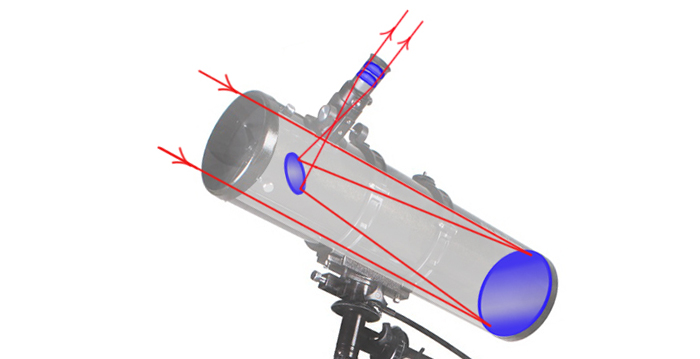
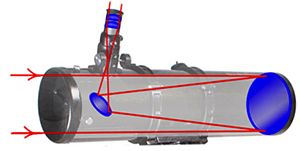
The Newtonian design is the simplest and most popular reflecting telescope for amateur astronomers. The secondary flat mirror is located near the focus point. As it`s turned diagonal, it leads the light outside. This type has a recognizable design, where the eyepiece sticks out of a pipe side.
How it works:
- A parabolic primary mirror collects light.
- A small flat secondary mirror, positioned at a 45-degree angle near the focal point, redirects light to the side of the tube.
- The eyepiece is mounted on the side.
Why it’s popular:
- Affordable
- Simple design
- Excellent light-gathering power
- Great for deep-sky observing
Downside:
- Requires occasional collimation (mirror alignment).
- The open tube allows dust to enter.
Cassegrain Telescope
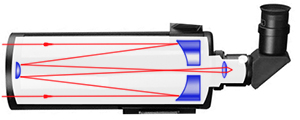
The classical Cassegrain uses:
- A concave primary mirror
- A convex secondary mirror
Light reflects off the primary mirror, then off the secondary mirror, and finally passes through a hole in the primary mirror to reach the eyepiece at the back of the telescope.
Advantages:
- Long focal length in a compact tube
- Comfortable rear viewing position
Optical note:
The classical Cassegrain design can show off-axis aberrations such as coma. Many modern variants improve on this system.
Gregorian Telescope
The Gregorian design uses:
- A parabolic primary mirror
- A concave elliptical secondary mirror
The secondary mirror sits beyond the primary focal point and reflects light back through a hole in the primary mirror.
This design produces an upright image, which historically made it useful for terrestrial viewing.
Today, it is less common than Newtonian or Cassegrain systems.
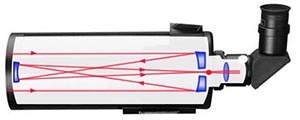
Ritchey–Chrétien Telescope
The Ritchey–Chrétien (RC) is an advanced form of the Cassegrain design.
It uses:
- A hyperbolic primary mirror
- A hyperbolic secondary mirror
This configuration eliminates coma and significantly reduces other off-axis distortions.
Why it matters:
- Produces sharp images across a wide field of view
- Ideal for astrophotography
- Used in many professional observatories
- The Hubble Space Telescope uses this design
The trade-off:
More complex to manufacture and align
More expensive

Nasmyth Focus
The Nasmyth system is a variation of the Cassegrain design.
After reflecting off the secondary mirror, the light is redirected by a third flat mirror to the side of the telescope mount.
This configuration is often used in large research telescopes because:
Heavy scientific instruments can be mounted without stressing the telescope structure
Why Reflecting Telescopes Dominate Modern Astronomy
Reflectors became the standard in professional astronomy for several reasons:
1. Large Aperture Capability
Mirrors can be built much larger than lenses.
Large aperture means:
- More light gathering
- Better resolution
- Ability to see faint, distant galaxies
2. No Chromatic Aberration
Mirrors reflect all wavelengths equally, eliminating color fringing.
3. Cost Efficiency
Large reflectors are significantly cheaper to produce than large refractors.
4. Compact Design
Folded optical paths (like in Cassegrain systems) allow long focal lengths in short tubes.
Advantages of Reflecting Telescopes
- No chromatic aberration
- Large apertures at lower cost
- Excellent for deep-sky observing
- Compact designs possible
- Widely used for astrophotography
- Dominant in professional research
Disadvantages of Reflecting Telescopes
- Require periodic collimation (optical alignment)
- Open-tube designs allow dust accumulation
- Longer thermal stabilization time (mirrors must cool to ambient temperature)
- Slightly lower contrast compared to high-end refractors
- Secondary mirror obstruction reduces light slightly
Reflectors vs. Refractors: Which Is Better?
It depends on your goal.
If you want:
- High contrast views of planets → refractor
- Deep-sky objects and galaxies → reflector
- Maximum aperture per dollar → reflector
- Minimal maintenance → refractor
For most beginners interested in serious observing, a Newtonian reflector offers the best balance of performance and price.