The Rocky Talkie Mountain Radio is our main recommendation when choosing a walkie talkie for snowboarding: its carabiner, backup leash, and straightforward controls address the practical problem of keeping a radio attached and accessible on the mountain. Choose the Motorola TALKABOUT T605 H2O for a more affordable two-radio kit with IP67 protection and AA battery backup. The Rocky Talkie Expedition adds waterproof construction and GMRS features for licensed users. None guarantees coverage across an entire ski resort: a ridge between riders can interrupt communication regardless of the advertised mileage.
- Secure mountain attachment: Rocky Talkie Mountain Radio.
- Waterproof kit for friends: Motorola TALKABOUT T605 H2O.
- Lower-cost waterproof option: Retevis RT49P, US FRS version.
- Main trade-off: better attachment, extra features, and higher power solve different problems; none removes terrain limitations.
- Match the radio service to everyone who will transmit.
- Compare snow protection, attachment, and access to the push-to-talk button.
- Check the exact kit, battery options, and charging connection.
WALKIE TALKIES FOR SNOWBOARDING AND SKIING ON

- ✓ Compare radio kits
- ✓ Check the exact version
- ✓ View current offers
As an Amazon Associate, we earn from qualifying purchases at no extra cost to you.
Compare Six Walkie Talkies for Snowboarding and Skiing
Start with protection, attachment, and licensing. Price symbols indicate relative cost per radio based on the checked US offer, which may come from a retailer other than Amazon. N/A means comparable information was not established.
| Category | Best Value for Money | Advanced Features | Premium Options | Budget Options | ||
|---|---|---|---|---|---|---|
| Model | 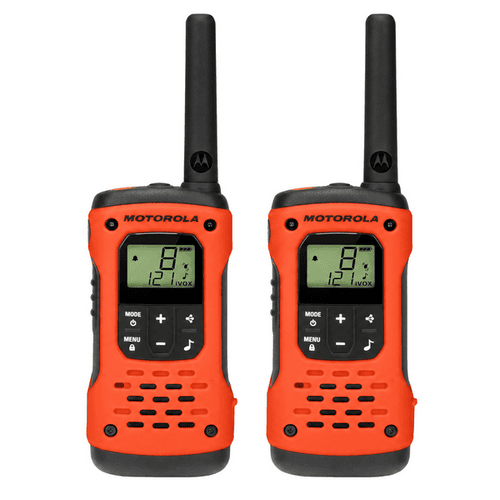 Motorola TALKABOUT T605 H2O | 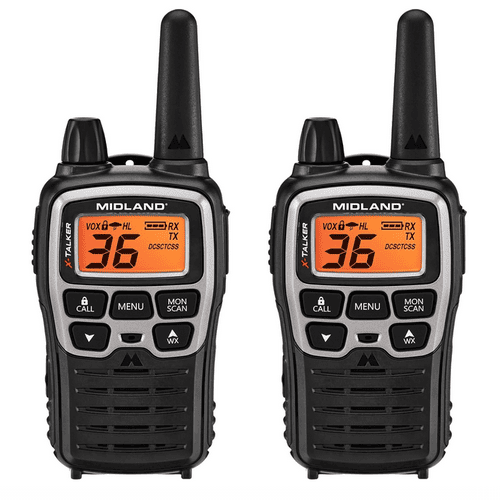 Midland X-Talker T71VP3 | 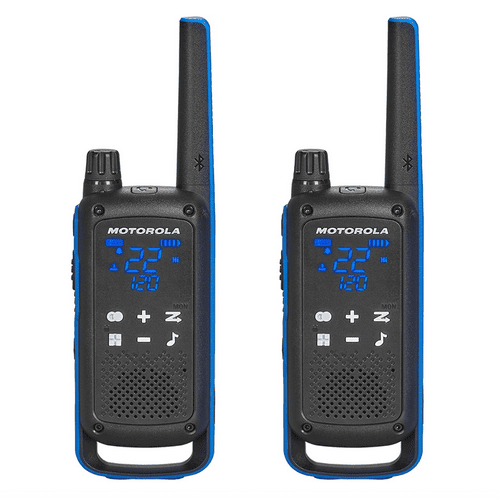 Motorola TALKABOUT T802 | 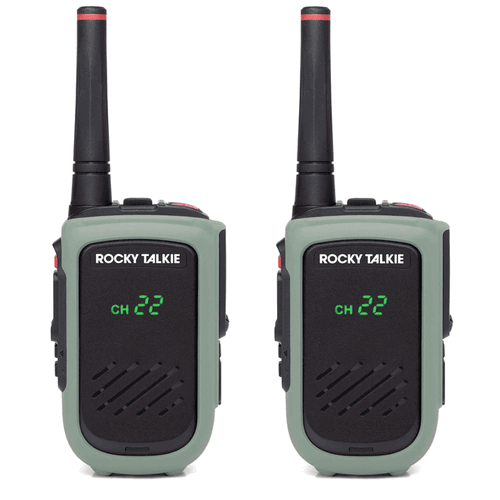 Rocky Talkie Expedition Radio | 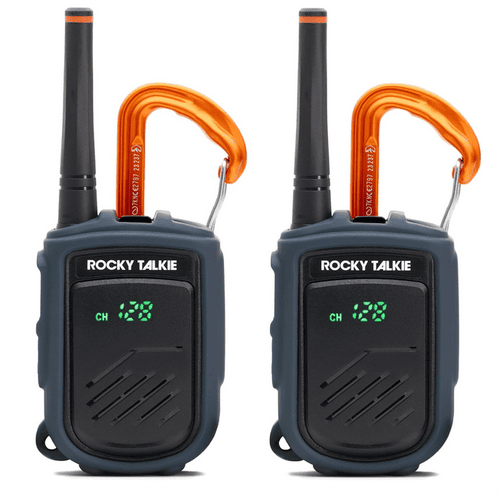 Rocky Talkie Mountain Radio | 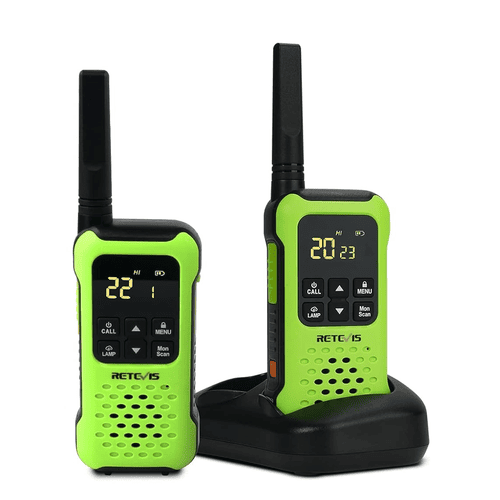 Retevis RT49P US FRS |
| Radio standard / version | US FRS | US FRS | US FRS | US GMRS | US FRS | US FRS, 22-channel version |
| License / authorization | No individual license for compliant FRS use | No individual license for compliant FRS use | No individual license for compliant FRS use | GMRS license; eligible family use under its terms | No individual license for compliant FRS use | No individual license for compliant FRS use |
| Featured | Waterproof AA backup | Desktop charging base | Bluetooth audio connectivity | Waterproof GMRS capability | Carabiner and leash | IP67 water protection |
| Channels / memory | 22 FRS channels; 121 codes | 22 FRS frequencies; 36 selections including coded presets | 22 FRS channels; 121 codes | Shared simplex channels plus 8 GMRS repeater channel pairs | 22 FRS frequencies; 128 selections including coded presets | 22 FRS channels |
| Voice / additional communication | Analog voice | Analog voice | Analog voice; app-enabled messaging and location sharing | Analog voice; repeater capable | Analog voice | Analog voice |
| Ready-to-carry weight | N/A | N/A | 7.2 oz with supplied battery; extra accessories excluded | N/A for complete attachment configuration | Approximately 7.9 oz with leash, per manual | N/A |
| Protection | IP67; headset use limited to dry conditions | Water resistant; comparable IP rating not established | IP54 splash protection | IP67 | IP56; not submersible | IP67 |
| Battery / charging | NiMH pack or 3 AA; USB-C | Rechargeable pack or 3 AA; Micro-USB and desktop base | 1300 mAh NiMH pack or 3 AA; USB-C | Replaceable 1800 mAh Li-ion; USB-C | Replaceable 1550 mAh Li-ion; USB-C | Rechargeable AA cells / AA backup; Micro-USB |
| Attachment | Belt clip | Belt clip | Belt clip | Rotating steel clip and backup leash | Carabiner and backup leash | Verify retention with your chosen clothing or pack |
| Main trade-off | No app or Bluetooth features | Less clearly documented protection against prolonged wet exposure | Phone-dependent extras; not submersible | Licensing and higher cost | Premium price; no submersion protection | Older charging connector; glove usability not independently compared |
| Price & Offer | $ | $ | $ | $$$ | $$ | $ |
Quick Picks by Use Case
Choose the problem you need to solve before paying for extra features.
Licensing & Legal Use
FRS is the straightforward starting point for friends
For ordinary recreational communication in the United States, a compliant FRS radio does not require an individual FCC license. The relevant framework is 47 CFR Part 95, including Section 95.305 and Subpart B. This applies to the US FRS versions selected here, not to any programmable radio that happens to cover the same frequencies.
FRS equipment must meet its service rules. Sections 95.561, 95.563, and 95.567 address certification, channels, and power; Section 95.587 includes the integral-antenna requirement. FRS power is limited to 0.5 watt ERP on channels 8–14 and 2 watts ERP on the other FRS channels. More advertised channel selections do not create more frequencies.
The Expedition is a different licensing decision
The Rocky Talkie Expedition is a GMRS radio. Under 47 CFR Section 95.1705, ordinary operation requires an individual GMRS license or operation under the permitted authority of a license holder. Eligible immediate family members may operate under that license, but an unrelated friend does not automatically gain authorization by joining the same ski group. Plan licensing before assigning GMRS radios.
Shared simplex channels can allow compatible FRS and GMRS radios to communicate, but each operator must still meet the requirements of the radio service being used. A GMRS radio does not become license-free when communicating with an FRS radio. Likewise, repeater capability does not provide permission or access to a particular repeater. NOAA weather reception provides information; it is not a way to call ski patrol.
How We Selected and Evaluated These Radios
This comparison centers on six selected US-market handheld radios with different buying roles: waterproof consumer kits, app-connected communication, mountain-focused attachment, a GMRS upgrade, and a budget waterproof pair. Colors and different pack sizes are not counted as separate models.
Five choices keep ordinary group operation within FRS. The Expedition is included separately for buyers prepared to meet GMRS requirements. Its additional capabilities are not treated as a reason every recreational group should switch services.
- Service and version: the American radio service must match the intended operators.
- Snow and moisture: documented protection takes priority over vague waterproof descriptions.
- Retention: clips, carabiners, and backup leashes affect how the radio is carried.
- Controls: button layout matters, but glove usability requires personal checking.
- Power logistics: replacement batteries, AA backup, and charging connections affect a full day outside.
- Useful extras: Bluetooth and repeaters matter only when the group will use them.
- Total purchase: compare the number of radios and included accessories before judging value.
This is a document-based buying comparison, not a hands-on snow test. Specifications come from manufacturer pages, manuals, and model documents. US retailer offers provide price context where an Amazon price could not be verified.
Amazon listing evidence varies by model, and current Amazon stock was not established. We do not assign measured audio, cold-weather endurance, or resort-wide range scores. Recommendations about suitability are editorial judgments based on the documented design and its limitations.
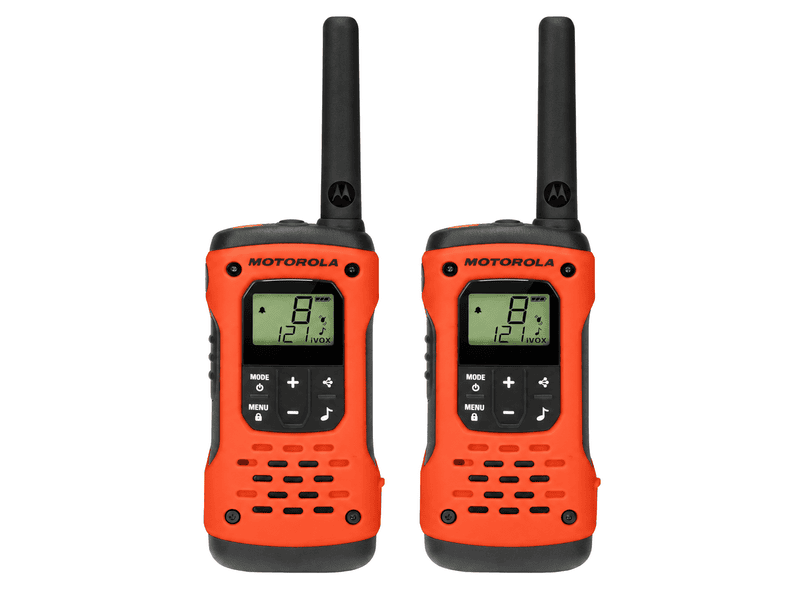
Motorola TALKABOUT T605 H2O — US FRS
Choose the T605 H2O when wet-snow protection and flexible batteries matter more than phone features. Its two-radio package is a practical starting point for friends who want conventional push-to-talk communication.
Why We Selected It
The T605 combines IP67 protection with a choice of rechargeable NiMH packs or three AA batteries per radio. That pairing is useful for a ski trip: moisture protection addresses wet exposure, while spare batteries offer another power option away from a charger. The checked T605 package also includes spare rechargeable packs and a carrying case. Its value comes from the complete kit and documented protection, rather than a claim of superior reception.
- IP67 provides a documented water-protection benchmark; maintain covers and seals instead of assuming every connected accessory preserves that rating.
- AA compatibility gives you a replacement-power option when charging is inconvenient; carry suitable cells according to the manufacturer’s instructions.
- The supplied belt clip supports conventional carrying, but inspect its fit on your jacket or pack before boarding a lift.
Friends or families who want a waterproof FRS pair, prefer voice communication, and value spare-power flexibility without adding phone pairing to their morning setup.
Buyers who specifically want Bluetooth audio or app-based messages. It also deserves a closer carrying check if your priority is a supplied carabiner-and-leash arrangement.
Our Verdict
We would choose the T605 over the T802 when water protection takes priority over connected features. Compared with the Mountain Radio, it offers AA backup and a more accessible two-radio purchase, while the Mountain puts more emphasis on attachment. The important accessory caveat is that Motorola specifies headset use in dry environments: the radio’s IP67 rating should not become a promise about a wired headset used in falling snow. Buy it for a practical waterproof voice kit, then check how you will carry and operate it.
PROs
- Documented IP67 protection
- Rechargeable packs or AA batteries
- USB-C charging
- Useful two-radio kit
CONs
- No T802-style connected features
- Headset use specified for dry conditions
- No supplied Mountain-style carabiner system
Assessment uses current US T600-series information and the T605 kit description. Check that the listing matches the USB-C package: older documentation and stock can describe different charging accessories.
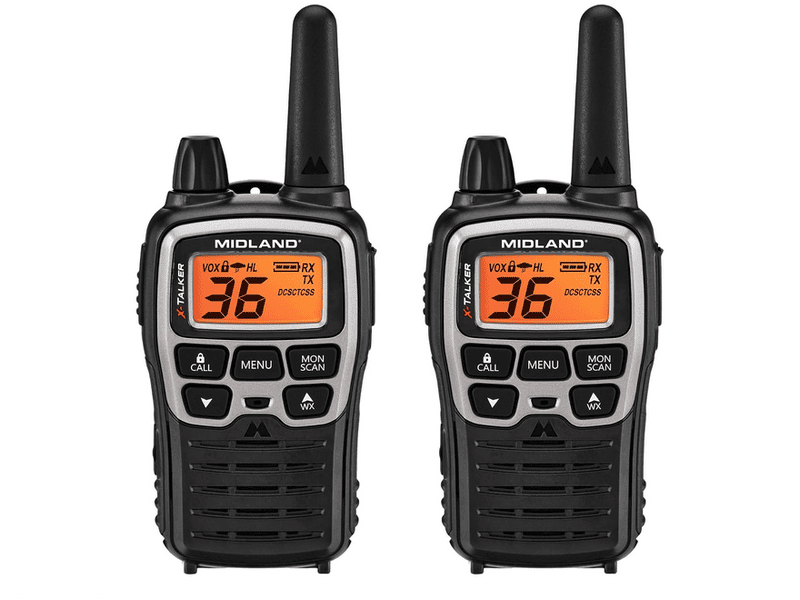
Midland X-Talker T71VP3 — US FRS
The T71VP3 is a sensible conventional kit when charging convenience and AA backup matter. Its weaker point for snowboarding is protection: water resistance is documented, but comparable IP67 protection was not established.
Why We Selected It
Not every rider needs app integration or a mountain-specific mounting system. The T71VP3 supplies two FRS radios, rechargeable packs, belt clips, and a desktop charger in a familiar format. It can also use three AA batteries per radio. That makes it an alternative for buyers who want a straightforward charging routine at the lodge. For exposed use in wet snow, however, we give greater weight to the explicitly rated protection of the T605.
- The desktop charger offers a convenient place to return both radios after a day outside; confirm charging contacts are dry first.
- Rechargeable packs and AA compatibility provide two power approaches, allowing the group to plan backups rather than depend on one charging opportunity.
- Weather reception adds an information source when coverage is available; it does not connect the radio to resort staff or emergency dispatch.
Occasional resort visitors who want a conventional two-radio set, appreciate a desktop charging base, and can keep the radios protected from prolonged wet exposure.
Riders who expect a radio to remain exposed during persistent wet snowfall and want a clearly documented submersion rating. Choose an IP67 alternative for that requirement.
Our Verdict
The T71VP3 earns its place through kit convenience, not through the advertised mileage or its larger number of channel selections. Those selections include coded presets rather than 36 independent FRS frequencies. Compare the total kit cost with the T605: if the difference is modest, the latter’s documented IP67 protection is a persuasive reason to spend more for snow use. Choose the Midland when you value its charging arrangement and can accommodate the protection limitation, rather than assuming every outdoor-branded radio offers the same weather resistance.
PROs
- Two-radio kit with desktop charger
- AA backup option
- License-free FRS operation
CONs
- Comparable IP67 protection not established
- Micro-USB rather than USB-C
- Coded presets can be mistaken for additional frequencies
The selected product is the current US T71VP3 FRS kit. Some retailer descriptions contain older licensing language; this comparison follows Midland’s current service designation and model documentation.
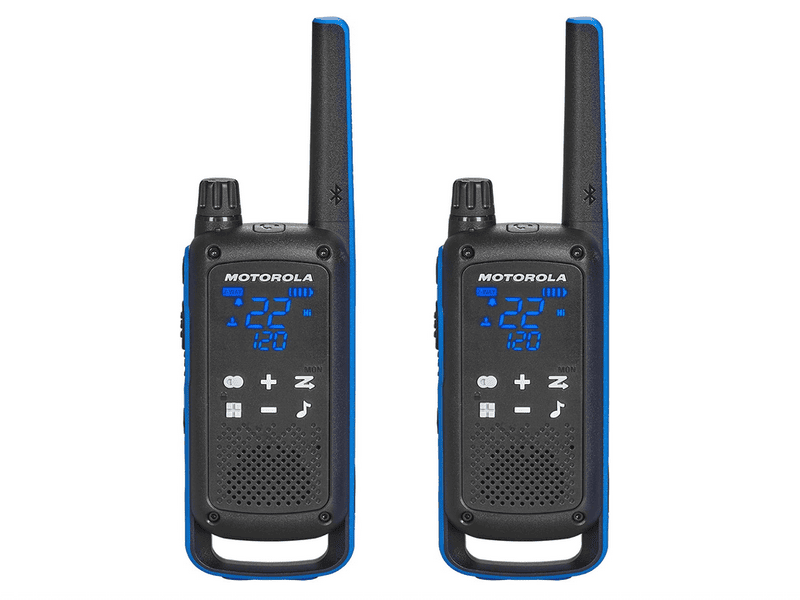
Motorola TALKABOUT T802 — US FRS
The T802 is the pick for riders who will use Bluetooth audio and TALKABOUT app features. Choose it for those capabilities, while accepting IP54 protection and the extra preparation that connected functions require.
Why We Selected It
The T802 provides a different reason to buy: Bluetooth connectivity supports compatible audio accessories and a smartphone app with messaging and location-sharing functions. These can help a group communicate beyond spoken directions when everyone prepares the necessary equipment. They still depend on the radio link and device setup; they are not cellular-independent tracking at unlimited distance. Conventional voice remains available, while NiMH packs, AA compatibility, and USB-C give familiar power options.
- Bluetooth audio connectivity creates an accessory option without a wired plug, but confirm compatibility and operation with your exact headset before traveling.
- App-based messages and location sharing offer alternatives to voice when configured correctly; they remain bounded by radio coverage and phone readiness.
- AA compatibility offers a power fallback for the radio, although a working phone is still required for the smartphone-based functions.
Groups willing to pair devices, check app compatibility, and practice before the trip. It is especially relevant when Bluetooth audio is a real requirement rather than a speculative extra.
Anyone seeking the fewest setup steps or a submersible radio. Riders who want uncomplicated voice communication with stronger water protection should compare the T605 first.
Our Verdict
Choose the T802 over the T605 because you want its connected functions, not because it is a newer route to longer voice range. Its IP54 rating is meaningful splash protection, but it is not IP67. The app adds another device, battery, and setup dependency to your day, which some groups will consider useful and others unnecessary. Before buying several sets, establish that everyone will actually use the messaging or location tools. For a group that only needs “meet at this lift,” a simpler radio can be the better purchase.
PROs
- Bluetooth audio connectivity
- App-enabled messaging and location sharing
- USB-C and AA backup
CONs
- IP54 rather than submersion protection
- Connected functions require additional setup
- Phone battery matters for app features
Specifications refer to the US T802, not the older T800 or a T803 accessory bundle. App functions and Bluetooth accessory support are manufacturer-described; this comparison does not establish compatibility with every phone or helmet headset.
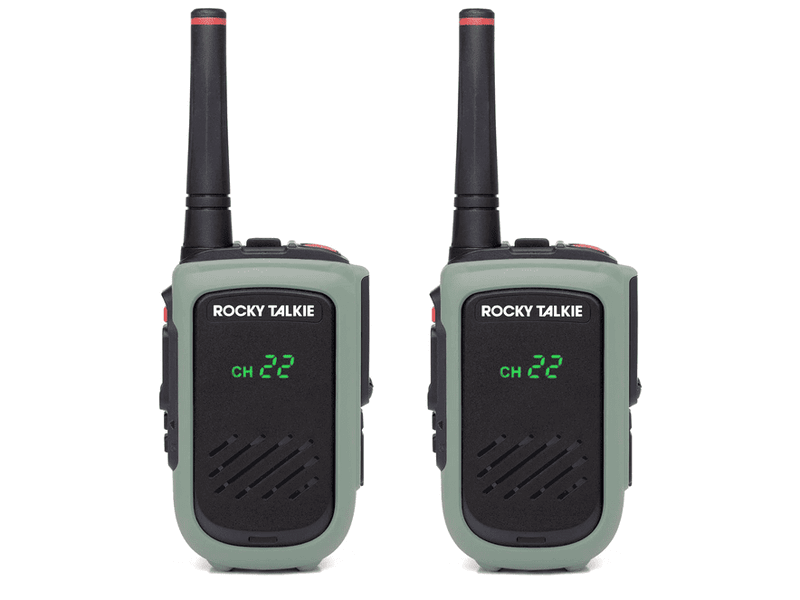
Rocky Talkie Expedition Radio — 5-Watt GMRS
The Expedition combines IP67 construction, a backup leash, and GMRS capabilities. It is a purposeful upgrade for authorized users, but licensing, additional cost, and terrain limits remain part of the decision.
Why We Selected It
The Expedition adds IP67 protection, higher-power GMRS operation, removable antennas, and repeater capability to a mountain-oriented carrying arrangement. The supplied rotating steel clip and backup leash address retention, while the replaceable lithium-ion battery supports a spare-pack strategy. These are useful distinctions from the Mountain Radio. However, the upgrade also changes operator requirements, and repeater channels are only useful when an appropriate repeater is available and its use is permitted.
- The steel clip and backup leash provide two retention elements; test their placement so neither interferes with clothing, straps, or movement.
- Two supplied antenna lengths offer a configuration choice, but the longer antenna should be evaluated for comfort and snagging on your equipment.
- Repeater capability adds an option beyond direct communication when local infrastructure and permission align; it is not automatic resort-wide coverage.
GMRS-authorized users who want a waterproof mountain radio, replaceable power, and the option of repeater operation. It suits a planned equipment system more than an unprepared group purchase.
Unrelated friends expecting one person’s license to cover everyone, or buyers who mainly need ordinary FRS voice communication and would leave the extra features unused.
Our Verdict
The Expedition makes sense when you can name the upgrade you need: IP67 instead of the Mountain’s IP56, GMRS features, or a compatible accessory arrangement. It does not make sense as a default answer to “I want more range” without considering the terrain and legal setup. Compared with the T605, it is a much more expensive way to equip a pair, and it removes the AA fallback. Buy the complete configuration you need, including any optional microphone, rather than judging the purchase by the radio’s power alone.
PROs
- IP67 protection
- Steel clip and backup leash
- Replaceable battery
- Removable antennas and repeater capability
CONs
- GMRS authorization required
- High cost to equip multiple riders
- No AA battery fallback
This is the US Expedition 5-Watt GMRS model, also encountered under the earlier 5 Watt Radio name. Manufacturer endurance claims are not treated as measured winter runtime in this comparison.
Rocky Talkie Mountain Radio — US FRS
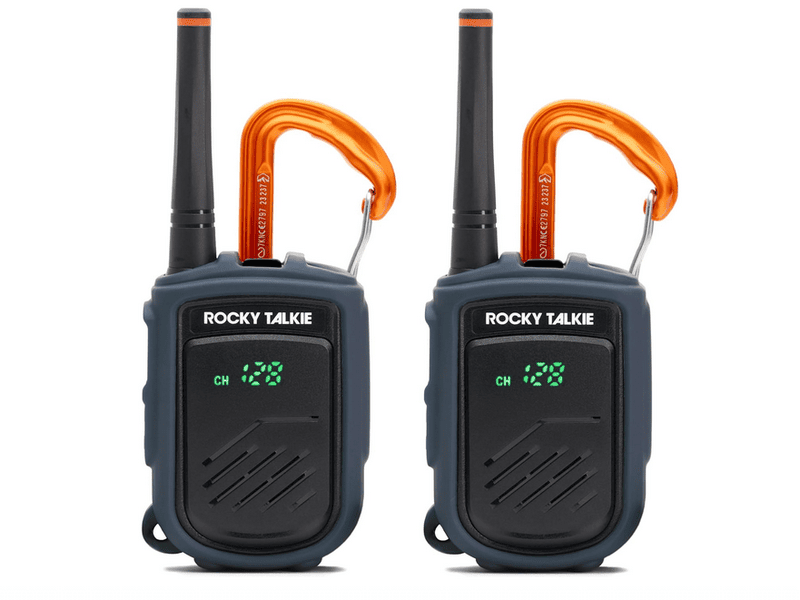
The Mountain Radio is our main pick for riders willing to pay for attachment and straightforward operation. Its strongest buying argument is the carrying system, rather than additional features or guaranteed extra range.
Why We Selected It
A radio is easier to use consistently when you can keep it accessible without worrying about a single plastic clip. The Mountain Radio supplies a carabiner and backup leash, alongside a large side push-to-talk button and channel locking. Its FRS service keeps individual licensing out of the group’s preparation. This is a premium choice because those design details address mountain carrying, while the IP56 rating and lack of AA backup remain clear limits.
- The carabiner and backup leash provide a supplied retention system; place both carefully so they remain clear of moving lift equipment.
- Channel locking helps prevent accidental setting changes while carrying the radio; verify the agreed channel before locking the controls.
- A replaceable lithium-ion pack allows planned spare power, while the manual distinguishes operating temperatures from the warmer conditions required for charging.
Frequent riders who prioritize a supplied attachment system, simple voice communication, and FRS operation. It is particularly relevant when the radio will be carried on a compatible pack strap.
Buyers seeking the lowest-cost pair, AA battery backup, Bluetooth audio, or protection against submersion. Its focused feature set should match your priorities before you pay the premium.
Our Verdict
Choose the Mountain over the T605 when attachment and control simplicity matter enough to justify the higher cost. Choose the T605 instead when waterproofing and AA fallback are more important. The Mountain’s IP56 rating is appropriate to its documented snow-and-splash protection, but it is not an immersion rating. Likewise, the manufacturer’s multi-day battery claim is not a promise for every temperature or transmission pattern. Our recommendation rests on its focused physical design; it does not imply that we measured better audio or reception than the other FRS picks.
PROs
- Supplied carabiner and backup leash
- Channel lock and large side PTT
- Replaceable battery and USB-C
- No individual FRS license
CONs
- Premium cost per radio
- Not submersible
- No AA fallback or Bluetooth audio
Assessment follows the current Mountain Radio specification and manual. The manual lists approximately 7.9 oz with leash; the smaller radio-only weight should not be used as the complete carried weight.
Retevis RT49P — US 22-Channel FRS
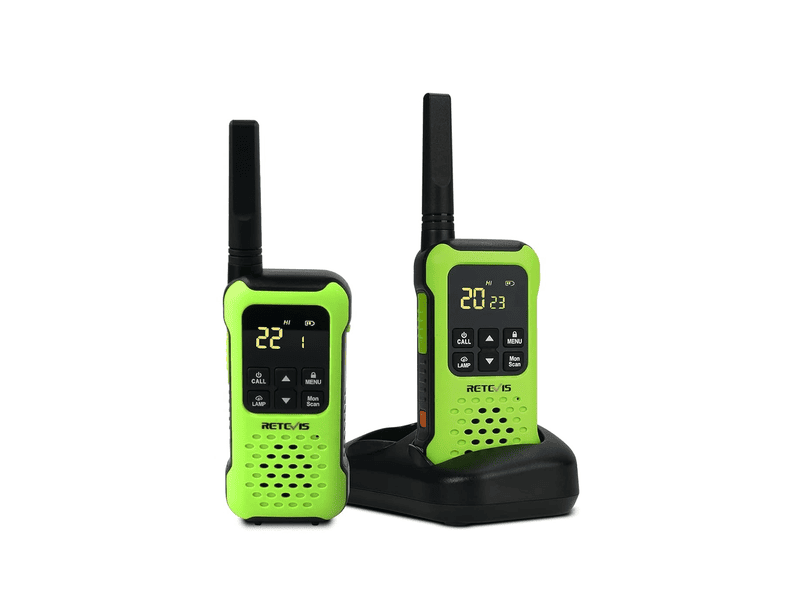
The RT49P offers a budget route to a waterproof FRS pair. It belongs on the shortlist when price matters, provided you verify the US version and accept older charging hardware.
Why We Selected It
The US FRS RT49P combines a relatively accessible pair price with manufacturer-specified IP67 protection and AA-based power. That gives it a meaningful role alongside the more expensive T605, rather than making it another generic low-cost radio. We have not established equal glove usability, audio performance, or cold-weather endurance between them. Its value therefore depends on the documented features and your willingness to check controls, retention, and charging accessories before committing to a group set.
- IP67 gives a published water-protection benchmark at a lower kit price; inspect covers and battery-compartment seals before exposing the radio.
- AA-based power can simplify spare-cell planning, but only approved rechargeable cells should be charged using the radio’s charging arrangement.
- The standard FRS channel set supports basic group voice communication without a smartphone app or individual license for compliant use.
Budget-conscious resort visitors who want documented water protection and can spend time checking the radio’s controls and carrying arrangement with their actual winter clothing.
Buyers who require USB-C throughout their travel kit or want the supplied mountain attachment system of the Rocky Talkie. Choose on those needs rather than the price alone.
Our Verdict
The RT49P is the budget alternative to consider before buying an unbranded radio with unclear regional specifications. Against the T605, its appeal is the lower checked pair price, while the Motorola offers USB-C and a clearly described accessory kit. Against the Mountain Radio, the difference is primarily carrying design and purchase cost. Do not assume the RT49P is equally comfortable in thick gloves just because both radios can transmit on FRS. A short indoor control check followed by an outdoor group trial is particularly valuable before your first full day.
PROs
- Lower-cost two-radio option
- Manufacturer-specified IP67
- AA-based power
CONs
- Micro-USB charging
- No supplied Mountain-style carabiner system established
- Comparative glove and winter-runtime performance unverified
The selected version is the 22-channel US FRS RT49P. Confirm the service, included cells, and charging accessories on the exact offer. Historical Amazon listing evidence does not establish present stock.
How to Choose a Walkie Talkie for Snowboarding
The best purchase is the one your whole group can carry, operate, and power consistently. Work through these decisions before comparing advertised miles.
Choose the service for the whole group
Start with who will press the transmit button. US FRS is the straightforward option for unrelated friends who want ordinary recreational voice communication without individual licensing. GMRS can be appropriate for authorized operators, but it adds preparation that should happen before the trip. A powerful radio handed to an unlicensed friend is not a practical upgrade. Avoid buying a programmable amateur radio simply because a listing mentions the same frequencies; frequency coverage alone does not establish service compliance.
Match protection to how you carry the radio
A radio clipped outside a pack faces different exposure from one carried inside a jacket. The Mountain’s IP56 and T802’s IP54 describe protection levels that should not be confused with IP67 submersion protection. Even an IP67 radio needs its seals and covers maintained correctly. An open accessory port, damaged battery seal, or unsuitable microphone connection can change the situation. Choose the complete radio-and-accessory configuration for your expected exposure, rather than treating the rating as permission to ignore care.
Check controls with your actual gloves
Try transmitting, adjusting volume, and locking the channel while wearing the gloves you use on snow. A large PTT button is useful only if you can reach it in the chosen carrying position. Also check whether jacket fabric blocks the speaker or rubs against the microphone. We have not measured comparative glove usability across these radios. Treat physical design as a reason to inspect a model, then make a personal check before your return window closes.
Plan retention as carefully as radio placement
A belt clip, carabiner, and backup leash solve related but different carrying problems. Check the attachment point on your clothing or pack, then make sure the radio cannot readily slide off when you bend or handle equipment. Keep cords and leashes short and clear of lift mechanisms and other snag points. Avoid placing a hard radio where it interferes with movement or sits uncomfortably during a fall. The Mountain and Expedition supply retention systems, but their placement still needs thought.
Build a power plan for a cold day
Battery performance depends on temperature, battery condition, listening volume, and how much you transmit. Do not compare a multi-day manufacturer claim with an hourly figure measured under an unrelated duty cycle. AA backup offers replacement flexibility; a replaceable proprietary battery offers another strategy. Budget for the spare power you actually intend to carry. Follow the permitted charging temperature in the manual: operating in freezing conditions does not mean a cold lithium-ion battery may be charged at the same temperature.
Test the complete microphone or headset setup
Confirm the connector, electrical compatibility, accessory weather protection, and fit under winter clothing. Motorola specifically limits T600-series headset use to dry environments. The Mountain and Expedition also use different connector arrangements, so an accessory should not be transferred on appearance alone. For Bluetooth, pair the exact audio device and practice before leaving home. Keep audio at a level that preserves awareness of nearby riders, instructions, and lift activity. VOX should be tested in wind rather than assumed to work reliably.
Compare the cost of equipping everyone
Check whether an offer contains one radio, a pair, or a larger set. Add required microphones, spare batteries, and carrying accessories before comparing totals. The Rocky Talkie models are sold individually in the manufacturer offers used here; a usable pair requires two units. A lower-cost waterproof kit may be the better group purchase if it covers the actual need. Conversely, paying more for a carrying system can be worthwhile when frequent use makes attachment and access a persistent concern.
Real-World Range and Communication Limits
A clear path between two slopes can support communication that fails at a much shorter distance once a ridge, building, or terrain dip blocks the path. Advertised mountain-to-valley miles describe favorable conditions, not a dependable resort radius.
For direct communication, where you are standing often matters more than a small difference in transmitter power. The Expedition’s higher-power GMRS capability should not be interpreted as a promise to reach the opposite side of a mountain. A supported repeater can change the communication path, but only when it exists, is accessible, and is appropriate for your use.
Agree on what to do when a call fails. Stop somewhere appropriate before operating the radio, retry briefly, and use your planned meeting location or another available communication method. Do not move into hazardous terrain just to regain a signal. Avoid setting a mileage target for the group unless it comes from checking the actual route under relevant conditions. Radios support coordination; they do not replace a trip plan or guarantee emergency contact.
Before Your First Trip
Set every radio to the same standard channel and matching tone or code. Across brands, check the actual tone or DCS value if code numbering differs. Use the basic shared channels rather than assuming similarly numbered presets are equivalent.
Have each person transmit and receive. Confirm volume, channel lock, accessory operation, and the difference between the PTT button and any alert button. Test without codes if reception is unexpectedly blocked.
Attach radios with winter clothing on, inspect seals, and pack approved spare power. Practice accessing the PTT without removing the radio. Charge indoors within the manufacturer’s permitted temperature range.
Use names, short messages, and a brief pause after pressing PTT before speaking. Establish a meeting point and a missed-contact procedure. Keep local ski-patrol contact information available through the resort’s recommended channels.
What to Avoid When Buying a Ski Radio
- Choosing by the largest mileage claim. Favorable line-of-sight figures do not tell you whether riders on opposite sides of your resort can communicate.
- Buying the wrong regional version. A similar-looking overseas radio may use a different service. Confirm the US model before comparing prices or accessories.
- Calling privacy codes encryption. CTCSS and DCS filter what your receiver opens for; other people can still hear transmissions, and the shared frequency can remain busy.
- Assuming one GMRS license covers a group of friends. Check operator authorization before distributing GMRS equipment.
- Extending a radio’s IP rating to every accessory. A connected headset or open port needs its own compatibility and exposure check.
- Counting preset combinations as extra channels. More coded selections do not provide more independent FRS frequencies or eliminate congestion.
- Ordering too few radios. Compare complete group costs, including microphones and batteries, rather than treating a single-radio offer as equivalent to a pair.
Special Cases & Common Questions
Can different brands communicate with each other?
Usually, compatible analog US FRS radios can communicate on a shared channel when their tone settings match or are disabled. Compare actual frequencies and tone values if preset numbering differs. This does not mean proprietary app messages or location features work across every brand.
Will a radio work with my Bluetooth ski helmet?
Do not assume compatibility. The T802 supports Bluetooth audio accessories, but your exact helmet system, pairing process, and microphone operation need checking. The other selected models should not be treated as Bluetooth radios. Test the complete setup before relying on it on the mountain.
Does an emergency button contact ski patrol?
Not automatically. An alert function on a consumer radio is not a connection to resort dispatch or emergency services. Learn the resort’s recommended contact methods and store its contact details. NOAA weather channels are for receiving weather information, not requesting assistance.
Can I leave VOX on while riding?
Only after checking how it behaves with your microphone, clothing, breathing, and wind. VOX can trigger unintentionally or miss speech when settings are unsuitable. A deliberate PTT transmission during a suitable stop is often easier to manage than assuming continuous hands-free operation will be dependable.
Do these replace avalanche rescue equipment?
No. These are communication radios, not avalanche transceivers or substitutes for backcountry training and rescue equipment. If your route enters avalanche terrain, follow the appropriate equipment guidance and separation instructions for electronic devices from your avalanche-transceiver manufacturer.
Should every rider buy the same model?
It simplifies setup, spare parts, charging, and troubleshooting, but it is not essential for basic compatible analog voice. Mixing models can be reasonable when needs differ. Test the complete group together, especially if you combine coded presets, wired accessories, or FRS and properly authorized GMRS operators.
Final Recommendation
Choose the Rocky Talkie Mountain Radio when secure attachment and straightforward FRS operation justify a premium. Choose the Motorola TALKABOUT T605 H2O when you want a more affordable waterproof pair with AA backup. Step up to the Rocky Talkie Expedition when authorized GMRS use and its additional capabilities fit a specific plan. Before buying, verify the exact US version, the number of radios, and the accessories you need. Then practice with the complete group: reliable habits and a meeting plan matter as much as the equipment when terrain interrupts a call.
Back to comparison