
Binoculars are amazing devices that are used to observe distant objects up close. They serve in a wide variety of fields—from amateur birdwatching to professional stargazing. Many potential users wonder, “How far can you see with binoculars?” The answer depends on variables such as magnification, lens size, and ambient conditions.
How is the magnification of binoculars measured and what does it mean?
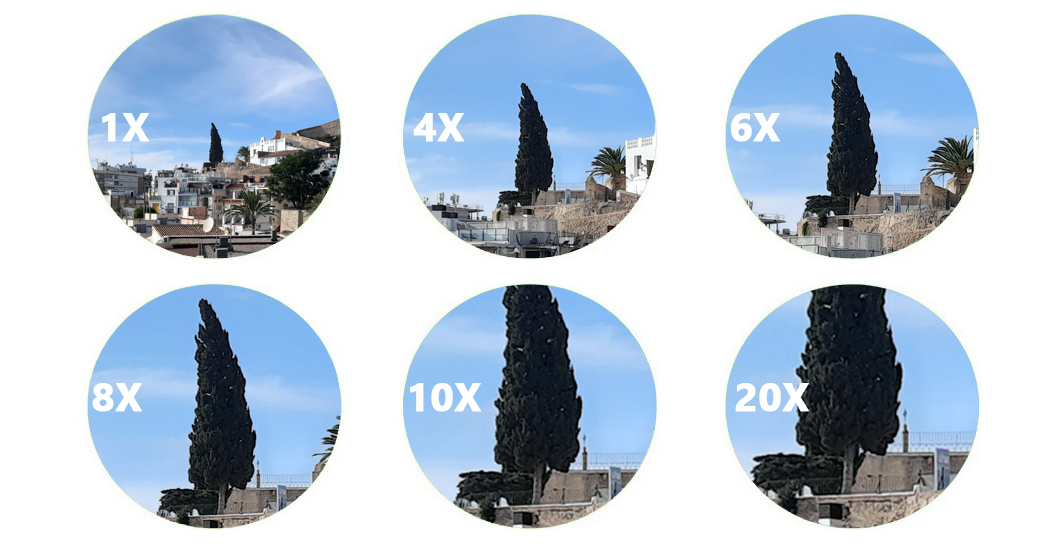
Manufacturers always indicate two values on the binoculars: magnification and lens diameter. The first number in the specification (e.g., 8×42) refers to the actual magnification, showing how much closer an object appears than it does to the naked eye. For example, an 8x magnification allows you to see a bird 1 kilometer away as if it were just 125 meters from you.
The second number, like the 42 in 8x42, represents the diameter of the objective lens in millimeters. Larger lenses let in more light, making the image brighter, but also add weight to the binoculars.
How to calculate the distance to the object
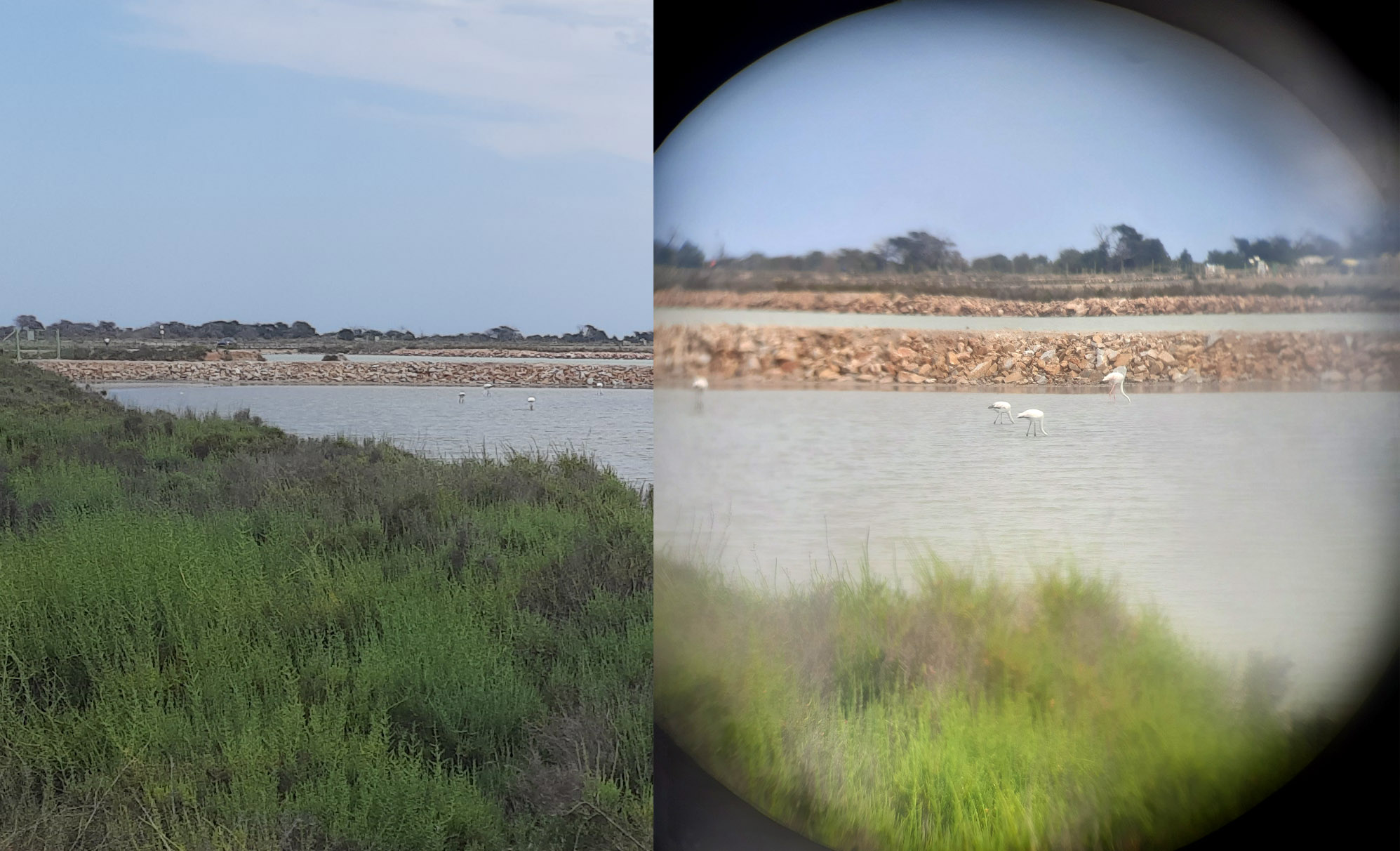
Here, in order to clearly demonstrate the range of vision of binoculars, I made a collage of two photos from a recent observation of flamingos. On the left you can see part of the photo of a flamingo at 1x magnification, on the right – a view through binoculars at 8x magnification (these were classic field binoculars 8×40). The photo was taken from a distance of ~200 m.
How to calculate how an object will be visible at a certain magnification? This can be done by dividing the actual distance to the object by the magnification of the binoculars. The result is the distance at which the object observed through the binoculars would be if we were looking at it with the naked eye. Let me explain with an example:
Visual distance = Actual distance / Magnification
For example, we are observing a deer 200 meters away from us through 8x binoculars. We calculate:
That is, we will see the deer through the binoculars as if it were 25 meters away from us. Using the table below, you can estimate the range for different binoculars:
| Magnification | Object on 200 м looks like… |
| 6x | 33,3 м |
| 8x | 25 m |
| 10x | 20 m |
| 15x | 13,3 m |
| 20x | 10 m |
The range of the distance in kilometers: choosing the right option
- Magnification: Higher magnification (e.g., 20x) allows you to see farther but narrows the field of view and may require a tripod. For tracking moving objects, lower magnifications (e.g., 8x) work better.
- Lens Size: Larger lenses gather more light, which is beneficial for long-range or low-light conditions.
Examples:
- With 10×50 binoculars, you can clearly read a car license plate from a distance of 3 kilometers.
- For wildlife observation during a hike, 8×42 binoculars strike a great balance between portability and clarity.
| Binocular | Ideal Application | Maximum Effective Distance |
|---|---|---|
| 8×32 | Birdwatching, hiking | ~2-3 km |
| 10×42 | Wildlife watching, hunting | ~4-5 km |
| 10×50 | Celestial observations, long-range viewing | ~5-6 km |
| 20×80 | Astronomical observations, professional use | ~15-20 km |
Binoculars with a 20-Kilometer Range
High-powered binoculars like 25×100 models can visualize stationary objects, such as mountain peaks, up to 20 kilometers away. However, visibility at such distances heavily depends on atmospheric conditions like fog or heat distortion. These binoculars are best used with a tripod for stargazing or panoramic landscape viewing.
Binoculars Distance Chart. How Far Can You Observe with Conventional Binoculars?
8×42 Binoculars
Preferred by birdwatchers, these binoculars provide a wide field of view and excellent light transmission, allowing observation of medium-sized animals (e.g., deer) at up to 3 kilometers under ideal conditions.
10×42 Binoculars
Perfect for hunters, these binoculars offer greater detail and can spot objects up to 5 kilometers, depending on weather conditions.
10×50 Binoculars
These binoculars excel in low-light conditions due to their larger lenses, enabling clear observation of objects up to 6 kilometers away. They are especially suited for stargazing.
8×40 Binoculars
Ideal for tracking moving objects, such as birds, these binoculars balance portability and functionality, allowing observation at 2-3 kilometers.
The Best Magnification for Hunting Binoculars
The ideal hunting binoculars are 8×42 or 10×42, offering lightweight designs and wide fields of view for tracking moving animals. Higher magnifications, like 12x or more, can narrow the field of view, making it harder to locate targets.
Consequences of Choosing an Inappropriate Magnification
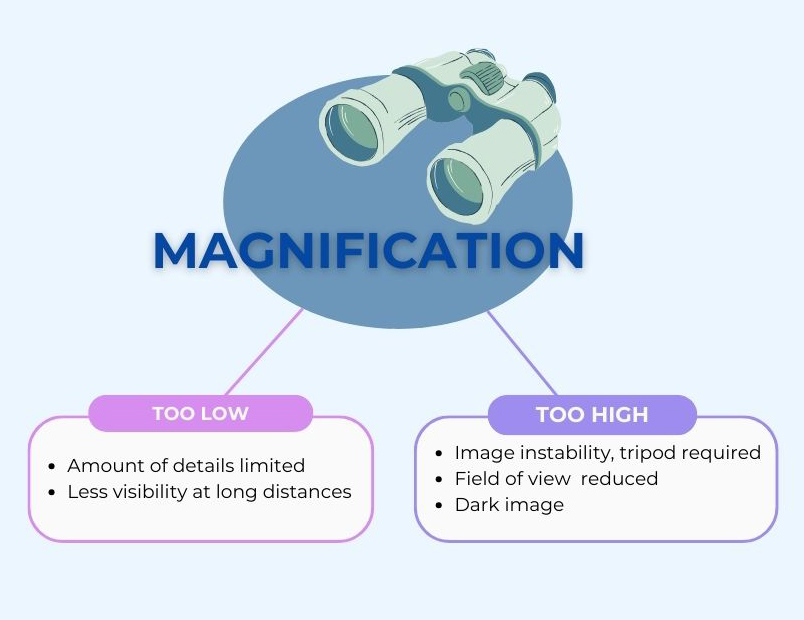
Too High Magnification: Results in image instability, reduces the field of view, and often requires a tripod.
Too Low Magnification: Limits the amount of detail you can see, especially for distant objects.
Determine your activity—birdwatching requires different binocular specifications than hunting or astronomy.
Determine your activity—birdwatching requires different binocular specifications than hunting or astronomy.
The Most Powerful Binoculars in the World
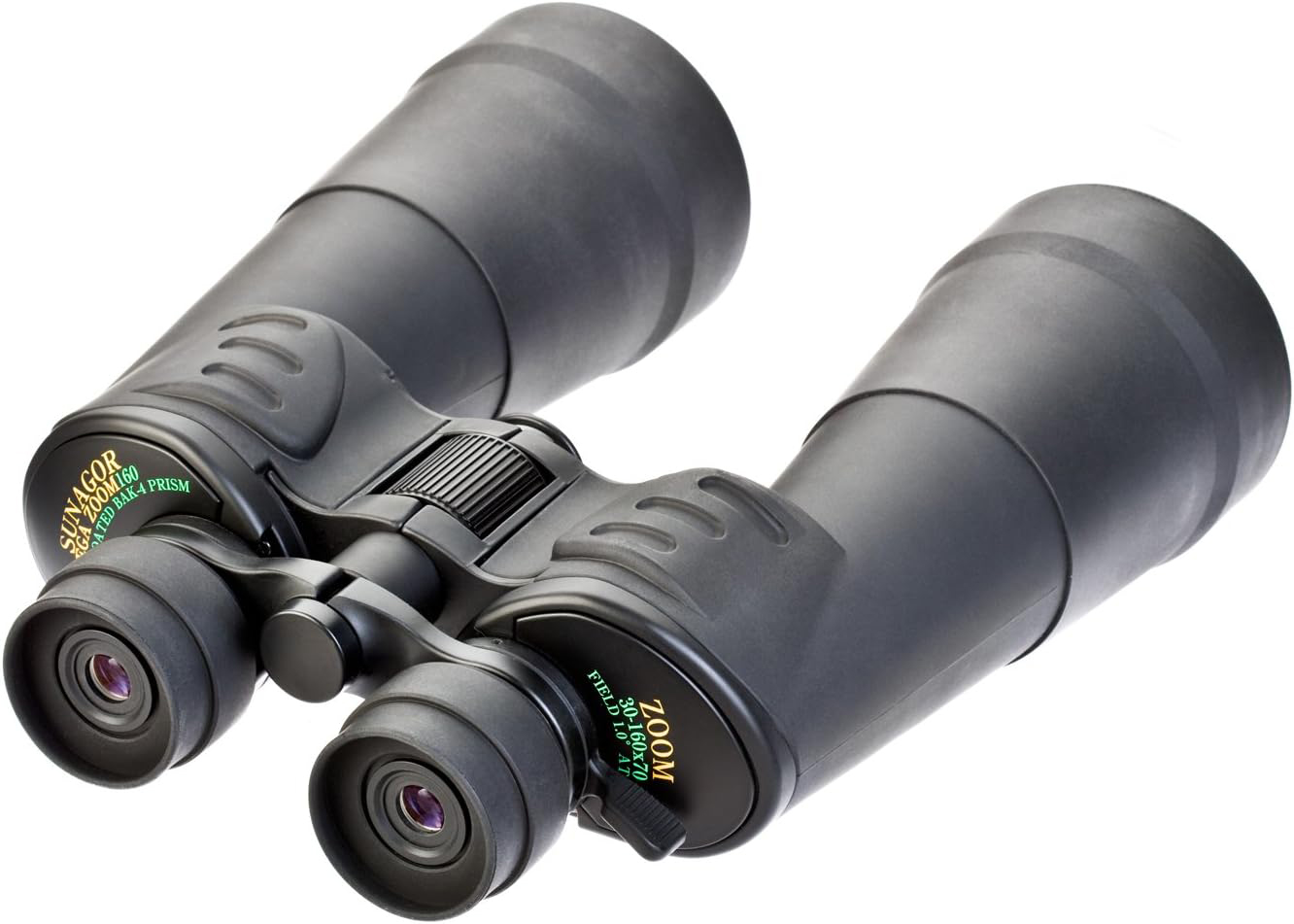
Did you know the Sunagor Mega Zoom 30-160×70 holds the record for the highest magnification? Adjustable from 30x to 160x, they’re perfect for long-range observations but require a tripod due to their weight and sensitivity.
Adjustable magnification binoculars: advantages and disadvantages
- Advantages: Versatility for various distances and flexible for different scenarios.
- Disadvantages: Less durable and bulkier than fixed-magnification models.
In Conclusion
The effectiveness of binoculars is determined by their magnification, lens size, and environmental conditions. Choosing the right binoculars involves balancing portability, clarity, and stability. Whether you’re hunting, birdwatching, or stargazing, there’s a perfect pair for you!