

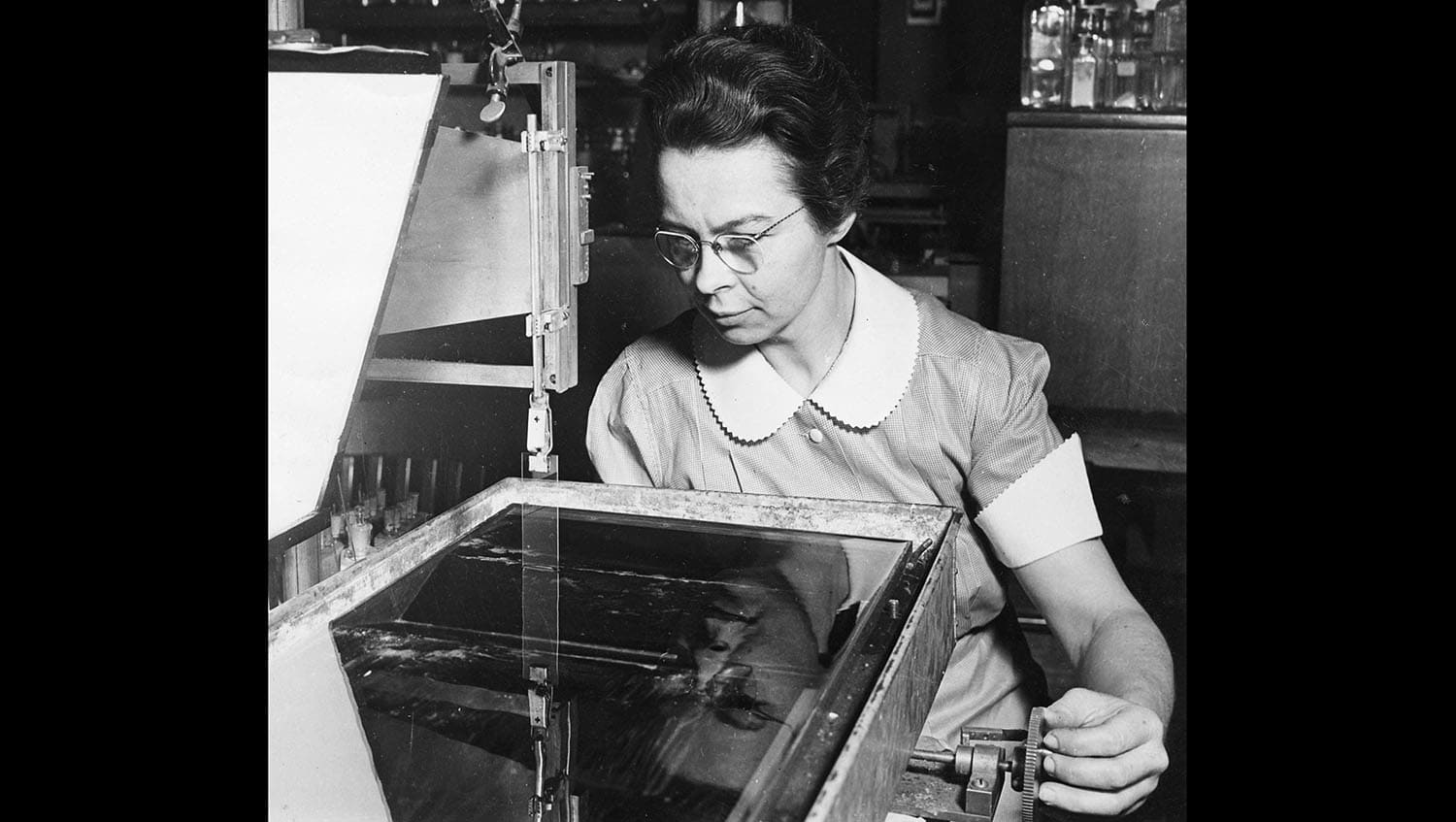
In the world of science, where the names of great men often overshadow the achievements of women, there are stories that deserve to be told with special passion and care. The story of Katharine Blodgett is one of them. Imagine Thomas Edison, whose inventions transformed everyday life—but now imagine a woman who, like him, revolutionized the world by making the invisible visible, and the visible even more perfect. Katharine Blodgett, a pioneer in the field of surface physics, was precisely such a figure, whose discoveries not only advanced science but also touched each of us—often unnoticed, just like her famous “invisible glass.” But the path to greatness for a woman in science at the beginning of the twentieth century was paved not only with discoveries, but also with invisible barriers, social pressure, and the need to conceal parts of her life. Are you ready to immerse yourself in a world where science meets personal drama, and genius overcomes every obstacle?
A Childhood That Shaped a Genius: From Schenectady to Paris
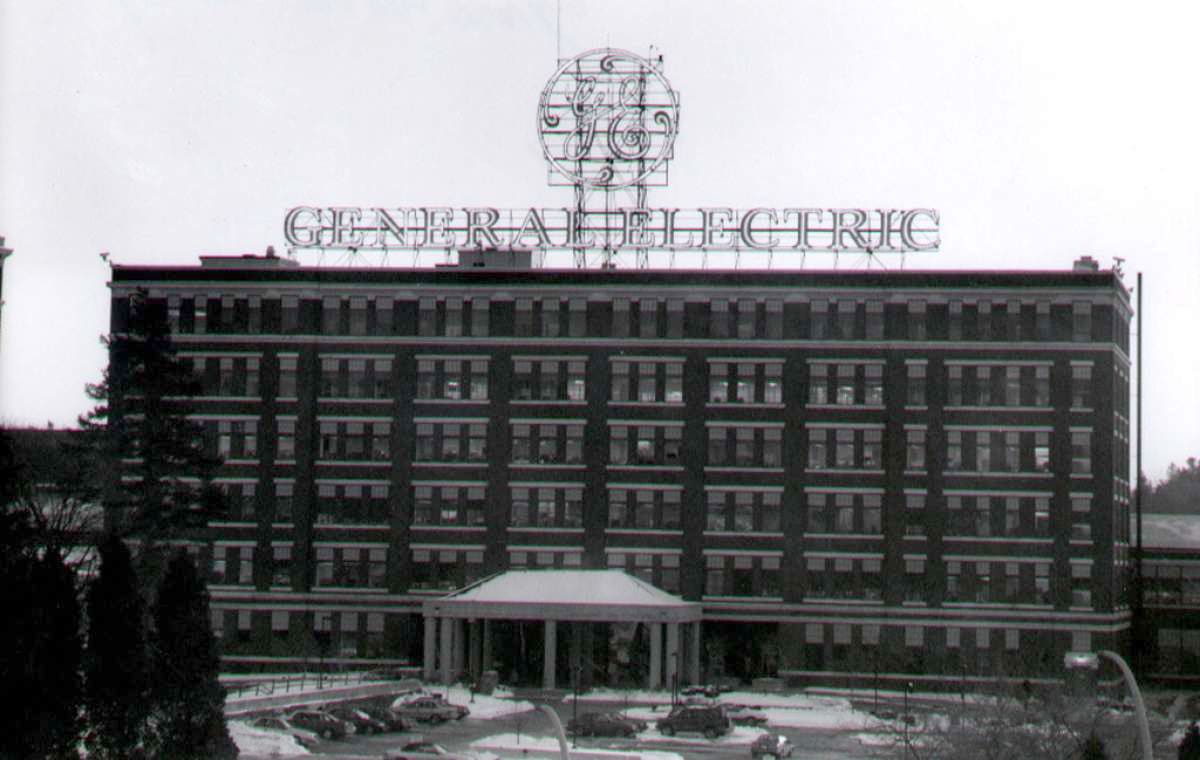
Katharine Blodgett was born on January 10, 1898, in Schenectady, New York, into a family where science and invention were familiar pursuits. Her father, George Blodgett, was a respected patent attorney at General Electric (GE), but he was tragically killed a month before her birth. This event might have cast a shadow over her childhood, but fate had other plans. GE, in recognition of her father’s contributions, took on the financial support of the family, allowing Katharine and her mother to move to New York and then, in 1901, to France.
There, surrounded by European culture and languages, young Katharine learned French, which undoubtedly broadened her horizons and prepared her for future scientific research. Returning to New York in 1912, she enrolled in the Rayson School, where she received an education equal to that of boys—something rare at the time. Even then, her exceptional abilities in physics, chemistry, and mathematics were evident, along with a creative approach to solving complex problems.
The Path to Knowledge: From Bryn Mawr to Cambridge
Katharine’s educational journey was as impressive as her future discoveries. In 1913, at just fifteen years old, she received a scholarship to the prestigious women’s college Bryn Mawr, where she earned a bachelor’s degree in physics in 1917. Her scientific talent was unmistakable. Even then, she firmly decided to devote herself to research.
On the advice of Irving Langmuir—future Nobel laureate and her mentor—Katharine continued her studies at the University of Chicago, where she earned a master’s degree in chemistry in 1918. Her master’s work on the adsorption of gases by charcoal proved to be incredibly relevant during World War I, when poisonous gases were widely used on the battlefield. Her research showed that charcoal could adsorb most toxic gases, which later saved many lives.

But Katharine did not stop there. In 1924, she went to England to pursue a doctoral degree at the renowned Cavendish Laboratory of the University of Cambridge under the supervision of Ernest Rutherford, another Nobel laureate. In 1926, Katharine Blodgett became the first woman to earn a Ph.D. in physics from Cambridge, defending her dissertation on the behavior of electrons in ionized mercury vapor. This was not just a personal achievement, but a breakthrough for all women in science, opening the doors to a world that had previously been closed.
The First Female Scientist at General Electric: In the Shadow of Genius, Yet Not Without Her Own Light
In 1917, at the age of 20, Katharine Blodgett made history by becoming the first woman scientist hired at the General Electric research laboratory in Schenectady. It was a time when the shortage of male workers due to the war opened up some opportunities for women, yet her career remained an exception in a world where investing in women scientists was considered risky because of the possibility of marriage and childbearing. Katharine began working as an assistant to Irving Langmuir, whose research at General Electric had already brought him worldwide recognition. Langmuir, who had worked with her father, immediately recognized Katharine’s immense talent and became her mentor.
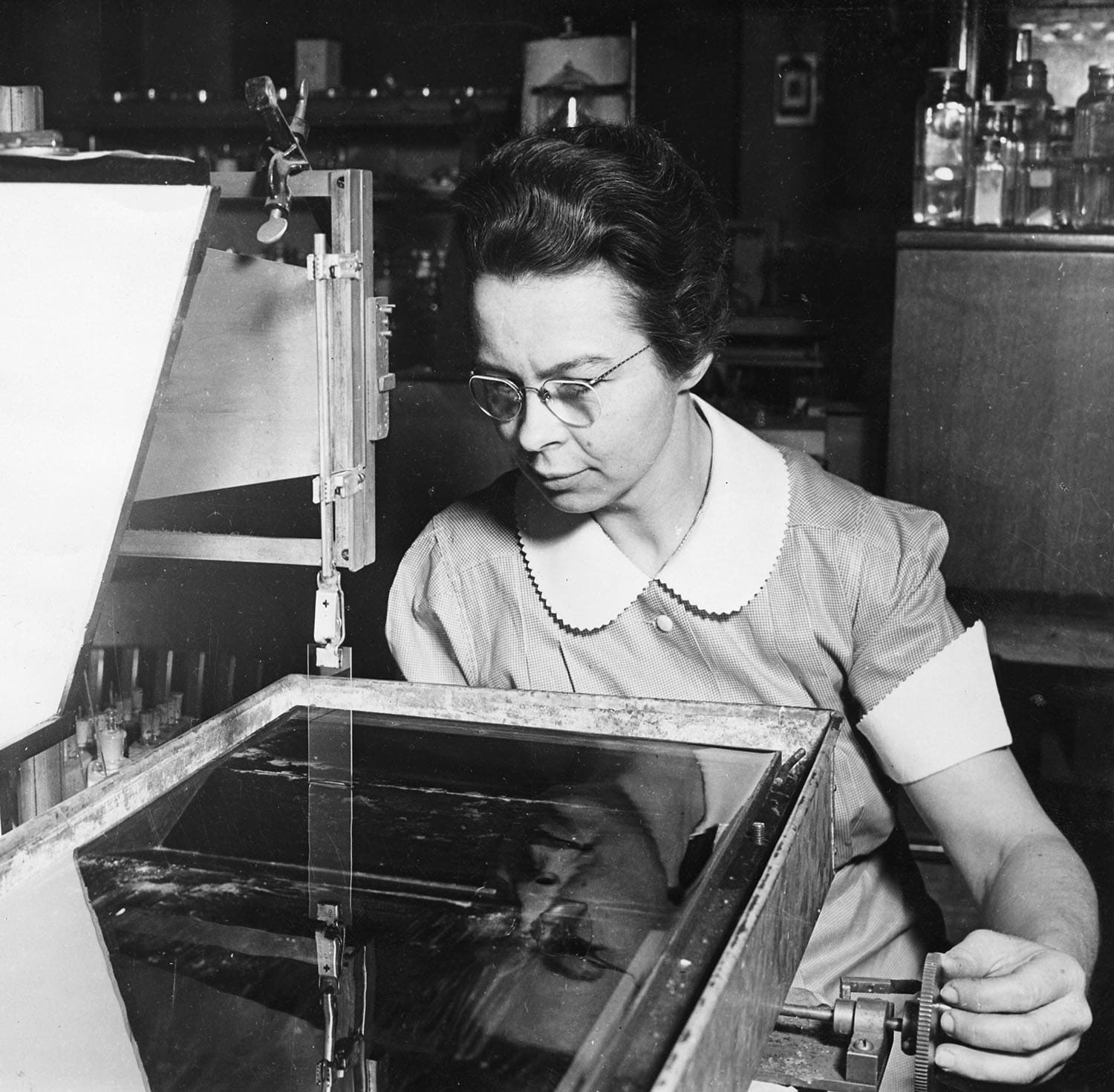
Together, they immersed themselves in the study of monomolecular films—ultra-thin layers just one molecule thick that could coat the surfaces of water, metal, or glass.
The Invisible Miracle: The Birth of Non-Reflective Glass
It was in this field that Katharine Blodgett made her most famous discovery. Langmuir studied monomolecular films as a scientific curiosity, but Katharine saw enormous practical potential in them. In the late 1930s, she found a way to apply these molecularly thin layers to glass and metal, layer by layer. She realized that if these films reduced glare on the surface of water, they could also reduce the glare reflected from glass. After all, even the clearest glass reflects 8–10% of the light that falls on it, which is why we can see it.
In 1933, Katharine developed a simple yet ingenious method for calibrating the thickness of these films with extraordinary precision—down to a millionth of an inch, at a time when the best instruments could measure only to the micron. She noticed that layers of stearic acid (a fatty substance used in candles and soap) displayed different colors, with each color corresponding to a specific thickness. This allowed her to deposit extremely thin layers of stearic acid onto a glass plate, controlling color changes with unprecedented accuracy.
The culmination of her work was the invention of “invisible” glass. In 1938, she received a patent for a process that produced glass that virtually does not reflect light. The essence of the invention was the application of 44 layers of barium stearate onto the surface of the glass. The thickness of this film was one-quarter of the average wavelength of visible light (about 1388 angstroms). As a result, the reflection from the film canceled out the reflection from the glass, allowing light to pass through with almost no glare (only about 2.5%). It was a true marvel, making glass nearly invisible!
Katharine Blodgett’s discovery was received not merely as a scientific success, but as a genuine sensation. Imagine this: in late 1938, a world on the brink of war suddenly began talking about “magic.” Here is how it happened:
“A Star Is Born” Overnight
On December 26, 1938, General Electric (GE) officially announced Katharine’s invention. GE’s PR machine went into full force, and Katharine Blodgett quite literally became a celebrity overnight. Newspapers across the country ran headlines like: “Woman Scientist Invents Invisible Glass!” For a public accustomed to thinking of science as dry formulas, the chance to see (or rather, not see) glass felt like a magic trick.
Press Reaction: Between Enthusiasm and Skepticism
The press of the time did not hold back on superlatives:
“Miracle glass”
Journalists described demonstrations where Katharine showed two glass plates—one ordinary, glaring in the light, and hers, which looked like an empty frame.
Attention to gender
Unfortunately, journalists of the 1930s could not ignore the fact that the discovery had been made by a woman. Articles often referred to her as a “modest woman scientist,” emphasizing that she enjoyed gardening and cooking—as if to “apologize” for her extraordinary intellect.
Practical dreams
Newspapers immediately began imagining the future: store windows where goods could be seen perfectly; automobile windshields that would not blind drivers at night; eyeglasses that would not hide the wearer’s eyes.
The Scientific Community: Recognition of Genius
Unlike the general public, scientists understood the full depth of her achievement.
Irving Langmuir, her mentor and Nobel Prize laureate, openly acknowledged that Katharine had surpassed him in the practical application of their shared theories. He called her work “brilliant.” What impressed her colleagues was not so much the transparency itself, but the method she used to achieve it. Her “color scale” for measuring the thickness of monolayers was recognized as a benchmark of precision. This was a time when nanotechnology did not yet have a name, but Katharine was already working at that scale.
GE: A Marketing Triumph
For General Electric, Katharine became the “face” of their innovations. The company used her image to demonstrate their commitment to progress and to giving opportunities to talent regardless of gender (although in reality, Katharine remained one of very few women in their laboratories).
A Grain of Truth: The Fragility of the Dream
Despite the widespread excitement, engineers quickly recognized a limitation of the method: the organic films were too delicate for everyday use (for example, eyeglasses that need to be cleaned regularly). This led to a situation where, although Blodgett gained fame as the “inventor of invisible glass,” industry later shifted to rougher but more durable methods, such as those developed by Alexander Smakula at Carl Zeiss.
Interesting fact: Katharine was so modest that when asked about her fame, she would say she had simply “found a way to apply soap bubbles to glass.”
As for your question: such intense media attention was a double-edged sword. It undoubtedly accelerated recognition of her work and opened doors that might otherwise have remained closed. At the same time, given her apparent preference for privacy and focus on research, this level of publicity likely created pressure and distractions that did not align with her personality. In her case, the recognition helped cement her legacy—but probably came at a personal cost.
“Gone with the Wind” and a Revolution in Optics: How Invisible Glass Changed the World

Imagine the year 1939. The epic drama Gone with the Wind premieres—a film that would forever enter the history of cinema. It became an instant hit, breaking box office records and capturing the hearts of millions. But few people knew that behind its remarkable clarity and depth of image stood Katharine Blodgett’s invisible invention. Her non-reflective glass was first used in cameras and projectors to create this masterpiece. The result? Exceptionally clear images that enhanced the overall experience and immersed viewers in the world of Scarlett O’Hara with an unprecedented sense of realism.
But the impact of “invisible glass” did not stop at cinema. With the outbreak of World War II, Blodgett’s invention found vital applications. It was used in submarine periscopes, rangefinders, and aerial cameras, providing unmatched clarity of vision and precision for military operations. Her work became not just a scientific breakthrough, but a strategic advantage that saved lives and influenced the course of history. Today, although methods developed by other scientists have found broader industrial use, Katharine’s contribution to the understanding and creation of thin films remains a cornerstone of molecular engineering and nanotechnology.
A Battle of Technologies: Blodgett vs. Smakula
While Katharine Blodgett in the United States was conquering the world with her molecular films, on the other side of the Atlantic, in the German laboratories of Carl Zeiss, scientist Alexander Smakula was solving the same problem. It was a true battle of technologies: organic elegance versus mineral durability.

A schematic of a Langmuir Blodgett trough:
1. Amphiphile monolayer 2. Liquid subphase 3. LB Trough 4. Solid substrate 5. Dipping mechanism 6. Wilhelmy Plate 7. Electrobalance 8. Barrier 9. Barrier Mechanism 10. Vibration reduction system 11. Clean room enclosure
Blodgett’s method resembled fine craftsmanship: she dipped glass into a liquid, layer by layer “growing” a coating from organic molecules. The result was nearly perfect—her glass approached almost 100% transparency. But there was one problem: the films were as delicate as a butterfly’s wing. A single touch could destroy the effect. Smakula took a different approach—he used vacuum deposition of inorganic salts, creating a hard, almost “stone-like” coating.
Why, then, do we more often see Smakula’s legacy today in binoculars and eyeglasses rather than Blodgett’s? The answer is simple and pragmatic: real-world conditions. Binoculars on the battlefields of World War II and telescopes in observatories needed protection from dust, rain, and rough handling. The method developed at Carl Zeiss (the famous T-coating) proved far more practical for mass production.
But don’t be too quick to write Katharine off. If Smakula won the battle for durability, Blodgett won the war for the future. Her method of “molecular engineering” became the foundation of modern nanotechnology. Wherever the goal is not just to protect a lens, but to assemble complex sensors or LCD displays molecule by molecule, Katharine’s ideas remain unmatched. She didn’t just make glass clearer—she taught humanity how to build the world one atom at a time.
| Parameter | Katharine Blodgett Method (1938) | Alexander Smakula Method (1935) |
|---|---|---|
| Technology | Langmuir–Blodgett films: Immersion of glass into a liquid containing organic molecules (soap/fats). | Vacuum deposition: Heating inorganic salts (e.g., magnesium fluoride) in a vacuum. |
| Material | Organic fatty acids (stearates). | Solid mineral salts. |
| Durability | Low: The films were soft and could literally be wiped off with a finger. | High: The coating was hard and resistant to environmental effects. |
| Industry | Required complex “wet” chemistry and a time-consuming layer-by-layer dipping process. | Easily scaled for mass production of lenses in vacuum chambers. |
Science in the Service of War and Peace: Katharine’s Many-Sided Talent
Katharine Blodgett’s contribution to science extended far beyond non-reflective glass. During World War II, she was actively involved in projects directly related to defense. Her early research on the adsorption of gases by charcoal was applied in the development of gas masks with adsorption filters. She also participated in creating anti-icing systems for aircraft wings, which were critically important for flight safety. One of her most unusual wartime inventions was the development of artificial fog generators, used by the Allies for concealment during the invasions of Italy (1943) and France (1944).
After the war, Katharine continued her research, collaborating with the U.S. Army on the development of instruments for measuring humidity in the upper atmosphere. She also worked on improving the conductivity of coatings, receiving patents for conductive coatings and methods of forming semiconductor layers on glass. Over the course of her career, Katharine Blodgett was granted seven U.S. patents and two in Canada, all assigned to General Electric. Her ability to transform fundamental scientific knowledge into practical, life-saving inventions places her among the greatest inventors of her time.
The Invisible Barriers of an Era
Katharine Blodgett’s life, filled with scientific triumphs, also had an invisible side. She was never married and lived for many years in a Boston marriage with Gertrude Brown, a woman from an old Schenectady family. We do not have reliable information about the nature of their relationship, but it can be said with a high degree of probability that Katharine Blodgett may have faced social pressure typical of her time.
Imagine what it was like—to be a brilliant scientist whose discoveries changed the world, while having to conceal a significant part of one’s personal life. At that time, the policies of General Electric, like those of most large corporations, did not provide open support for LGBTQ+ employees. On the contrary, there was immense pressure that forced people to hide their private lives to avoid discrimination, job loss, and social ostracism. This likely explains why Katharine Blodgett never spoke publicly about her views on such matters or about her personal life. We sincerely hope that, in her private world, she found happiness.
A Legacy Beyond the Visible: Recognition and Passions
Katharine Blodgett retired from General Electric in 1963 after 45 years of productive work. But her life was not limited to science alone. She was a member of the Optical Society of America and the American Physical Society. Her scientific career was recognized with numerous awards and honors, including honorary doctorates from four universities. In 1951, she received the prestigious Garvan Medal from the American Chemical Society, and that same year the city of Schenectady proclaimed “Katharine Blodgett Day” in her honor. In 1971, she was awarded the Progress Medal from the Photographic Society of America.
Beyond science, Katharine was a multifaceted individual. She wrote humorous poetry, took part in amateur theater, and had a passion for gardening, astronomy, antique collecting, and playing bridge. She was also active in volunteer work, serving as treasurer of the Travelers Aid Society. Katharine Blodgett passed away in 1979 at the age of 81, leaving behind not only scientific discoveries but also an example of resilience, intellect, and humanity. Her contributions to science—especially in the fields of thin films and molecular engineering—continue to inspire new generations of scientists, proving that true genius has neither gender nor boundaries.
Sources:
- Wikimedia Commons — Katharine Burr Blodgett (1938), Smithsonian Institution, No known copyright restrictions https://commons.wikimedia.org/wiki/File:Katharine_Burr_Blodgett_(1898-1979),_demonstrating_equipment_in_lab.jpg
- Wikimedia Commons — LB trough, OMUD58, CC0 https://commons.wikimedia.org/wiki/File:LB_trough.svg
- Still from Gone with the Wind (1939), directed by Victor Fleming. © Warner Bros. All rights reserved. Used under Fair Use
- Wikimedia Commons — Irving Langmuir House (brillo ajustado), Daniel Case, bajo la licencia CC BY-SA 3.0 https://commons.wikimedia.org/wiki/File:Irving_Langmuir_House_2008.jpg
- Wikimedia Commons — GE Plant Schenectady (brightness adjusted), Brucemaxwell27, bajo la licencia CC BY-SA 4.0 https://commons.wikimedia.org/wiki/File:GE_Plant_Schenectady.jpg