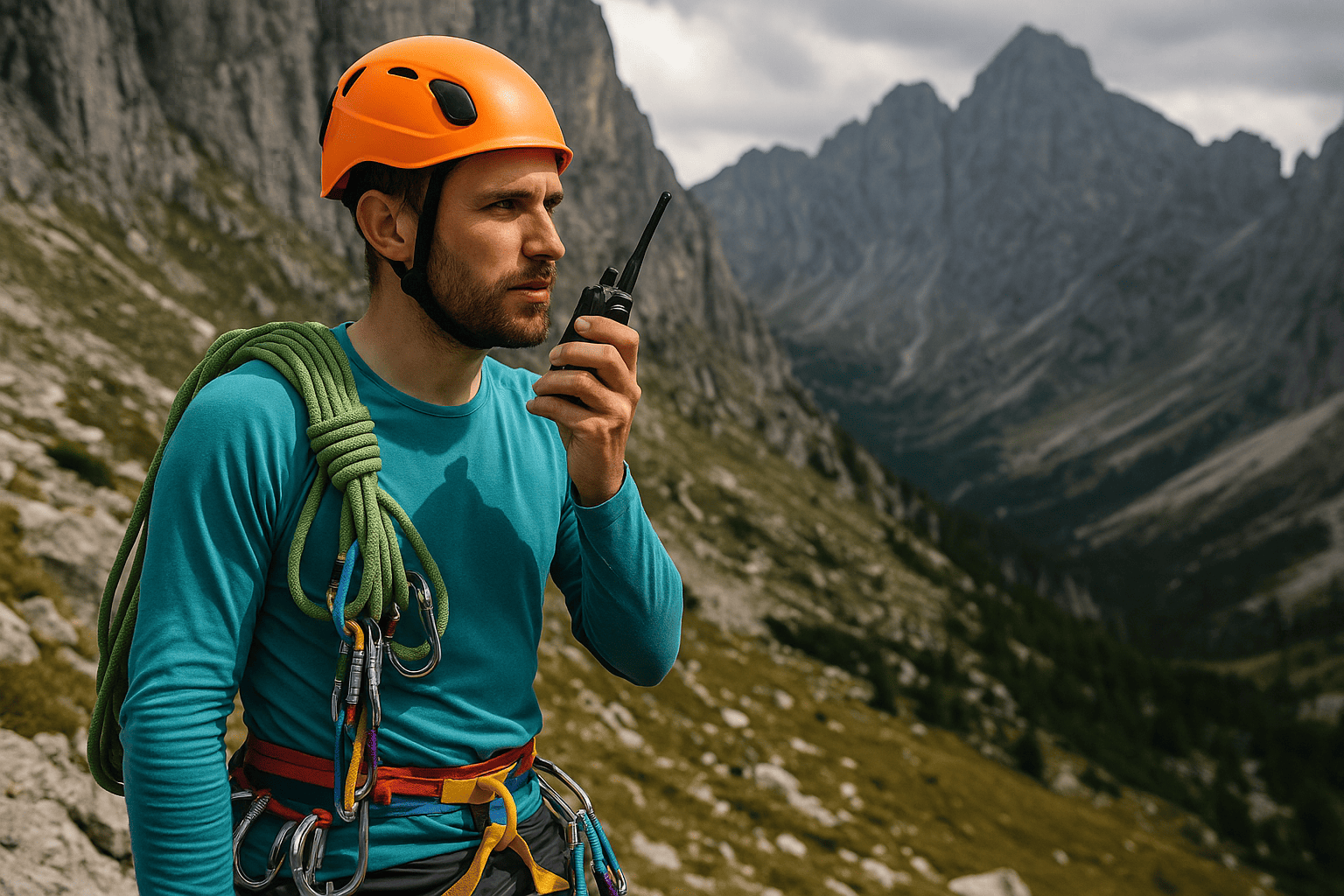
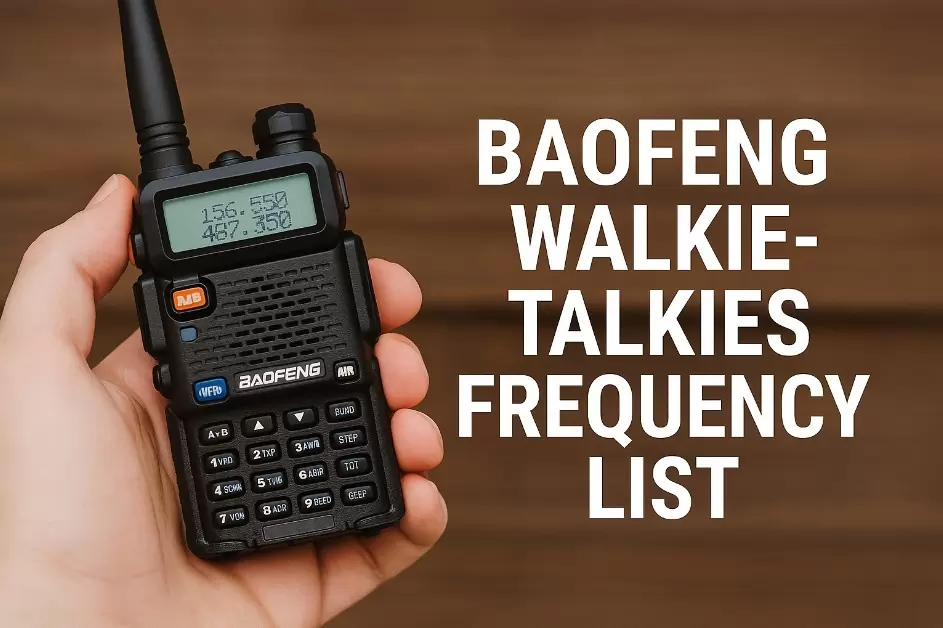
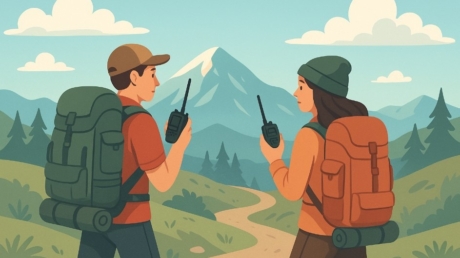
When you go to the mountains, it’s not the best idea to rely on a cellphone for connection to your friends. Cellular coverage in the mountains is unreliable, and you risk ending up without a means of communication. Remember that it may be very dangerous in the mountains to stay without a connection. It’s not necessary if you go to the popular skiing slopes, but what if there is nobody around, and you need help? Sometimes it may be a question of your safety or even a risk to your life. So, this article is about how to choose the best two-way radio for snowboarding in the mountains.
How far can walkie-talkie for snowboarding reach in the mountains?

The first point that you probably will think, it’s the communication range. It’s an important feature, but not the main one. Radio waves work well on open space without buildings and other barriers. It means that your snowboarding walkie-talkie will freely connect you with your comrades if you stay on the top, and they are at the foot of the hill, or if they are on the neighboring hill and there is only the air between you.
But if your friends are on the other side of a hill, your two-way radio can’t help you even if there are a couple of hundred meters between you. It’s all about where you choose to deploy the two-way radio. You should think in advance, where you will use it. Don’t assume that because the cost is high, it will suit your purpose: it is not a guarantee of the largest coverage range. Try to choose good terms of use to unlock its potential.
How does a walkie-talkie for snowboarding solve the question of interferences?
The next things you will need to think about are the interferences. They are a common companion of everybody who uses license-free frequency. So, the next useful feature for snowboarding walkie-talkie is the ability to work using subtones. The subtones are not a rarity among two-way radios. There are two types of subtones: CTCSS (analog) and DCS (digital); they are special signals that we can’t hear but the companion radio can. If you use them, you will hear only the radio that has the same preset subtone. You and your friends must choose a subtone in advance and set it on each radio before using.

Don’t forget that other people can still hear you; it’s just you that won’t hear them. However, it solves the main task – to set you free of the interferences. Still, you should know that if there are too many people in one place, this method won’t help you. In this case, it is reasonable to turn to the programming of non-standard grid spacing. If your walkie-talkie allows, you can change the step and set the channel between two often used. It will reduce the chance of meeting somebody else. If your radio for snowboarding has a display and a keyboard, you could probably make the changes directly at your destination. If not, you should take care of it at home first.
Robust and waterproof radio for snowboarding
The next important features for your walkie-talkie are it’s robustness and waterproofness, of course. If your radio falls out of your pocket on the snow while you are snowboarding, it should have a reliable body to keep it working. You can determine that your two-way radio is suitable for such conditions if it has relevant certificates: a military standard MIL-STD810 and an IP level against water and dust. You should have an IP65 or higher to be sure that your walkie-talkie is suitable for snowboarding. MIL-STD810 means that a device is able to withstand shaking and crushing. You can read more about protection standards here.
You should have IP65 or higher to be sure that your walkie-talkie is suitable for snowboarding
Convenience walkie-talkie for snowboarding
- Also, you should pay attention to convenience. While you’re in motion on a snowboard or skis, a headset is more comfortable. Besides, the headset will allow you to cover your transceiver under your jacket.
- Lithium batteries work for a shorter period of time in cold conditions.
- If you don’t want to use a headset or a tangent, pay attention to the button’s size and their arrangement. They should be comfortable to use in gloves.
- Next, think about the length of the antenna. If it’s too long and rigid, there is a risk of breaking it. So, it should be flexible.
Legal conditions of a walkie-talkie for snowboarding
If you go to a resort abroad, you have to understand the legal conditions of using a two-way radio there. Which frequency can you use and what is the maximum output power legal there? For example, a frequency PMR446 that is common in Europe is forbidden for use in the USA and Canada. American FRS and GMRS are not legal to use in the United Kingdom and Europe. Besides, there are different charging connectors and output voltage in different countries. If you don’t think through these points, you might be unprepared for reality.
Read more about free walkie-talkie frequencies in Europe.
Let’s conclude what you should look for in a walkie-talkie for snowboarding.
- It should have legal channels that are suitable for your target country
- It should be waterproof and shockproof
- It should be comfortable to use
- It should be able to work using subtones
TOP 5 walkie-talkies for snowboarding 2025
Now let’s take a look at the best walkie-talkies for snowboarding in 2025. This is an up-to-date TOP list featuring radios equipped with the latest technology. Below in our article, you’ll also find the 2021 ranking. While those older models may no longer be as attractive, they’re still solid options — and you can often find them on eBay at a lower price.
1. Motorola Talkabout T800

One of the best all-around choices for snowboarders. With Bluetooth connectivity to your phone via the Motorola Talkabout app, it lets you send messages and location data even without cell signal. It’s weatherproof, has excellent range, and works well with gloves.
Why it’s great: Smart features + solid hardware in cold conditions.
- Dimensions: 7.5 x 2.2 x 1.3 in
- Power: 0.5–2 watts (FRS/GMRS)
- Weight: 7.4 oz (with battery)
- Number of channels: 22 + 121 privacy codes
- Battery type: NiMH rechargeable or 3× AA
- Water resistance level: IPX4
- VOX (voice activation): Yes
- Headset connection: Yes (3.5mm jack)
- SOS signaling: No
2. Midland GXT1000VP4

A favorite among outdoor adventurers. It’s rugged, has a weather alert system, and provides excellent range in open mountain areas. The “Direct Call” feature lets you contact a specific person in your group — handy when you’re split across trails.
Why it’s great: Strong signal and emergency weather alerts.
- Dimensions: 10 x 6.5 x 3 in (with package)
- Power: Up to 5 watts (GMRS)
- Weight: 8.5 oz
- Number of channels: 50 (22 standard + 28 extra)
- Battery type: NiMH pack or 4× AA
- Water resistance level: IPX4
- VOX (voice activation): Yes
- Headset connection: Yes (dual pin)
- SOS signaling: Yes
3. Baofeng UV-9R Plus
For the more experienced user who wants range and flexibility. It’s a waterproof dual-band radio that works on both VHF and UHF, offering excellent long-range communication. Requires programming and possibly a license in some regions, but rewards you with serious power.
Why it’s great: High power + waterproof build for off-grid riders.
- Dimensions: 5.5 x 2.3 x 1.5 in
- Power: 5–8 watts (selectable)
- Weight: 9 oz
- Number of channels: Programmable (128 memory channels)
- Battery type: 2200 mAh Li-ion rechargeable
- Water resistance level: IP67
- VOX (voice activation): Yes (via programming)
- Headset connection: Yes (Kenwood 2-pin)
- SOS signaling: Yes (programmable)
4. Retevis RT49P
Designed with outdoor sports in mind, this radio is fully waterproof (IP67), floats in water, and includes NOAA weather scanning. The buttons are oversized — perfect for cold fingers or gloves.
Why it’s great: Floatable, glove-friendly, and fully waterproof.
- Dimensions: 7.4 x 2.4 x 1.4 in
- Power: 0.5–2 watts
- Weight: 6.6 oz
- Number of channels: 22
- Battery type: 3× AA or NiMH rechargeable
- Water resistance level: IP67 (fully waterproof)
- VOX (voice activation): Yes
- Headset connection: Yes
- SOS signaling: No
5. Cobra RX680
A compact and rugged walkie-talkie with 38 privacy codes, decent range, and IP54 weather resistance. It has a simple, intuitive interface and a long battery life — great for all-day boarding.
Why it’s great: Budget-friendly but reliable in mountain conditions.
- Dimensions: 6.5 x 2.2 x 1.3 in
- Power: 2 watts (FRS)
- Weight: 7.2 oz
- Number of channels: 22 + 121 privacy codes
- Battery type: Rechargeable lithium-polymer
- Water resistance level: IP54
- VOX (voice activation): Yes
- Headset connection: Yes
- SOS signaling: No
| Model | Range (up to) | Waterproof Rating | Special Features | Battery Life | Price Range (USD) |
|---|---|---|---|---|---|
| Motorola Talkabout T800 | 35 miles* | IPX4 | Bluetooth app, GPS location sharing | Up to 25 hours | $80–$100 |
| Midland GXT1000VP4 | 36 miles* | IPX4 | NOAA alerts, Direct Call | Up to 11 hours | $70–$90 |
| Baofeng UV-9R Plus | 5–10 miles (real-world) | IP67 | Dual band, programmable | Up to 18 hours | $40–$60 |
| Retevis RT49P | 5 miles (mountain) | IP67 | Floats, NOAA, glove buttons | 12–20 hours | $60–$80 |
| Cobra RX680 | 38 miles* | IP54 | 38 privacy codes, compact | Up to 18 hours | $50–$70 |
*Maximum range is under ideal conditions (line of sight). Mountain terrain typically reduces range to 1–5 miles.
TOP 5 walkie-talkies for snowboarding (oldy but still great)
Midland GXT1050

Relatively inexpensive, lightweight, and reliable model, which will be a good choice for any ski lover. The camouflaging body looks just fine, and thanks to good ergonomics, the gadget is easy to use. The main technical characteristics are close to professional ones.
- Dimensions: 120x60x35 mm.
- Power: 0.5-5 W.
- Weight: 180 g.
- Number of channels: 69.
- Battery type: 4 AA or Ni-MH.
- Water resistance level: JIS4.
- Availability of VOX (voice activation): yes.
- Headset connection: yes.
- SOS signaling: yes
Additional functions: display backlight, vibration alert, “whisper” mode.
Motorola Talkabout T400

Comes in a pair. Users who value reliability will love this model – one of the most secure in our review. She is not afraid of moisture or shaking, or blows. Excellent equipment allows you to charge the walkie-talkie from a cigarette lighter or a power bank. All accessories fit into a convenient case, which makes it possible to always have them at hand.
- Power: 0.5 W.
- Weight: 197 g.
- Number of channels: 22
- Subtones: 121.
- Battery type: Ni-MH (up to 8.5 hours) or 3 АА alkaline batteries (26 hours).
- Level of water protection: IP54.
- NOAA weather channels
- Range: up to 35 miles
- Flashlight.
- Availability of VOX (voice activation): yes.
- Headset connection: yes.
Additional functions: charging from a power bank and a cigarette lighter, built-in flashlight.
Motorola Talkabout T82 Extreme

This is a very serious tool that fully justifies its rather high cost. Can be used with both standard rechargeable batteries and optional batteries. Serious functionality makes the model a good purchase for experienced users.
- Dimensions: 181x57x33 mm.
- Power: 0.5 W.
- Weight: 197 g.
- number of channels: 16.
- Battery type: Ni-MH or 3 AA.
- Level of water protection: IPX4.
- Impact resistance: yes.
- Availability of VOX (voice activation): yes.
- Headset connection: yes.
- SOS signaling: yes.
Additional functions: built-in LED light, low battery alert, vibration alert, 20 call signals, key lock.
Motorola DP1400
 Cobra ACXT645 Ski Walkie Talkie
One of the best models according to Amazon. Shockproof, waterproof, perfect for mountains. The radio is equipped with a display with an indication. Thanks to the built-in backlight, you won’t lose the radio even if it falls into the snow at night. The radio can catch weather channels, which is especially important for skiers. The approximate operating range is up to 35 miles. Supplied with NI-MH battery and you can replace it with 3 AA batteries.

- Flashlights.
- Range: 35 miles
- 10 NOAA channels
- the number of channels: over 3124 combinations.
- Battery type: 3 AA or rechargeable NI-MH
- Level of water protection: IPX4 / JIS4.
- Impact resistance: yes.
- Availability of VOX (voice activation): yes.
- Headset connection: yes.