When choosing binoculars, it is important to understand the meaning of various specifications. Below, we will go through the main features using a 12×50 model as an example. This will help you navigate your choices and find the right binoculars for your needs—whether you’re observing nature, stargazing, or heading out on the water.
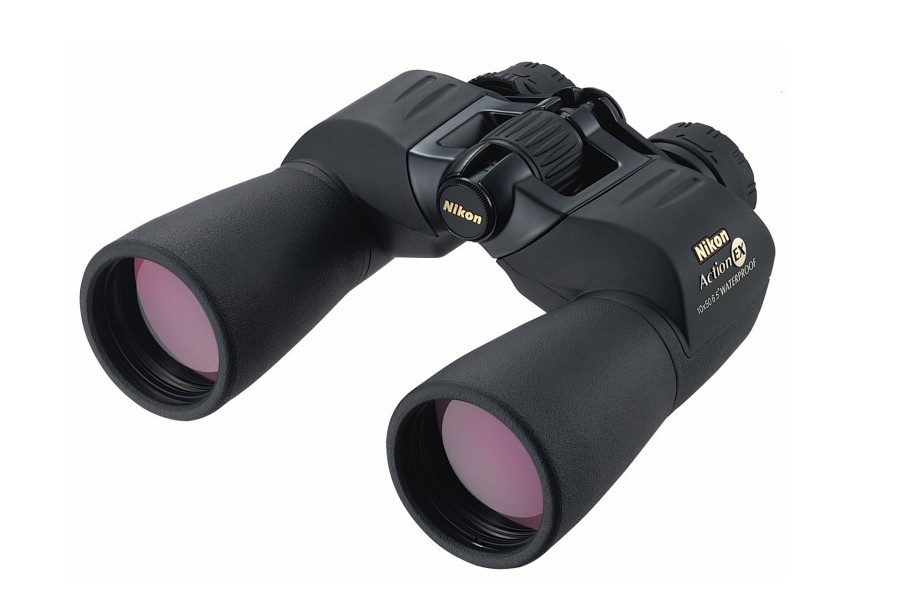
Here are specs of binocular Nikon Action EX 12×50 CF WP:
| Magnification | 12 |
|---|---|
| Front lens diameter (mm) | 50 |
| Exit pupil (mm) | 4.2 |
| Type of build | Porro prisms |
| Lens coating | fully, multiple |
| Focusing system | Central focusing (Central wheel) |
| Eyepiece cups | rotatable |
| Diopter-adjustment side | right side |
| Zoom function | – |
| Image stabilizer | – |
| Compass | – |
| Rangefinder | – |
| Eyepieces for spectacle wearers | yes |
| Splash-proof | yes |
| Protection bag | yes |
| Threaded tripod connector | yes |
| Watertight | yes |
| Lens cover | yes |
| Eyepiece cap | yes |
| Strap fitting | Loops connector, wide |
| Apparent field of view (°) | 66.0 |
| True field of view (°) | 5.5 |
| Field of view at 1,000 m (m) | 96 |
| Close focus limit (m) | 7.0 |
| Light intensity | 17.6 |
| Twilight factor | 24.5 |
| Length (mm) | 178 |
| Width (mm) | 196 |
| Weight (g) | 1045 |
| Series | Action EX |
| Surface material | Rubber armouring |
| Colour | black |
P.S. If you want to choose binoculars by purpose, we have a cool detailed article here. Jump!
Magnification — 12×
This means that objects will appear 12 times closer than they actually are. High magnification is ideal for long-distance viewing, such as in the mountains or for astronomy. However, as magnification increases, the field of view narrows and image stability decreases—so you may need a tripod or very steady hands.
Objective lens diameter — 50 mm
The objective lens is the front lens. The larger its diameter, the more light it collects. A 50 mm lens is large and provides bright, clear images even in low light. It’s great for dusk or dawn, though it also makes the binoculars heavier and bulkier.
Exit pupil — 4.2 mm
This is the diameter of the light beam exiting the eyepiece. It affects how comfortable the image appears to your eyes. A 4.2 mm exit pupil is considered versatile—bright enough for daylight and acceptable at twilight.
Build type — Porro prisms
Porro prisms provide good image depth and a more three-dimensional view. These binoculars are often larger than roof prism models, but offer bright images and are typically more affordable at similar quality levels.
Lens coating — fully multi-coated
Lens coatings reduce internal reflections and increase light transmission. Fully multi-coated optics have multiple layers on all air-to-glass surfaces—this is a mark of high-quality binoculars. They produce bright, high-contrast images with minimal glare.
Other types of lens coatings include:
- Coated — a single-layer coating on one surface. Basic level.
- Fully coated — single-layer coating on all air-to-glass surfaces.
- Multi-coated — multiple layers, but not on all surfaces.
- Fully multi-coated — multiple layers on all elements (our model).
Focusing system — central wheel
This is the most convenient and common way to focus—using one large wheel between the tubes. It allows quick focus adjustment for both eyes at the same time.
Eyecups — rotatable
Rotating eyecups are easy to adjust, especially if you wear glasses. You can extend or retract them based on your vision needs.
Diopter adjustment — right side
Allows you to compensate for differences in vision between your eyes. Once set, you’ll get a sharp image without needing to refocus each time.
Special features — none
This model has no zoom, image stabilization, compass, or rangefinder. That simplifies the design and makes the binoculars more reliable.
Eyeglass-friendly — yes
The binoculars have enough eye relief to be used comfortably while wearing glasses, without losing the field of view.
Weather protection — splash-proof, waterproof
This model is resistant to moisture and can be used in the rain or humid conditions. The body is often nitrogen-filled to prevent internal fogging.
Accessories
The set includes lens caps, a carrying case, and a wide strap connector. All these add convenience during use and transport.
Tripod mount — yes
There is a standard thread for mounting on a tripod. This is especially useful for long viewing sessions or with high magnification.
Field of view
- Apparent field of view: 66°
- True field of view: 5.5°
- At 1,000 m: 96 m
A wide field of view helps track moving objects, such as birds or vehicles. It’s especially valuable for dynamic observation.
Close focus limit — 7 m
This is the minimum distance at which the binoculars can focus. Ideal for watching birds or animals at medium distances. Not suitable for macro-level observations.
Light intensity — 17.6, Twilight factor — 24.5
These parameters show how bright the image is in low-light conditions. A high twilight factor means you can use the binoculars at dawn or dusk effectively.
Size and weight
- Length: 178 mm
- Width: 196 mm
- Weight: 1045 g
This is a large, heavy binocular—best for those who carry it in a backpack or use it with a tripod.
Series — Action EX
A reliable product line featuring water resistance, rubber armor, and good optics. Suitable for hiking, hunting, and marine use.
Body material — rubber armoring
The surface doesn’t slip in your hands, protects against impacts, and increases the binoculars’ durability.
Color — black
A neutral, practical color that doesn’t reflect light, stands out in nature, or distracts the user.
Conclusion
A 12×50 binocular is a powerful and reliable tool for medium to long-range viewing. It is well-suited for travelers, hunters, birdwatchers, and stargazers. Understanding these specifications will help you choose the right model that will serve you for years to come.