

My passion for birdwatching began in 2020 during the COVID-19 pandemic, when I started watching pigeons out of boredom from the window of my apartment. My company had switched to fully remote work, the virus was raging outside, and I had to spend the whole day at home. At that time, we lived on the first floor, and pigeons often gathered on the nearby lawn. I took my dad’s old binoculars and started observing the birds’ behavior. What fascinated me was how different all the pigeons turned out to be when seen up close. Watching them through binoculars is completely different from glancing at them as you walk by. Through the binoculars, you can see how beautiful their plumage is, how they behave — it feels like you are transported to another world, and it’s both engaging and calming at the same time.
Gradually, I discovered an online forum for birdwatching enthusiasts and started keeping a field journal. As of now, I have already made 193 entries in it. I wouldn’t call myself a hardcore birder, but every vacation I take my journal and binoculars with me. In this article, I want to talk about how to choose binoculars for bird watching.
How to choose binoculars for bird watching
Let’s immediately outline the essential features of good binoculars for bird watching. They should be:
- Magnification from 6x to 8x, or higher, but with image stabilization.
- Prism type: either Roof or Porro. Roof prisms are more expensive but more compact.
- Objective lens diameter: from 35 to 50 mm. The larger the lenses, the brighter the image and the wider the field of view. For evening birding, objective lenses should be at least 40 mm.
- Exit pupil diameter: for daytime observation, 4 mm is enough. If you plan to use binoculars in the evening or at night, you’ll need 5–7 mm.
- The glass should preferably be BaK-4 or ED. Cheaper BK-7 glass is not recommended because it has greater light loss and produces a darker image. Prisms made of BaK-4 glass deliver a brighter and clearer image.
- Field of view: the wider, the better, as it makes it easier to locate birds at a distance as soon as you raise the binoculars to your eyes, and to track them in flight. One thing to keep in mind: with inexpensive binoculars, a wide field of view often comes at the expense of image sharpness. A field of view of 120 meters (or approximately 7 degrees) is sufficient.
- Weight: up to 700 grams if you plan to use them handheld. If using a tripod, the weight doesn’t matter.
- The body should be protected from at least moisture and dust. Even better if it’s also resistant to fogging and impacts. Minimum protection rating: IP54.
- Eye relief: if you wear glasses and plan to observe birds while wearing them, you’ll need binoculars with an eye relief of 17–20 mm. If it’s less, you won’t be able to look through the binoculars with your glasses on.
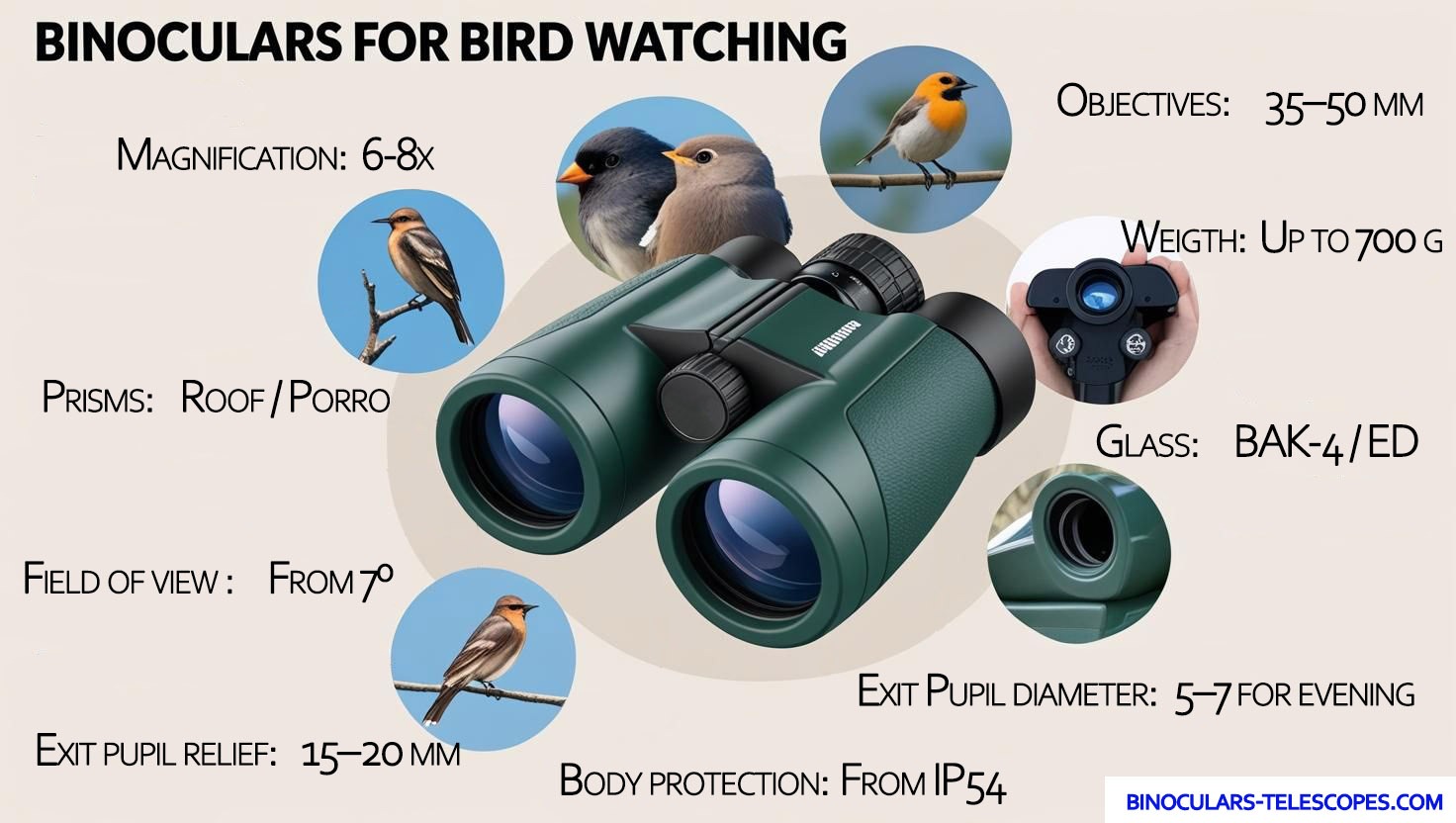
For better clarity, let’s display this information in a table:
| Parameter | Value |
|---|---|
| Magnification | 6-8x | Prisms | Roof / Porro | Objectives | 35–50 mm | Exit Pupil diameter | 5–7 for evening | Glass | BAK-4 / ED | Field of view angular / linear | From 7º / from 120 m | Weigth for using without a mount | Up to 700 g | Body protection | From IP54 | Exit pupil relief | 15–20 mm |
Well, it seems we’ve considered everything in this list. Further in the article, we will take a closer look at why and how all of this works exactly this way.
Magnification 6–8x
This is the ideal magnification for birdwatching at a distance and without using a tripod. Binoculars with this magnification are generally still lightweight, and it’s not difficult to hold them in your hands for an extended period. You can choose higher magnification, but keep in mind that already at 10x it may become difficult to keep objects within the field of view, and the image will shake. Starting from 10x magnification, it is recommended to use a tripod. Alternatively, you can use binoculars with image stabilization.
Additionally, magnification affects the field of view. Of course, you need to check each binocular model individually, but overall, 6–8x magnification provides an optimal field of view, around 7º.
Roof / Porro prisms

In principle, the differences here are not very noticeable. The question is how much money you are willing to spend on binoculars. Typically, more expensive models with Roof prisms provide a better image and are more durable than Porro prism binoculars in the same price range.
If you are just starting birdwatching and don’t want to spend a lot of money, I recommend binoculars with Porro prisms. Although they are a bit bulkier, they offer a more stereoscopic, more three-dimensional image. It feels different.
I recommend Roof prism binoculars for those who have already started and want to move to a new level. Due to the fact that the internal prism layout system is more complex, these binoculars are more expensive, but they are also more likely to use higher quality glass, and it’s more common to find models with nitrogen-filled housings. This protects the expensive optics from fogging due to temperature changes.
If you want to better understand the difference between Porro and Roof prisms, feel free to check out our other article.
Objective lenses 35–50 mm
This is simple: choosing the diameter of the objective lens means choosing between the compactness of the binoculars and their field of view/brightness. The larger the objective lenses, the more light they let into the observer’s eye, resulting in a brighter image. However, brightness also largely depends on the type of glass used for the prisms and the presence of anti-reflective and light-enhancing coatings. If these are present, even a compact binocular will deliver a bright and sharp image not only during the day but also at dusk.
In addition, the wider the objective lens, the wider the field of view. On average, for outdoor use, objective lenses of 35–50 mm are recommended, and for birdwatching, what matters most is color accuracy and image detail.
Exit pupil 5–7 mm
The pupil of the human eye changes its diameter depending on lighting conditions. In bright light, it narrows to 2–4 mm, and in darkness, it expands to 5–8 mm. If the exit pupil diameter of the binoculars is smaller than that of our eye, they won’t transmit enough light to the eye, and the image will appear dark.
For example, if the exit pupil of the binoculars is 4 mm, but we are observing in low-light conditions in the evening and our pupil has expanded to 7 mm to absorb as much light as possible, these binoculars will only transmit a little over half of the light required by our eye to form a sharp image.
BAK-4 glass for beginners, ED for advanced users
We won’t dive deep into technical details here: we have a separate article about prism glass types. You can find the difference between BAK-4 and BK-7 here, information about BAK-4 glass here, and a comparison of ED and BAK-4 glass here.
In general, BAK-4 glass is the most affordable option with minimal light loss. Take a look at the comparison table of light transmission coefficients for the most popular glass types used in binoculars. The higher the coefficient, the more light the glass transmits, the brighter and sharper the image, and the fewer optical distortions there will be.
| Glass Type | Light Transmission Coefficient | Comment |
|---|---|---|
| ED (Extra-low Dispersion) | ~1.43 – 1.50 | Ultra-low dispersion glass, minimizes chromatic aberrations |
| BaK-4 (Barium Crown) | ~1.553 – 1.568 | High-quality glass with a high refractive index and low internal light scattering |
| BK-7 (Borosilicate Crown) | ~1.5168 | Standard optical glass, often used in entry-level optics |
| K-9 (Chinese Crown Glass) | ~1.516 | Chinese equivalent of BK-7, slightly more durable and affordable |
Since the main task in birdwatching is observation, it is critically important to have a bright and sharp image with accurate color reproduction and fine details. Brightness can be increased with anti-reflective and multi-coatings, but other image qualities depend on the glass type. As you can see, the best option is ED glass, but binoculars with ED glass prisms are more expensive. Therefore, in our list, I suggest BaK-4 glass. It provides the minimum acceptable image quality at a reasonable price.
Field of view from ~7° angular or 120 meters linear
This specification is usually printed on the binocular’s body near the magnification and objective lens size. Look for at least 120 meters at a distance of 1000 meters — this field of view will be sufficient to easily locate birds in treetops or follow them in flight. This field of view is considered fairly wide.
IP54 protection and above
The weight is clear, so we won’t dwell on that. But let’s talk more about body protection. There is an international protection rating scale with several levels of dust and water resistance. The higher the numbers after “IP”, the better the protection. The first digit indicates resistance to solid particles, the second to water. For outdoor use, binoculars should have at least protection against large particles (dust, sand) and water splashes — this is rated as IP54. Maximum protection is IP68, meaning the binoculars can be submerged in water and protected against fine dust particles.
Eye relief 17–20 mm if you wear glasses
Usually, binocular focus adjustment can compensate up to 5 diopters, so wearing glasses is often unnecessary. However, if removing your glasses is uncomfortable or the focusing range doesn’t cover your vision needs, you can use binoculars while wearing glasses. In this case, the eye relief (the distance from the eyepiece lens to the point where the image comes into focus) should be at least 15–20 mm.
What size binoculars for bird watching to choose?
The size of your binoculars is an important factor. On one hand, you don’t want to carry a giant that weighs down your backpack and takes up half the space. On the other hand, you want brighter images, higher magnification, and better performance.
Too big — and you’ll get tired, too small — and you won’t see anything

Balance is key. Imagine you’re hiking through a pine forest, the morning sun barely breaking through the treetops. Somewhere above, a crossbill calls. You want to grab your binoculars quickly and spot the bird. But hanging on your neck is a hefty beast weighing nearly a kilo. By the time you take it off and focus, the bird is gone. Frustrating, isn’t it?
Now imagine another scenario. You have a small, almost pocket-sized binocular. Lightweight, convenient. But here’s the problem — at 60 meters, where a robin sits on a branch, all you see is… a tiny dot. Zero details. Yet it’s the fine details that reveal the true beauty of birds.
So, what is the optimal size?
8×42 — like the Toyota Corolla of binoculars
Most birdwatchers, both experienced and beginners, agree that the ideal size for birdwatching binoculars is 8×42. It’s like the Toyota Corolla of optics: reliable, balanced, suitable for almost any situation. Why?
- 8x magnification allows you to see birds clearly while still holding a steady image without shaking.
- 42 mm objective lenses gather enough light to produce a bright image, even on cloudy days or under tree canopies.
- The weight usually does not exceed 700 grams, making it comfortable to carry around your neck all day without discomfort.
And what if you travel often?

If your birdwatching trips are more like spontaneous strolls to a city park, and you only carry a backpack for a thermos and a sandwich, you might want to consider more compact models, such as 8×32 or 10×32 binoculars. They are lighter, more convenient to take on a trip, and take up less space in your luggage.
For example, I often take my old 10×32 on short trips. Its strap is already worn out, and the body is scratched, but it’s like a loyal companion — always by my side. The combination of parameters is very convenient for use on the go. The only drawback is that it’s a bit weak in low light, even though it has anti-reflective coatings.
But if you’ve been reading this article carefully, you probably already understand why: the exit pupil diameter is only 3.2 mm, and for evening birdwatching, you need at least 5 mm.

Speaking of birds at sunset
For evening birdwatching, models with 50 mm objective lenses are much better suited. They gather light very well, providing a bright and vivid image even after sunset. But the weight… Almost a kilogram may sound like nothing, but in reality, your hands get tired quickly with such models. I only take these binoculars if I know for sure I’ll be using a tripod or observing from a fixed position.
Best small and lightweight bird watching binoculars
| Model | Magnification & Objective | Field of View | Weight | Eye Relief | Prism / Glass | Optical Coating | Waterproof | Exit Pupil | Price (approx.) |
|---|---|---|---|---|---|---|---|---|---|
| Vortex Diamondback HD 8×32 | 8×32 | 426 ft @ 1000 yds | 450 g | 16 mm | Roof / BaK-4 | Fully Multi-Coated, Dielectric | Yes (IPX7) | 4 mm | $250 |
| Zeiss Terra ED Pocket 8×25 | 8×25 | 357 ft @ 1000 yds | 310 g | 16 mm | Roof / ED | Hydrophobic Multi-Coating | Yes | 3.1 mm | $400 |
| Nikon Monarch M7 8×30 | 8×30 | 435 ft @ 1000 yds | 465 g | 15.8 mm | Roof / ED | Fully Multi-Coated, Dielectric | Yes | 3.75 mm | $480 |
| Leica Ultravid BR 8×20 | 8×20 | 341 ft @ 1000 yds | 240 g | 15 mm | Roof / HighLux | HDC & AquaDura Coating | Yes (splashproof) | 2.5 mm | $850 |
| Celestron TrailSeeker ED 8×32 | 8×32 | 393 ft @ 1000 yds | 454 g | 17 mm | Roof / ED | Fully Multi-Coated, Phase & Dielectric | Yes | 4 mm | $260 |
1. VORTEX DIAMONDBACK HD 8X32
You don’t always need a luxury brand to feel confident in the field. The Diamondback HD 8×32 from Vortex is one of those trusty companions you can sling around your neck all day without noticing the weight – until you raise it to your eyes and realize it punches far above its price tag.
With a super-wide 426ft field of view, it’s ideal for following quick movers like warblers and swallows across tangled canopies. The 32mm objective strikes that sweet spot between light-gathering ability and portability. Waterproof, rugged, and with a crisp HD image thanks to dielectric coatings, this bino doesn’t just keep up – it pushes ahead.
2. ZEISS TERRA ED POCKET 8X25
The Zeiss Terra ED Pocket isn’t just a compact binocular – it’s the binocular that disappears into your jacket until a kestrel hovers into view. Light as a feather at just 310 grams, it’s the kind of glass you never leave at home, even when traveling light.
Despite its size, the view it offers is unmistakably Zeiss: clean, crisp, with great contrast, especially in open light. The hydrophobic lens coating means it shrugs off morning dew or coastal mist with ease. Sure, the 3.1mm exit pupil limits low-light use, but during daylight, it’s a stellar companion – agile, sharp, and fast to focus.
3. NIKON MONARCH M7 8X30
If your birding takes you from dense forests to breezy estuaries, the Nikon Monarch M7 8×30 is your go-anywhere, see-everything binocular. It offers a whopping 435ft field of view – the widest of the bunch – which makes tracking birds in flight feel intuitive, almost second nature.
The image pops with color and clarity, thanks to ED glass and high-end coatings. At 465g it’s solid but still lightweight enough for long days in the field. The rubber armor and waterproof housing round it out as a reliable tool, not just a luxury item. This one’s for serious birders who want both performance and flexibility.
4. LEICA ULTRAVID BR 8X20
Few binoculars feel this refined. The Leica Ultravid BR 8×20 is a marvel of engineering, folding down so small you could forget it’s with you – until it reveals an image that’s classic Leica: bright, razor-sharp, and rich with detail.
At just 240g, it’s perfect for the minimalist birder or globe-trotting traveler. Yes, the 2.5mm exit pupil means low-light limitations, but under blue skies or sunny trails, it’s magical. The splashproof body and premium coatings make it tough enough for outdoor use, and the craftsmanship? That’s something you’ll appreciate every time you take it out.
5. CELESTRON TRAILSEEKER ED 8X32
Don’t let the modest price fool you – the TrailSeeker ED 8×32 is one of those under-the-radar performers that delivers far more than expected. ED glass, phase-corrected prisms, and dielectric coatings ensure bright, color-true images that stand up to much pricier models.
Weighing just under 455 g and offering a generous 17 mm of eye relief, it’s comfortable for extended use – even with glasses. The 393ft field of view is ample for tracking songbirds through hedgerows or hawks over fields. If you want serious optics without emptying your wallet, this is a smart, satisfying pick.
What to choose for beginners?

If you are just starting birdwatching, choose binoculars that combine convenience, reliability, and simplicity. The optimal option is a model with 8× magnification and 42 mm objective lenses. Such binoculars offer a wide field of view, a stable image even without a tripod, and are suitable for observing birds in forests, parks, or open nature. It’s also important to pay attention to waterproofing and comfort — it is difficult for beginners to follow birds for a long time using heavy or uncomfortable equipment.
Below are three excellent options for beginner birdwatchers in 2025:
- Vortex Diamondback HD 8×42 – reliable, lightweight, wide field of view, good image quality at an affordable price (~$240).
- Celestron Nature DX 8×42 – budget-friendly choice for getting started, waterproof, decent optics (~$160).
- Nikon Monarch M7 8×42 – versatile mid-range binoculars with excellent optics and a durable body (~$570).
Vortex Diamondback HD 8×42
- Magnification: 8×
- Objective lens: 42 mm
- Field of view: 393 ft at 1000 yd (120 m)
- Weight: 620 g
Features: Durable prisms, fully multi-coated lenses, waterproof, compact body.
Description: The best balance between price and quality. Ideal for forest walks and handheld birdwatching. Popular among beginners and those looking for a versatile binocular at a reasonable price (~$240).
Celestron Nature DX 8×42
- Magnification: 8×
- Objective lens: 42 mm
- Field of view: 388 ft at 1000 yd (118 m)
- Weight: approx. 652 g
Features: Nitrogen-filled, waterproof and dustproof, anti-reflective coating.
Description: A great option for those who are not ready to spend much. A simple, convenient, and reliable model for first trips to nature (~$160).
Nikon Monarch M7 8×42
- Magnification: 8×
- Objective lens: 42 mm
- Field of view: 435 ft at 1000 yd (132 m)
- Weight: 668 g
Features: ED glass, wide field of view, quality construction, waterproof, enhanced optics.
Description: A versatile binocular for those ready to invest a little more. Perfect for both beginners and users who want serious equipment right from the start (~$570).
What strength of binoculars is best for bird watching?
The optimal magnification for birdwatching is between 6x and 10x. Nowadays, many binoculars come with image stabilization technology. If you are ready to invest in such models, you can go for higher magnification.
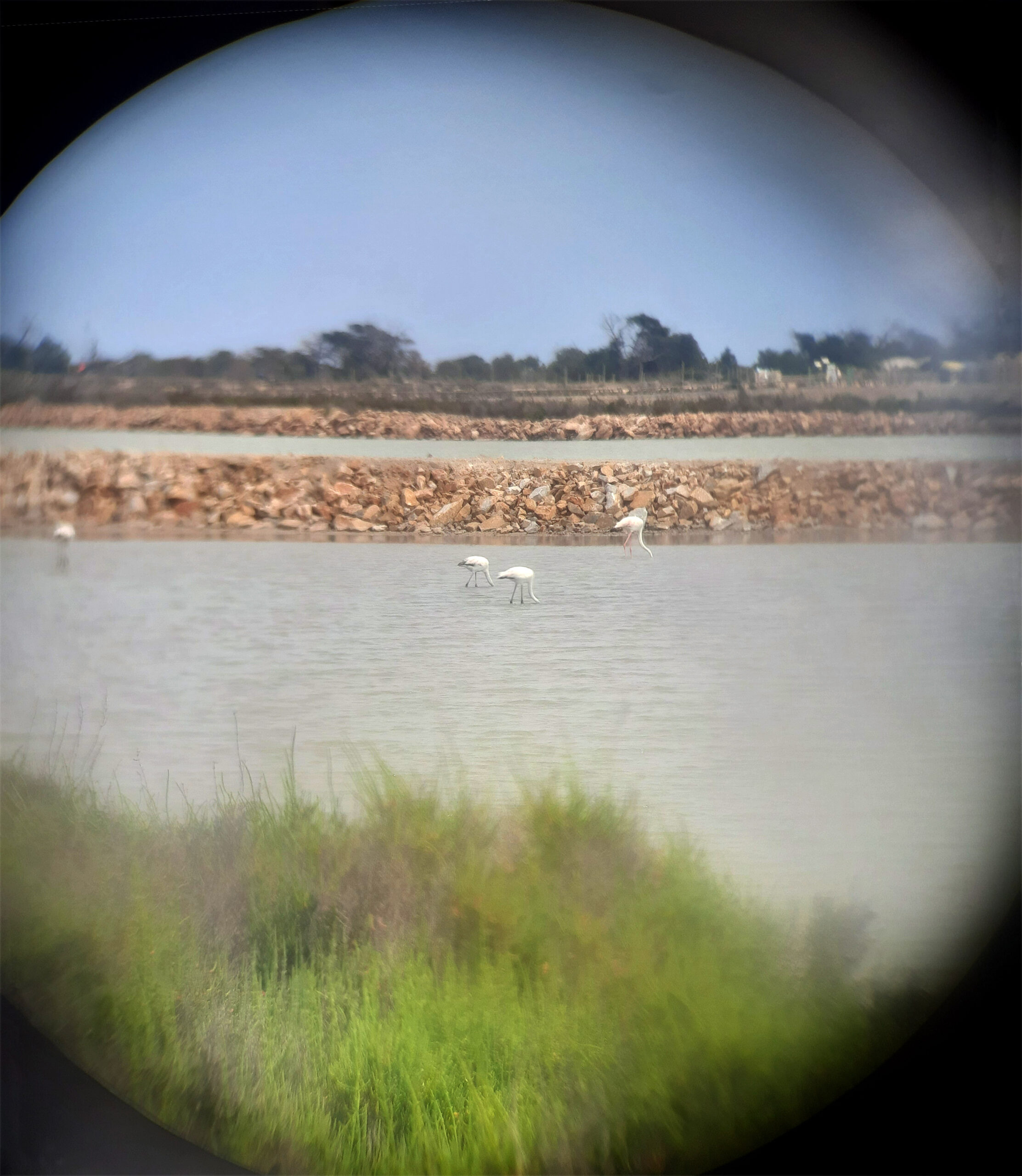
Otherwise, if you want stronger magnification but prefer to save money, using a tripod is recommended.
Why is 6-10x magnification considered optimal?
- It brings birds significantly closer: For example, a bird 200 meters away will appear as if it were only 33 to 20 meters away.
- Provides a stable image for handheld viewing: Minimal image shake compared to higher magnification.
- Keeps binoculars compact and lightweight.
- Maintains a sufficiently wide field of view: Helps track flying birds or spot them in trees easily.
Are 8x or 10x binoculars better for birding?
Both magnifications are popular but serve slightly different purposes.
8x – Universal choice
Great for general birdwatching in forests, parks, or when birds are moving quickly.
- Wider field of view: Easier to locate and follow birds.
- Stable image: Less hand tremor effect.
- Slightly brighter image: Performs better in low-light conditions.
10x – For longer distances
Ideal for observing birds at greater distances, near lakes, coasts, or in the sky.
- Stronger magnification: Better detail recognition from afar.
- Narrower field of view: Image more sensitive to hand shake; may require tripod in some situations.
TOP-5 8×42 binoculars for bird watching
Nikon Monarch M5 8×42
Why in the TOP-5: Reliable and versatile binoculars from a renowned brand, suitable for various environments, from forests to open fields. Solid image quality at a fair price.
- Magnification: 8×
- Objective lens: 42 mm
- Field of view: 140 m at 1000 m
- Weight: 640 g
- Prisms: Roof, BaK-4 glass
- Optics coating: Fully multi-coated, dielectric
- Protection: Waterproof, nitrogen-filled, fogproof
- Exit pupil: 5.25 mm
- Eye relief: 19.5 mm
- Price: ~ $468
Suitable for: Beginners and experienced birdwatchers looking for a good balance between price, quality, and comfort.
Vortex Diamondback HD 8×42
Why in the TOP-5: One of the most popular birdwatching binoculars in the USA. Offers sharp, contrast-rich images with a durable build at a reasonable price.
- Magnification: 8×
- Objective lens: 42 mm
- Field of view: 131 m at 1000 m
- Weight: 618 g
- Prisms: Roof, BaK-4 glass
- Optics coating: Fully multi-coated, dielectric
- Protection: Fully waterproof, nitrogen-filled
- Exit pupil: 5.25 mm
- Eye relief: 17 mm
- Price: ~ $350
Suitable for: Travelers, birdwatchers, hunters — a versatile choice for outdoor conditions.
Zeiss Terra ED 8×42
Why in the TOP-5: German quality at a relatively affordable price. Bright, high-contrast image suitable even for dusk conditions.
- Magnification: 8×
- Objective lens: 42 mm
- Field of view: 125 m at 1000 m
- Weight: 725 g
- Prisms: Roof, ED glass
- Optics coating: Hydrophobic, multi-coated
- Protection: Fully waterproof, nitrogen-filled
- Exit pupil: 5.25 mm
- Eye relief: 18 mm
- Price: ~ $586
Suitable for: Demanding observers who want premium image quality and durability without overpaying for top-tier models.
Celestron TrailSeeker ED 8×42
Why in the TOP-5: Excellent price-performance ratio among ED glass binoculars. Great color reproduction and sharpness.
- Magnification: 8×
- Objective lens: 42 mm
- Field of view: 142 m at 1000 m
- Weight: 655 g
- Prisms: Roof, ED glass
- Optics coating: Fully multi-coated, phase correction
- Protection: Waterproof, nitrogen-filled
- Exit pupil: 5.25 mm
- Eye relief: 17 mm
- Price: ~ $328
Suitable for: Those who often hike, travel, and don’t want to worry about rain, dust, or cold weather.
Steiner SkyHawk 4.0 8×42
Why in the TOP-5: Known for durability and excellent optics. Ideal for travel and tough weather conditions.
- Magnification: 8×
- Objective lens: 42 mm
- Field of view: 125 m at 1000 m
- Weight: 740 g
- Prisms: Roof, BaK-4 glass
- Optics coating: Fully multi-coated, water-repellent
- Protection: Waterproof, nitrogen-filled
- Exit pupil: 5.25 mm
- Eye relief: 17 mm
- Price: ~ $527
Suitable for: Those who often go hiking, travel, and want reliable performance without worrying about rain, dust, or harsh weather conditions.
Best 10×42 binoculars for bird watching
You can confidently choose the same series and brands as mentioned above but with 10x magnification. However, here are alternative noteworthy models for those looking for variety.
| Model | Magnification & Objective | Field of View | Weight | Eye Relief | Prisms / Glass | Optics Coating | Waterproof | Exit Pupil | Price |
|---|---|---|---|---|---|---|---|---|---|
| Maven C.1 10×42 | 10×42 | 95 m at 1000 m | 675 g | 16 mm | Roof / ED | Fully Multi-Coated, Dielectric | Yes (Waterproof, Nitrogen) | 4.2 mm | ~ $450 |
| Bushnell Engage 10×42 | 10×42 | 104 m at 1000 m | 715 g | 18 mm | Roof / ED | EXO Barrier, Fully Multi-Coated | Yes (IPX7) | 4.2 mm | ~ $400 |
| Eschenbach Trophy D 10×42 | 10×42 | 105 m at 1000 m | 730 g | 15 mm | Roof / BaK-4 | Multi-Coated, Phase correction | Yes (Waterproof, Nitrogen) | 4.2 mm | ~ €500 |
| Leupold BX-4 Pro Guide HD 10×42 | 10×42 | 99 m at 1000 m | 709 g | 16 mm | Roof / HD glass | Fully Multi-Coated, Twilight Light Management | Yes (Water and Dustproof) | 4.2 mm | ~ $600 |
| Opticron Explorer WA ED-R 10×42 | 10×42 | 104 m at 1000 m | 670 g | 17 mm | Roof / ED | Fully Multi-Coated, Dielectric | Yes (Waterproof) | 4.2 mm | ~ £370 |
Why they made the list:
- Maven C.1 10×42: American-made with excellent image quality, ED glass, and reliable waterproofing.
- Bushnell Engage 10×42: Well-balanced price and advanced lens protection with EXO Barrier technology.
- Eschenbach Trophy D 10×42: German quality, vivid image, good handling even with gloves.
- Leupold BX-4 Pro Guide HD 10×42: Premium optics, twilight brightness boost, sturdy construction.
- Opticron Explorer WA ED-R 10×42: Lightweight, wide field of view, ideal for travelers.
Are 20×50 binoculars good for bird watching?
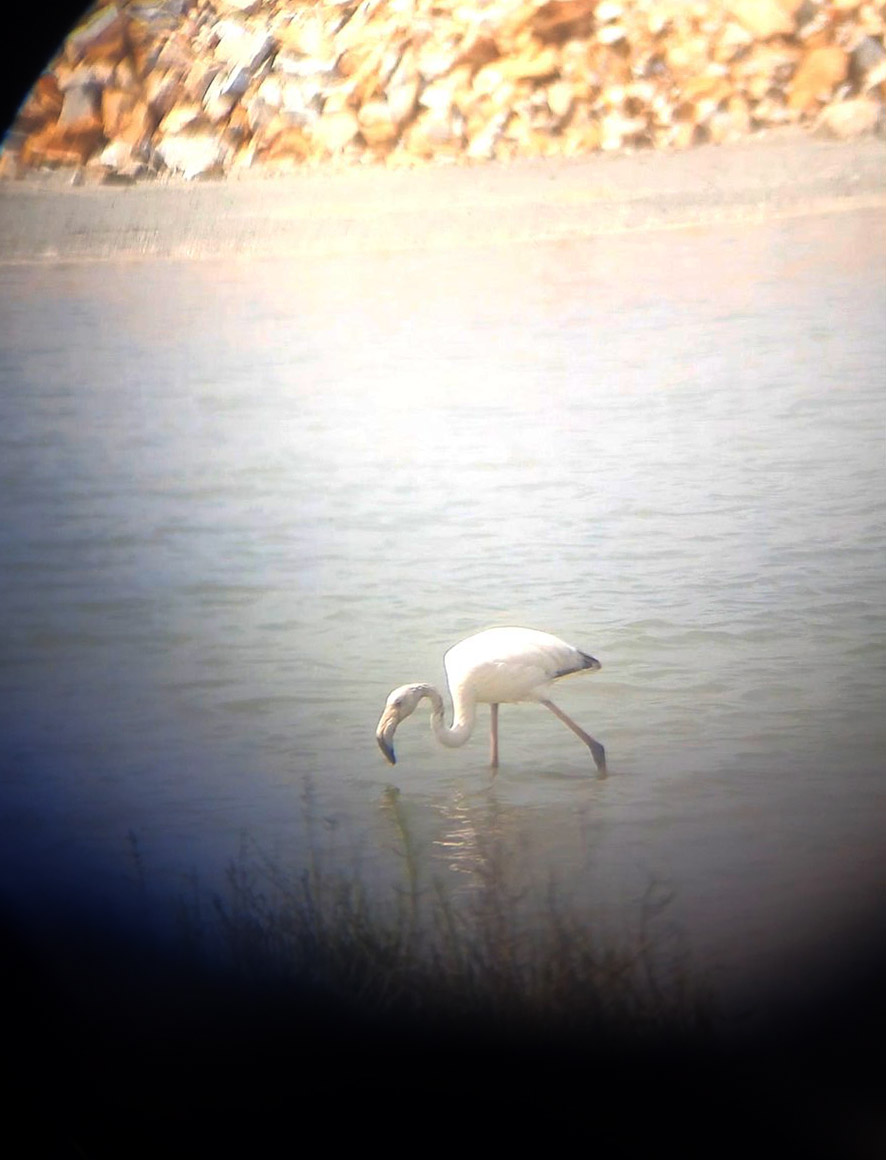
No, 20×50 binoculars are generally unsuitable for birdwatching, especially for handheld use or casual walks. These models are designed for astronomy and long-distance observation.
Drawbacks for birding:
- Bulky and heavy
- Narrow field of view
- Impossible to use without a tripod
- Likely large minimum focusing distance
However, for stationary observation from a tripod in open areas, 20×50 binoculars can be used to observe distant birds. At 20x magnification, a bird 200 meters away appears as if only 10 meters away.
Binoculars for birdwatching with camera
Binoculars with a built-in camera for birdwatching might sound like an appealing idea — observe the bird and take a photo right away. In reality, things aren’t that simple. Let me explain why.
Advantages, although there aren’t many:
- You can instantly get a photo or video of what you are observing.
- Some models allow you to save recordings to a memory card or transfer them directly to your smartphone.
- Convenient for travel — no need to carry both binoculars and a camera separately.
Disadvantages:
Unfortunately, there are more downsides than benefits.
- Optical quality suffers. These devices often provide worse image quality than even mid-range conventional binoculars.
- The built-in camera is not a professional-grade module — it’s more comparable to an action camera or an entry-level compact camera.
- Most of these models are more suited for entertainment or personal use rather than serious birdwatching. If your goal is high-quality observation, feather detail, and accurate color reproduction, especially in low-light conditions, it’s better to buy quality conventional binoculars and a separate camera or smartphone with a telephoto lens.
- They are often heavier, bulkier, and offer inferior protection against moisture and impacts.
In short, if your goal is to enjoy observing birds with high-quality optics, it’s better to get a good classic binocular. If you simply want to record your memories and don’t care much about photo quality — you can give these devices a try.
| Model | Magnification & Objective | Camera (Mp) | Video | Weigth | Memory | Protection | Price, average |
|---|---|---|---|---|---|---|---|
| Barska 8×32 Digital Camera Binoculars | 8×32 | 8 MP | Full HD 1080p | 650 g | microSD up to 32 GB | Lightweight waterproofness | ~$180 |
| Camonity 5MP Digital Binoculars | 12×32 | 5 MP | HD 1280×1080 | 450 g | microSD up to 32 GB | No | ~$130 |
| Eoncore 2" LCD Digital Binoculars | 12×32 | 5 MP | HD 720p | 430 g | microSD up to 32 GB | No | ~$110 |
| Bushnell ImageView 10×25 | 10×25 | 1.3 MP (interpolation up to 5 MP) | VGA 640×480 | 400 g | SD up to 16 GB | Splashproof | ~$150 |
| Rexing B1 Night Vision Binoculars | 10×25 | Photo up to 12 MP | HD Video | 500 g | microSD up to 32 GB | IPX4, night vision | ~$230 |
Barska 8×32 Digital – one of the few more or less balanced options. Decent mid-range optics, comfortable to use, acceptable photo quality. However, don’t expect bright detail comparable to ED glass.
Camonity 12×32 – a budget-friendly option for entertainment. Higher zoom, but lower light-gathering ability. Photos are acceptable for social media but lack sharpness.
Eoncore 12×32 LCD – convenient thanks to the built-in screen. You can instantly review your shots. However, photo and video quality remains at an entry-level standard.
Bushnell ImageView 10×25 – compact and made by a well-known brand, but the camera resolution is quite modest. More suitable for recording events than for capturing beautiful, detailed images.
Rexing B1 – an interesting hybrid with night vision functionality. Suitable not only for birdwatching but also for nighttime observations. However, daytime image quality is typical for devices of this kind.
What do users of Reddit say about them?
Reddit users generally agree with our opinion on camera binoculars:
“In my experience no they are not. You typically get a low end binoc with a low end digital camera. <…> Get decent binocs and a decent camera and you will get much better results.” – cmonster556
“if you try to straddle the fence and get two things in one you really get two mediocre things and neither works very well.” – sciendias
“Bins with built‑in cameras are pretty much all still crap.” – basaltgranite
In almost all cases, people recommend using regular binoculars and a tripod for your phone. The quality of the pictures is excellent:
“you could DIY or buy a mount for your phone on your binoculars.” – iwrestledasharkonce
There is only one case where users recommend such a model, and that is the Swarovski AX Visio, priced at no less than $5,000:
“They are very cool, but I don’t know if they’re worth the $5000 yet.” – ChadHahn
“A possible exception is the Swarovski AX Visio, recently released to mixed reviews. It’s ~$5k.” – basaltgranite
TOP-10 binoculars for birdwatching 2025
Here we have compiled an updated ranking of the Top 10 binoculars for birdwatching in 2025. The models differ in magnification, price, and specialization — so that everyone can choose the most suitable option for themselves.
| Model | Magnification & Objective | Field ofview (yards @1000 yds) | Weigth (g) | Prism / Glass | Covering | Waterproofness |
|---|---|---|---|---|---|---|
| Swarovski NL Pure 8×32 | 8×32 | 8.4° (~147 m) | 650 г | Roof / Fluorite ED | Dielectric, FMС | Yes |
| Leica Noctivid 10×42 | 10×42 | ~130 m | 775 g | Roof / BaK‑4 | Thermal/Multicoated | Yes |
| Nikon Monarch M7 10×42 | 10×42 | 114 m | 710 g | Roof / ED | FMC, Dielectric | Yes |
| GPO Passion ED 8×42 | 8×42 | ~125 m | 690 g | Roof / ED | FMC, Dielectric | Yes |
| Hawke Frontier ED X 8×42 | 8×42 | 130 m | 720 g | Roof / ED | FMC, Dielectric | Yes |
| Maven B1.2 10×42 | 10×42 | 99 m | 700 g | Roof / ED | FMC, Dielectric | Yes |
| Celestron Nature DX ED 12×50 | 12×50 | – | 1 075 g | Roof / ED | FMC, phase | Yes |
| Vortex Viper HD 8×42 | 8×42 | 140 m | 740 g | Roof / BaK‑4 | FMC, Dielectric | Yes |
| Canon 15×50 Image-Stabilized | 15×50 | ~160 m | 1 960 g | Roof / BaK‑4 | FMC + stabilization | Yep |
| Celestron TrailSeeker 8×42 | 8×42 | 142 m | 655 g | Roof / BaK‑4 | FMC, phase-corrected | Yep |
Swarovski NL Pure 8×32
A favorite among professionals: incredibly wide field of view, ultra-compact, and considered a work of art. Why is it the best? Because it combines portability, maximum brightness, and resolution — a tool for ornithologists and guides who want the very best.
Leica Noctivid 10×42
Among the many premium binoculars, this one stands out with its “organic” natural image and brightness. Despite 10x magnification, the image remains clear and stable — one of the best choices for HDR observation.
Nikon Monarch M7 10×42
The balance between price and quality: ED glass, waterproofing, convenient handling. An excellent choice for enthusiasts who value versatility and detail at long distances.
GPO Passion ED 8×42
British “premium-budget”: ED glass, dielectric prisms, magnesium body — almost like Swarovski. Perfect for those who appreciate beauty and detail in nature.
Hawke Frontier ED X 8×42
One of the best ED binoculars under $500. Bright, deep image, wide field of view, style, and reliability.
Maven B1.2 10×42
Noticeably higher quality than similar lines, with convenient focusing. Ideal for those who want ED glass but are not ready for top-tier prices.
Celestron Nature DX ED 12×50
Huge magnification plus large objective lenses — almost like a stationary tool, yet still portable. Suitable for long-distance observations but heavy.
Vortex Viper HD 8×42
A solid all-rounder with a wide field of view, ED glass, reliable build, and lifetime warranty. An excellent choice from the practical segment.
Canon 15×50 IS
A unique option in its class: built-in image stabilization makes 15x truly usable handheld. Perfect for prolonged handheld observation.
Celestron TrailSeeker 8×42
Comfortable field of view, durable body, lightweight, and affordable. Often mentioned as the best “people’s choice,” especially for travel and tours.
How to choose the right one for you?
- Premium level: Swarovski NL Pure, Leica Noctivid — for professionals and enthusiasts.
- Price/quality balance: Nikon Monarch M7, Vortex Viper, TrailSeeker.
- Great alternatives with ED glass: GPO Passion, Hawke Frontier.
- Maximum magnification: Canon 15×50 IS, Celestron Nature DX 12×50 — for detailed long-distance observation. Tripod use recommended.
Best binoculars for birding under $100
Now let’s look at budget models. The market is full of offers, and we’ve found decent options suitable for beginners or those looking for a lightweight backup pair for walks. Of course, you shouldn’t expect premium quality for this price, but some models handle the task quite well.
Celestron UpClose G2 8×42
- ✔ Magnification: 8×
- ✔ Objective lens: 42 mm
- ✔ Field of view: 119 m / 1000 m
- ✔ Weight: approx. 700 g
- ✔ Coating: Multi-coated lenses
- ✔ Waterproofing: Partial
An affordable and fairly bright binocular for park or backyard observations. Not ideal in bad weather, but the image is decent for the price (~$65).
Bushnell Falcon 10×50
- ✔ Magnification: 10×
- ✔ Objective lens: 50 mm
- ✔ Field of view: 99 m / 1000 m
- ✔ Weight: approx. 800 g
- ✔ Coating: Fully coated optics
- ✔ Waterproofing: None
A classic option with large objective lenses and basic optics. Provides good magnification but is heavy for long walks. Suitable for stationary observation (~$70).
Occer 12×25 Compact
- ✔ Magnification: 12×
- ✔ Objective lens: 25 mm
- ✔ Field of view: 96 m / 1000 m
- ✔ Weight: 350 g
- ✔ Coating: Multi-coated lenses
- ✔ Waterproofing: Yes (splash-proof)
A super-compact pocket option for travel. Strong magnification with minimal weight, but image brightness drops in low light conditions (~$50).
SkyGenius 10×50
Good for daytime observations. Suitable for beginners, especially for birdwatching in open areas or gardens (~$60).
Adorrgon 12×42 HD
An optimal choice among Chinese budget models. Stronger magnification, decent brightness, comfortable weight for walks. Good for observing large birds or landscapes (~$85).
Of course, getting high-quality images under $100 is difficult, but if your budget is limited or you are just starting out, these models will work. If compactness matters, go for Occer. If you want power and brightness — Bushnell or Adorrgon. Celestron and SkyGenius are versatile, affordable options for casual walks.

Best Nikon binoculars for birdwatching
Nikon is a Japanese brand with nearly a century of history. Most people know Nikon for its cameras, but the company is not only famous for them. The brand also produces binoculars ranging from entry-level to luxury. Nikon’s product range includes binoculars for hunting and birdwatching, compact models for travelers, waterproof marine binoculars, and more.
Nikon binoculars are known for their high build quality and premium optics, yet the brand also offers many affordable models. So, what makes them good for birdwatching?
- Excellent glass quality. Even in budget-friendly series, Nikon uses decent optics with multi-coated lenses for bright and sharp images, while premium models are equipped with ED (Extra-low Dispersion) glass.
- Wide selection — from pocket-sized compact models to full-size “heavyweights” for tripod-mounted stargazing.
- Weather resistance. Most models are protected against moisture and fogging, making them suitable for hiking, forests, wetlands, and coastal areas.
- Thoughtful design. Nikon binoculars fit comfortably in hand, are easy to adjust even with gloves, and are well-suited for both beginners and experienced users.
And most importantly, Nikon offers models for almost any budget — from affordable binoculars for beginners to premium-class optics.
We have prepared a list of, in our opinion, the best Nikon binoculars for birdwatching in 2025 — based on user reviews and the modern demands of birdwatchers.
Nikon Monarch M7 8×42
- ✔ Magnification: 8×
- ✔ Objective lens: 42 mm
- ✔ Field of view: 435 ft @ 1000 yds (144 m at 1000 m)
- ✔ Weight: 660 g
- ✔ Prism type: Roof / ED glass
- ✔ Coating: Fully Multi-Coated + Dielectric
- ✔ Waterproofing: Fully waterproof (Nitrogen purged)
- ✔ Price: around $500
One of the best universal binoculars for birdwatching. Excellent brightness, wide field of view, and comfort for long walks. ED glass minimizes chromatic aberrations, the image is sharp and natural.
Nikon Monarch M7 10×42
- ✔ Magnification: 10×
- ✔ Objective lens: 42 mm
- ✔ Field of view: 362 ft @ 1000 yds (120 m at 1000 m)
- ✔ Weight: 680 g
- ✔ Prism type: Roof / ED glass
- ✔ Coating: Fully Multi-Coated + Dielectric
- ✔ Waterproofing: Fully waterproof
- ✔ Price: around $520
For those who prefer greater magnification. Perfect for observing large or distant birds, such as waterfowl or raptors in open spaces.
Nikon Prostaff P7 8×30
- ✔ Magnification: 8×
- ✔ Objective lens: 30 mm
- ✔ Field of view: 456 ft @ 1000 yds (151 m at 1000 m)
- ✔ Weight: 470 g
- ✔ Prism type: Roof / BaK-4
- ✔ Coating: Multi-Coated + Dielectric
- ✔ Waterproofing: Yes, nitrogen-filled
- ✔ Price: around $200
A compact and lightweight option for those who do not want to carry heavy optics. Excellent field of view, fast focusing, and decent image quality for reasonable money. Suitable for walks and travel.
Nikon Prostaff P3 8×42
- ✔ Magnification: 8×
- ✔ Objective lens: 42 mm
- ✔ Field of view: 377 ft @ 1000 yds (126 m at 1000 m)
- ✔ Weight: 575 g
- ✔ Prism type: Roof / BaK-4
- ✔ Coating: Multi-Coated
- ✔ Waterproofing: Yes, weather-resistant body
- ✔ Price: around $150
An affordable option for beginners or as a second “hiking” binocular. Simple but functional optics, decent field of view, and weather protection.
Nikon Trailblazer ATB 8×25
- ✔ Magnification: 8×
- ✔ Objective lens: 25 mm
- ✔ Field of view: 429 ft @ 1000 yds (143 m at 1000 m)
- ✔ Weight: 280 g
- ✔ Prism type: Roof
- ✔ Coating: Multi-Coated
- ✔ Waterproofing: Yes (Nitrogen purged)
- ✔ Price: around $120
Ultra-light pocket binoculars for travel and spontaneous observations. Will not replace full-size models in terms of brightness but handles well in clear weather and daylight.
If top features are important to you and you are ready to spend $500+, choose the Monarch M7 — one of the leaders among mid-range models.
What is the conclusion regarding Nikon binoculars?
- For travel and light walks, Prostaff P7 8×30 or the compact Trailblazer ATB 8×25 are excellent.
- If you need a budget but reliable option — Prostaff P3 8×42.
Best binoculars for wildlife viewing

Birdwatchers often become interested not only in observing birds but also in studying the behavior of other animals. Watching wildlife is very different from observing birds at a feeder or admiring architecture in the city. Out in the wild, everything often happens quickly, at a distance, and sometimes in challenging weather conditions. Deer, boars, foxes, birds of prey — most subjects are shy, mobile, and don’t like to pose. This means that to observe their behavior, color details, or simply identify the species, you need really good binoculars.
What is important for binoculars for wildlife observation:
- Sufficient magnification to reach distant targets — usually 8x, 10x, or even 12x.
- Bright lenses — for twilight and forest shadows. Diameter from 32 mm, but preferably 42-50 mm.
- Protection against water, dust, and fogging. The field is no place for fragile optics.
- Reliable construction and optics that deliver a bright, high-contrast image with minimal distortions.
- Comfort — if the device is inconvenient or too heavy, you won’t last long with it.
With these criteria in mind, we have compiled a TOP-5 list of binoculars for wildlife observation.
TOP-5 Best binoculars for wildlife viewing 2025
1. Vortex Viper HD 10×42
A durable and bright model, perfectly suited for versatile field use. Performs excellently both in forests and open areas.
- ✅ 10×42, Roof prisms, HD glass (Extra-Low Dispersion)
- ✅ Fully multi-coated optics + phase correction
- ✅ Fully waterproof and dustproof (IPX7), nitrogen-filled
- ✅ Field of view: 341 ft at 1000 yards
- ✅ Weight: 705 g
- Price around $500
2. Nikon Monarch M7 10×42
A very popular option among hunters and wildlife enthusiasts. More compact than many analogs and delivers excellent image quality even in low light.
- ✅ 10×42, Roof prisms, ED glass
- ✅ Fully multi-coated optics, phase correction
- ✅ Waterproof body, nitrogen-filled
- ✅ Field of view: 362 ft at 1000 yards
- ✅ Weight: 680 g
- Approximately $480
3. Swarovski NL Pure 12×42
Premium class for those ready to invest in top-level optics. Huge detail at long distances, ideal for safari and observing large animals.
- ✅ 12×42, Roof, top-class optics with HD glass
- ✅ Fully multi-coated optics, unique ergonomics
- ✅ Waterproof, nitrogen-filled
- ✅ Field of view: 339 ft at 1000 yards
- ✅ Weight: 840 g
- Around $3300
4. Steiner Predator AF 8×30
Specifically designed for observing animals, with enhanced contrast for “animal” colors. A great option for daytime trips, hunting, and travel.
- ✅ 8×30, Porro prisms, high-definition glass
- ✅ Autofocus from 20 meters to infinity
- ✅ Water and dust protection, shock-resistant body
- ✅ Field of view: 360 ft at 1000 yards
- ✅ Weight: 540 g
- Approximately $350
5. Celestron Nature DX 8×42
A budget-friendly yet decent binocular for beginners who love nature. Decent brightness, moisture protection, and compact size for its class.
- ✅ 8×42, Roof prisms, BaK-4 glass
- ✅ Fully multi-coated optics
- ✅ Waterproof, nitrogen-filled
- ✅ Field of view: 388 ft at 1000 yards
- ✅ Weight: 660 g
- From $170





Cool blog.