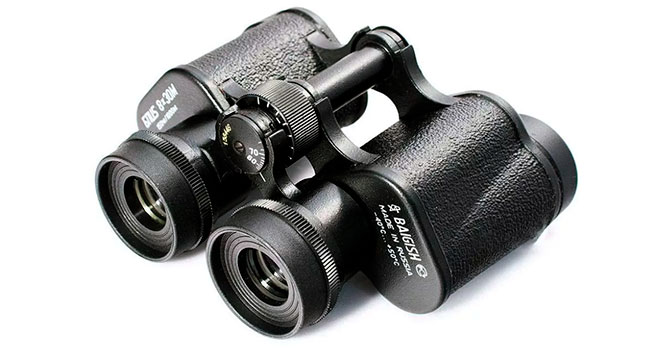
✅ Wide field of view and prism BAK-4
✅ Durable, hard to break
✅ Cheap. Easy to adjust
Metallic Russian Baigish binocular KOMZ BPC5 8x30M was released in 1982. Since then its image quality has noticeably improved (yellowness went away) and instead of old plastic (bakelite) eyecups, it has rubber ones.
It is made with the classic Porro scheme and central focusing system. If you have different acuity of the right and left eyes, there is an additional adjustment of the right eyepiece. You can change diopters from -5 to +10. D additional is from -2.5 to +2.5 diopters.
The binoculars are compact and lightweight and are recommended for hunting, bird watching and tracking. It has a natural color rendition, is devoid of obvious distortion and has a wide field of view. In dim lighting it provides a bright image with good contrast.
The options for Russian Baigish binoculars 8×30 M KOMZ BPC5:
- Baigish BPC5 8x30M with “ruby” coating of the lens to increase the contrast image at dusk;
- with a goniometric grid in the right eyepiece. It allows you to determine the distance to the object of observation. Useful for hunters and birdwatchers.
The price of a small division of the goniometric grid is 18 arcminutes or 0-5 thousandth distances. The price of a large division is 36 arcminutes or 0-10 thousandth distances.
To determine the distance to the observed object using a goniometric grid, it is necessary to carry out the following calculations:
The distance R (m) to objects of known size L (m) should be determined by the formula R = (L / n) x 1000, where “n” is the count on the grid-scale, in units (1 scale division is 5).

The Metallic Baigish 8×30 is traditionally known for its rugged, utilitarian design, reminiscent of the Soviet era. Despite its rough exterior, it is durable and provides excellent image stability during handheld observations—shaking barely affects the view. According to user reports, the lenses are made of glass and feature a red tint, indicating a ruby coating. In terms of image quality, the binoculars deliver minimal distortion and natural colors.
One of Baigish’s distinctive features is its “open” eyepieces, meaning the eyepieces rotate freely along with the central focusing ring. Keep in mind that binoculars with open eyepieces require periodic lubrication. How often you need to do this depends on usage intensity and conditions. Dust and dirt can settle on the lubricant, and if it’s not refreshed in time, particles may get inside the mechanism.
Baigish binoculars from the USSR

Here you can see an old version of Baigish binoculars, which were issued in the USSR. Truly, this exact model was made in 1992, i.e. one year later after the USSR was break up. The shape is the same, but the eyepieces are made of the bakelite without rubber eyecups. Today you can find such exemplars on Avito and E-bay.
How to distinguish the Baigish fake from the original?
Earlier, we already did a photo review of one fake of KOMZ Baigysh 50×50 binoculars.
Modern Baigish KOMZ BPC5 8×30M binoculars (produced after 2009) feature rubber eyecups.
- The prisms are made of BAK-4 glass, not BK-7.
- The body is metal, not plastic.
- There should be no glue on the prisms.
A true Baigish binocular is made entirely of metal, including all hidden parts. To check, try unscrewing the lens and examine the sleeve. You can distinguish metal from plastic by sound: tap the part with something solid—plastic sounds dull, while metal has a sharper tone.
To identify the prism glass, look through the eyepieces at a bright light. If the exit pupil appears round, the prisms are BAK-4. If the pupil looks cropped on all four sides, it’s BK-7.
Be careful when buying.
Good luck with your observations!





In it something is. Now all is clear, I thank for the information.
Willingly I accept. The theme is interesting, I will take part in discussion. Together we can come to a right answer. I am assured.